Railways Blog

A blog about trains, covering photography, railway history, transport politics and modelling, in no particular order.

Twilight of the 87s

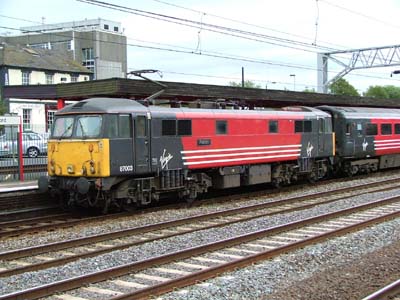
87003 'Patriot' at Stafford

Today I spent a few hours at Stafford photographing the last runs north of Birmingham of the class 87s. On Monday the new timetable begins, and the shiny new Pendolino tilting trains take over all West Coast Main Line services apart from a handful of Euston-Birmingham shuttles, which will be progressively Pendolinofied in the coming months.

The passing of the 87s doesn’t seem to attracted the same attention from enthusiasts as the end of the Cross Country 47s two years ago; I saw just one other photographer at Stafford. Perhaps it was the dull weather, not conducive for good photography. Or perhaps the electric 87s aren’t considered as charismatic as the Sulzer-powered diesels.

Introduced in 1974 with the electrification of the northern section of the WCML, these 5000hp locomotives have been the backbone of the route for thirty years. They, and the Mk3 coaches (the best coaches British Rail ever built) now face an uncertain future. Judging by the longevity of other stock they probably have another ten years useful life left in them, if any operator can find a use. I believe DRS are going to take on at least some 87s, for use both on freight working, and the night sleepers on behalf of First Scotland. My guess is that Freightliner may end up taking some 87s to replace their own fleet of 86s, which are ten years older. As for the excellent Mk3 coaches, that’s a topic of intense debate in both industry and enthusiast circles. We shall have to see.
Posted in Photos, Railways | Comments Off

Bad Trainspotter Fashion Alert!

People call the 70s “The decade that taste forgot”. I know trainspotters are not known for fashion sense, but pictures like this, from 1977, are scary. Look at those two guys in polo-necked pullovers in the bottom right-hand corner!

On the other hand, since I myself have been seen at railway and model railway events wearing a Uriah Heep t-shirt, maybe I’ve forfeited the right to comment on other people’s dress sense….

Posted in Railways | Comments Off

The Chocolate Tube Challenge

The new game proposed by Going Underground. I think I’ll stick to Mornington Crescent.

Posted in Railways | 4 Comments

The N Gauge Show

Spent yesterday at the N Gauge show held at a place called The Warwickshire Exibition Centre, near Leamington Spa. This venue turned out to be a converted cowshed in the middle of nowhere! Fortunately the organisers did organise a bus shuttle to and from the nearest railway station (without which I would not have attended). While you might not think a converted cowshed might make an ideal exhibition venue, the quality of the hall inside was a lot better than the impression you got from the outside.

The said cowshed contained a wide variety of layouts, British, German, American and Japanese. And of course, loads of traders, ranging from RtR box shifters to suppliers of specialised kits and bits.

Most people were drawn to the Bachmann stand near the front entrance with it’s display cabinet of preproduction samples of long-awaited new models. For fans of the post-privatisation scene there was 170 DMU in three liveries (SWT, Midland Mainline and Central Trains), for kettle fans there was the LNER V2. And for all diesel era modellers there was the HAA coal hopper, a much needed model; the long discontinued Minitrix model has been fetching silly prices on eBay for several years now. As well as the all-new models they had some reliveries on display too; most significant were the blue and grey Mk2s.

New entrant in British N, Dapol, didn’t have a stand. But Maurice of Osborns models did have some samples of the Great Western Autocoach, and very nice it looked. A bit early for my chosen period for British modelling, though.

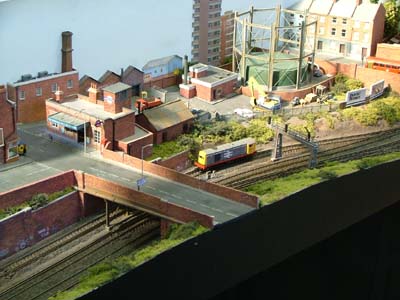
Two layouts that impressed me the most were two of the smallest; Hedges Hill Cutting, just over five feet long representing a short length of third rail electrified line somewhere in South London, through which passed a variety of southern region EMUs and diesel-hauled freight trains. The focus was on high detail urban modelling.

Hedges Hill Cutting

The other small layout was a total contrast; Woodhead. Also electrified, it was an accurate model of the western Portal of the now closed Woodhead tunnel, set around 1970 just before passenger trains ceased on the route. Almost the entire locomotive fleet was made up from class 76 electrics.

76 emerges from Woodhead Tunnel

There were plenty of other good post-kettle layouts; Drem, Stapleforth Mainline, Princes Street Gardens, Elgin, Hartshill Bank, and the massive six track Kings Park.

Of course, the traders did grevious harm to my credit card; there’s an Arnold Re4/4 in EBT (Emmental Burgdorf Thun) livery, plus a pair of the more modern Re460s in “SF” advertising livery. And, for a different country in a different era, a couple of Dapol BR gunpowder vans. All it needs is a decent class 24 and I can see a Cambrian Coast layout coming on.

Posted in Railways | 3 Comments

Swedish train crash

Nasty level crossing accident in Sweden. BBC news are reporting two deaths; but it doesn’t say if those deaths were passengers or traincrew, or from the lorry.

The accident happened when a passenger train collided with a lorry on a railway crossing near the south-eastern coastal town of Kristianstad.

As is usual for this kind of accident, the cause seems to the recklessness of the road user.

Swedish radio quoted witnesses as saying the lorry appeared to make a late run for the crossing as the barrier descended.

If the lorry driver isn’t one of the two fatalities, then he needs the book thrown at him. Just like they threw the book at Gary Hart.

This Swedish news site (in Swedish) has quite a few pictures. It looks like the train was a 3-car DMU of the type used on many Scandinavian express services (I think the design originated in Denmark). The leading car appears to have spun though 180 degrees and is facing the way it came. There’s a lot of damage to the front end.

Posted in Railways | 1 Comment

Paying for Quality

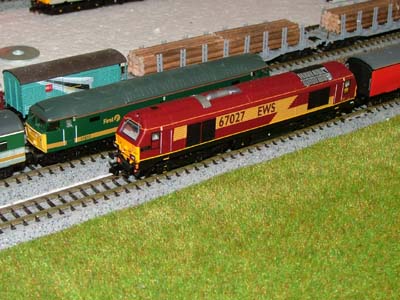
CJM class 67

If you want real quality in British N, you have to be prepared to pay a premium price of it. This CJM model of EWS’s class 67 is a case in point. A hand finished model with a lot of fine etched detail parts, it more than five times as much as the Farish class 47 on the track behind it. Although it is, as Electric Nose would say, “The Dog’s Danglies”, at that price I had to reluctantly concede that I cannot justify more than one of these magnificent models.

The biggest problem is that is shows up most of the Farish stock it will be hauling as hopelessly crude and toy-like. The super-BG behind it is a conversion of a Farish BG with etched sides, made for my by Ian Stoate of Ian Stoate Models. At the moment I don’t have a whole train of the things, though; the rest of the set is the toylike and shiny Farish TPO vans.

Posted in Railways | Comments Off

The Flying Fag Packet

Graham Farish FGW Mk2 BSO

The new Farish Mk2 Brake Second has arrived. I have mixed feelings about this one; on one side they’re to be commended in managing to reproduce the complex livery at all (I spoke to one of the major transfer (decal) manufacturers a couple of years back asking if they were going to make transfers for the lower bodysides; they replied that it wasn’t possible with the printing technology they had). The quality of the printing is good; they haven’t been able to reproduce the ‘fade’ of the prototype perfectly, but the way they’ve done it falls into the realm of acceptable compromise, at least in my opinion.

The down side that the model is still quite crude, and shows how far British outline modelling is behind the models available for continental European prototypes. All details, including the windows, are simply printed on to a clear plastic bodyshell. Since they’ve used a ‘one size fits all’ body, this one’s lacking the footsteps for the centre doors, which are just printed on. It would probably be possible to improve this by adding some microstrip for footsteps and handrails. The clear bodyshell also means there’s no relief in the windows at all; which can look wrong in certain lightings. It also lacks any kind of interior.

On the other hand, the price is a lot lower than you’d pay for recent products from Minitrix of Fleischmann.

Posted in Railways | Comments Off

Spot the Difference

Neil, guest blogger at Going Underground has discovered someone who should be working for Bachmann. Are there, I wonder, people who couldn’t tell a 2CV from a Morris Marina?

Posted in Railways | 3 Comments

Dapol’s Forthcoming 73

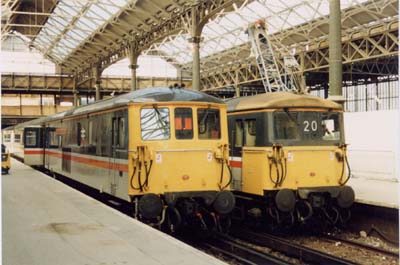
Class 73s at Victoria, 1990)

Dapol have revealed that their new N-gauge D&E model is to be a class 73 electro-diesel. I’m not sure how popular a prototype it will turn out to be; on the plus side, the prototype carried an awful lot of different liveries. On the minus side, they were very much restricted to a narrow geographical area, which cannot be modelled effectively without an awful lot of accompanying models, none of which are commercially available.

From a pure sales criteria, I don’t know how much that matters. I’ve long suspected that prototype modellers are a minority; there are many people that mix and match all sorts of stock from different eras and regions with no regard to prototypical verisimilitude. And then there are the dreaded collectors, who aren’t even bothered with layouts at all. And even hardcore prototype modellers get tempted by the odd model that runs nowhere near their chosen prototype, be it a Danish GM Nohab or a New Haven freight motor.

Unfortunately, the specification for this class 73 appears to be 15 years behind the times. According to Dapol:

  • It will have a 3 pole motor, and won’t have a flywheel.
  • No low-friction mechanism.
  • It will have directional headlights, but no tail lights
  • No provision for DCC
  • No NEM coupling mounts.

Unfortunately for Dapol, for everyone who compares it with 20 year old Farish products, there will be someone else who will insist on comparing it with the latest release by any one of the major continental or American manufacturers. And the latter group are likely to find it wanting.

There’s an attitude amongst British modellers that we should be grateful for anything a manufacturer produces, and we shouldn’t complain when something’s not up to scratch; just in case the manufacturer decides to take their ball and go home. I firmly believe that attitudes like that, and the sycophantic ‘Don’t upset the advertisers’ attitude by magazine reviewers (“It looks OK at normal viewing distances and will improve with running in TM) is holding British railway modelling back. That and the extreme price sensitive nature of the British outline market; if I ever state on a mailing list that I’d willingly pay Fleischmann prices for Fleischmann quality British outline models, I always get a chorus of complaints from people complaining that I want to price them out of the hobby.

I won’t be buying a Dapol class 73, no matter how wonderful it may or may not be. My British modelling is focussed firmly on the south-west of the country, an area the 73s never visited. Perhaps if Dapol were to learn lessons from the 73, and later releases include things like a 150 DMU or 122 “Bubble Car”?

Update: It appears the initial reports were inaccurate in at least one respect; it will have a flywheel after all.

Posted in Railways | Comments Off

Round and Round It Goes

Electric Nose has completed his upper level return loop. Now continous running is possible thanks to the dumbell layout.

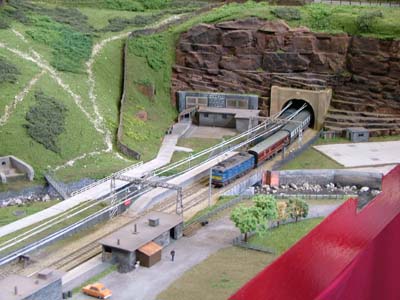
The layout is an end-to-end design, but with return loops at either end any train left to it’s own devices will eventually end up back where it started if nothing is in it’s way. Once I obtain the required track-circuit modules, this upper level loop will effectively become a linear fiddle-yard, enabling through traffic to be more convincingly portrayed. But for the last couple of hours I’ve sat back with a glass of wine and just watched a couple of trains circling the loft, something I’ve not been able to do before. I was suprised to find that a train moving at a typical freight speed will take 20 minutes to return to it’s starting point in the fiddle-yard. Nice!

Last time I had space for a decent-sized layout (a 12′x8′ outbuilding at my parents’ place in Slough), I had a layout with a dumbell formation. It certainly gives the best operating potential compared with the more traditional end-to-end or train set oval formations; trains appear to go somewhere and come back, but without needing to be remarshalled first. Unlike an oval layout you don’t need two of everything to make up a realistic operating sequence.

The trouble with this formation is the twin return loops take up quite a bit of space, so it’s not such a viable option for a layout that’s got to fit in a spare room or along one wall of a room used for other purposes.

Posted in Railways | 2 Comments