Railways Blog

A blog about trains, covering photography, railway history, transport politics and modelling, in no particular order.

Thoughts on Electification

Cold Spring Shops has recently mentioned a brief history of the Milwaukee Road Electrification, and a 1923 National Geographic article predicting electification as the furture of American railroading.

Interesting question as to why European railways electified their main lines on a large scale, but this didn’t happen in America. Virtually every European main line in mountainous territory is electrified, and many of them have been electrified since the early years of the 20th century. American electrification seems limited to just the Northwest Corridor and some commuter lines. For long distance freight haulage, the diesel reigns supreme. The Milwaukee is dead and gone, and the Great Northern abandoned their electrification even earlier.

Why is this? Is it because of fundamentally differing traffic patterns on opposite sides of the Atlantic? Europe’s higher population density means cities are closer together, and inter-city passenger traffic is still important. It’s worth noting that the one important American intercity route is electrified. Or is it because America had abundant domestic supplies of oil, while most European nations have plenty of coal? How much is the fact that European railways are largely state-run, while American railroads remain privately-owned?

Sad to note that the first freight railway through mountainous terrain in Britain to be electrified, the Woodhead line across the Pennines, outlived the Milwaukee by less than a decade, closing in 1981.

Posted in Railways | 2 Comments

Not just call centres

I’m amused by this story.

Railways bosses have drafted in engineers from India to work on five Victorian signal boxes in Stockport.

Twelve men have been flown in to make sure refitting work is finished on time.

Network Rail says there are not enough British workers to do the job. And the Indians are particularly well qualified because railways there still rely heavily on Victorian signal boxes built by the British.

Perhaps we should get some WP class streamlined pacifics to pull the trains, instead of the Pendolinos?

The signal boxes in the Stockport area were an anachonism in the 70s. While much of the newly-electrified West Coast Mainline got shiny new power boxes with state-of-the-art 1960s panels, in Stockport they just connected up the new colour light signals to the old Victorian lever frames. They even retained mechanical worked points! Where else in the country is a four track main line still operated by absolute block?

Posted in Railways | Comments Off

The downside of High Speed Rail

Patrick Crozier thinks high speed rail is boring:

I have now travelled on high-speed lines in France, Belgium, Italy, Germany and Japan. And they are all dull. They’re too synthetic. Too quiet. Too antiseptic. Too fast even. They don’t move about enough. They don’t make any satisfying noises – like the rush of air against the superstructure, far less the (now not quite so familiar) clickety-clack of British commuter railways. Far better the joys of a British Mark III carriage or even the deep-sprung seating of the workmanlike Mark I.

Ah, sometimes, nothing quite beats travelling in a old pressure-ventilated Mk1 or Mk2 with all the windows open and a big locomotive at the front. The over-silenced underfloor engines of something like a Voyager is no comparison with the roar of a English Electric EE12CSVT or a Sulzer 12LDA28C!

The view from the window isn’t as interesting either. Typical high speed lines in Europe have a significant proportion of the route in tunnel, and much of the sections that aren’t buried underground are hidden behind sound barriers. No views of picturesque villages from the train window. And with passenger trains segregated from the freight and local trains, no wayside stations or marshalling yards either.

Patrick also makes the valid point that service frequency and network density are as important as maximum speed when it comes to overall journey times. Just about every long distance journey I make by train depends on a local connection train at each end. I find how good or bad the connections are makes as much difference as to the overall end-to-end timing as the speed of the intercity section of the routes.

Posted in Railways | Comments Off

What’s the future of Cross-Country?

What are we to make of this?

The Strategic Rail Authority (SRA) today announced that it had not received an acceptable offer from Virgin Rail Group (VRG) in the renegotiation of the CrossCountry rail franchise.

A Best and Final Offer for a single-tender deal running to 2012 was recently received from VRG, but was significantly too high to pass the value for money test that the SRA undertakes on behalf of taxpayers. As a consequence, the SRA informed VRG this afternoon that it is ending negotiations on the CrossCountry franchise.

The SRA’s rights, which are designed to protect the interests of both passengers and taxpayers, are contained in a ‘Letter Agreement’ signed between the two parties in July 2002. This gives the SRA the right to terminate the franchise should it be unable to reach agreement on a long-term deal.

The SRA has informed VRG that it reserves its right to terminate the franchise, and that it will inform VRG of how it intends to take matters forward on the franchise in the near future. In the meantime, the annual budgeting process will continue on the franchise.

Services on CrossCountry are unaffected.

The Guardian has some comments on the issue.

The failure of talks means the SRA could throw open the competition to rival bidders, or choose to share out the network between other train operators.

One industry source last night suggested the government wanted to redistribute Virgin’s new Voyager trains to replace ageing fleets on other inter-city lines.

CrossCountry trains are among the most heavily subsidised in Britain receiving £241m last year. They have been crippled by problems with overcrowding and punctuality.

Cross Country used to be the cinderella of the Inter-City network, relying on hand-me-down trains from other, more prestigious routes. When Virgin trains took over the franchise on privatisation, they replaced their entire fleet of trains with shiny new ones, a far greater investment than this network of routes had ever seen before. One has to ask if it was justified, especially when the new trains turned out to be so unsuitable for some of the routes. It would have made more sense for them to have built a much smaller fleet of new ones, and refurbished some of the older ones.

Quite what the future holds now is anyone’s guess. The SRA seems to be taking a short-term bean-counting approach to running the railway, and the constant musical chairs of franchising is getting more and more ridiculous; First lose North Western but gain Scotrail, Arriva lose Trans-Pennine but gain Wales, National Express lose Scotland and Wales but gain East Anglia. Now it’s Virgin’s turn. One could say they had this coming with the fiasco of Operation Princess.

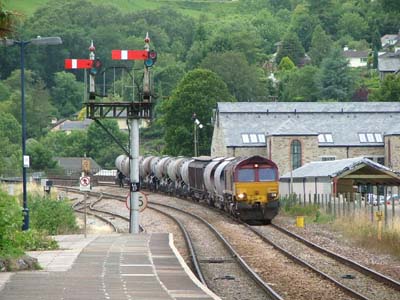
What might happen if the SRA breaks up the Cross-Country franchise altogether and splits up the services between the other intercity franchises? Will the Voyagers be redeployed on other routes, and the ‘ageing fleets from other inter-city lines’ (i.e. Inter-City 125s) return to the cross country routes? Personally I think we ought to see cascaded Mk3s from the West Coast line hauled by the EWS class 67s made more-or-less redundant with the end of the mail trains. Which operator might run the long-distance trains such as those running between Scotland and Cornwall? Might those trains even disappear altogether?

I think it’s a case of watch this space…
Posted in Railways | Comments Off

Attack of the 50′ cat!

Oh No! Electric Nose indulges in cat-blogging. And the cat seems to be imitating Kitten Kong!

Posted in Railways | Comments Off

Train Photos!

I’ve been uploading a few of the train photos I took on my west of England trip to my Fotopic.Net gallery. So far there are assorted EWS and Freightliner 66s at Lostwithiel, and a few shots from Cockwood Harbour. More to come!

St Blazey to Cliffe Vale at Lostwithiel

Posted in Photos, Railways | 2 Comments

Transport Direct

The Government’s shiny new Transport Direct website is intended to give you a route by public transport from anywhere to anywhere else. So I thought I’d give the website a try, with a journey I make regularly, from my parent’s house in Slough to my present home in Cheadle Hulme.

I’m not impressed. It begins by suggesting I get the No 43 bus to Windsor, then the train back to Slough! It gets the trunk haul section of the run right (one change at Oxford). But at the other end it’s even worse. Instead of getting off the Rail Replacement Bus five minutes from my home, it proposes continuing to Stockport, getting a train to Hazel Grove, then the 303 and finally the 157 bus. A huge ‘drunken walk’ type journey just to get to a bus stop 50yd nearer than the rail station!

This is nonsense.

It’s on a par with the 400 mile overnight round trip the Railtrack website used to give for the 50 mile journey from Ipswich to Cambridge if you entered a time just after the last direct train had left. It would get you to Cambridge a few minutes before the first train the next morning.

All I can say is, this system is not ready for prime time yet.

Posted in Railways | 1 Comment

Railways by Dead Tree Only

Patrick Crozier laments the fact that, unlike the mainstream press, Modern Railways doesn’t have an Internet version, and he can’t link to Roger Ford’s though-provoking article on the subject of safety.

Sadly the transport press isn’t up to speed on the interwebthingy. As Electric Nose keeps telling us, the model railway press is often quite hostile towards the internet, with the Railway Modeller famously forbidding advertisers from putting URLs in their adverts. Other magazines have condemned certain email discussion lists with the sort of venom Andrew Orlowski directs at weblogs.

They just don’t get it.

Posted in Railways | 2 Comments

Turkish Rail Tragedy

BBC NEWS | World | Europe | Turkish train crash ‘kills 128′

A Turkish government official says at least 128 people have been killed after a high-speed train derailed.

Health Ministry Undersecretary Nejdet Unuvar said that another 57 people were injured in the derailment.

“The scene is one of carnage… There are people lying all over the place,” journalist Oguz Dizer was quoted as telling NTV television.

A number of carriages were overturned, but it was not immediately clear what caused the train to leave the tracks.

Reports say the train had 230 people on board, so 128 dead would be more than half the passengers on the train, which if true is a major tragedy.

From the pictures of the TV news, I have to say I’m somewhat skeptical about the reported death toll. It’s common for initial estimates of the number of deaths on major train accidents to be revised downwards as the wreckage is searched and people are accounted for. Let’s hope and pray that’s true for this crash.

The pictures showed showed several modern carriages lying at various angles, but largely intact. The damage shown didn’t seem serious enough for the sort of death toll being talked about. Of course, I may be completely wrong; presumably a clearer picture will emerge tomorrow morning.

Update:. The Turkish authorities have revised the death toll down to 38. Still bad, though.

Posted in Railways | Comments Off

Fish says “Keep the TPOs!”

In this interview with Fish with a Dutch prog website, he’s clearly in favour of trains of windowless red coaches hauled by class 67s

And there are people depending on the mail, and the mail is not cheap…And with the prices, the service is absolutely [rude word deleted]despicable. So we are now taking legal advice and we’re also going to the BBC on a Watchdog program, because we got fans who complain to us about how long it takes for their [rude word deleted] CD to arrive in the mail.

We’ve sent test packages out to places and seeing just how long it would take to get there.

And the thing is, the Royal Mail, they are now going to take the night train off. We used to have the famous night train. And it was this train from London, and it was this train that goes down with all the packages and the post and stuff. And they take it off because we don’t need it anymore.
THEY [Another Rude Word deleted] NEED IT NOW MORE THAN [the same word deleted again] ANY OTHER TIME – [Insulting sexual reference]!!

The whole interview is well worth reading. The piscine one is not happy with the current state of the music business.

Posted in Music, Railways | Comments Off