Railways Blog

A blog about trains, covering photography, railway history, transport politics and modelling, in no particular order.

Train Crash in Berkshire

Bad news. The BBC are reporting one person dead when a High Speed Train collided with a vehicle and derailed near Aldermaston in Berkshire.

So far, the report does not specify whether the fatality was from the train, or on the vehicle it hit

Update:. The incident happened at Ufton Nervet, which is an AHB (Automatic Half-Barrier) level crossing (reported on the SWRG mailing list). Too early to say exactly what happened, but 99% of level crossing accidents turn out to be the fault of the road user. Bear this in mind when we get the predictable media feeding frenzy about ‘rail safety’.

Further Update: Sky News are reporting “several fatalities”. The report mentions “9 derailed coaches”, which sounds like pretty much the entire train, with some coaches at right angles to each other. This is bad.

Update: Police are now reporting six deaths. There are some suggestions (not confirmed) on mailing list postings that the car driver deliberately stopped on the crossing as a suicide attempt. This may be a baseless rumour, but Christian Wolmar did suggest this as a possibility on the TV news. There have been suggestions that the car was heading up the track.

Posted in Railways | Comments Off

Ouch!

If the election result wasn’t bad enough, commuters in Washington had another shock. Not leaves, this time.

Posted in Railways | 1 Comment

Pendolino Prang

For the second time in a week, one of Richard Branson’s shiny new wobbly trains has failed to stop at the end of the line.

Rail passengers are facing delays after a Virgin train hit the buffers at Liverpool’s Lime Street Station for the second time in a week. The Pendolino train hit the buffers at platform seven, at lunchtime on Tuesday. It is not thought that anyone was hurt.

I hope this isn’t symptomatic of a wider problem with these trains. I’m reminded of the early years of the Thames Turbos (class 165 and 166), where one ran through the buffers at Slough during the leaf-fall season, and ended up sitting on platform five (just missing the famous glass case containing the stuffed dog). I also remember waiting for a class 455 EMU at Datchet that overshot the platform by seven car lengths and had to reverse back in, at the same time of year. But the very urban approach to Liverpool Lime street isn’t exactly prime leaf-fall territory.

We shall have to see what the cause of these incidents turn out to be. Let’s hope any problems get identified before there’s a more serious incident

Posted in Railways | 1 Comment

Happy Birthday, NYC Subway

Boing Boing reminds us that the New York Subway celebrates it’s 100th birthday this month. Not the oldest underground railway in the world (the London Underground has that honour), but it is the world’s most extensive network.

My only experience of the NYC subway is a fleeting glimpse of a train on the elevated section across the Bronx from a taxi stuck in a traffic jam en-route from Newark airport to Stamford CT on a Sunday afternoon. I think the train, which resembled the old LT “P” stock was one of the now scrapped “Redbirds”.

Posted in Railways | 3 Comments

October Railway News

Several years ago, Peco advertised they’d be making a N gauge model of a HAA coal hopper, perhaps the definitive freight wagon of the diesel era. Just when everyone assumed it was vapourware, and would never see the light of day, it appeared in the shops without warning! Electric Nose is impressed. At any rate, it didn’t produce a reaction appropriate for the Martians that once advertised mashed potato…

On the real railway, the endless franchising musical chairs gives is another round of new liveries. Yes, Barbie comes to Scotland. I think it looks rather better than the garish livery from the previous franchise holder.

Posted in Railways | Comments Off

Transport Wingnut Alert

Patrick Crozier linked to a site called Transport Watch, describing it as “Lots of facts, lots of comparisons”.

While it is a professional-looking site, it doesn’t take more that a quick glance to realise that this site has an ideological axe to grind. The name, including the word “Watch” ought to be a dead giveaway. The bland introduction deliberately avoids telling us what that ideological axe is; you have to read behind the lines to recognise their real barking moonbat beliefs.

Transport Watch is an independent organisation not connected with any business, organisation or political party initially funded by a private trust and dedicated to making the best use of land already committed to transport in the interests of the community as a whole.

It all seems to be the work of one man, Paul F Withrington. I did a bit of Googling on the name, and came up with this ridiculous troll posting on the uk.railway newsgroup, posted four years ago.

Contrary to pupular belief, passenger rail is three to five times as expensive, has one-third the capacity to move people, uses up to three times the fuel and probably kills as many people per passenger-mile as would an equivalent express bus service.

If rail is such a good idea, why not pave the M! with railway lines?

Of course, if they did that the system would be brought to a near standstill tomorrow – just like the 10000 miles of right of way currently sterilised by railway lines – they carry an average flow equivalent to only 250 buses plus lorries per day per track.

The railway modernisation programme is to cost UKP60 billion. It is equivalent to building six domes per year every year for 10 years. The effect on the share price is nil. That price is so low the whole system could be bought for a mere UKP5 billion at a time when the replacement cost is between six and 100 times that value.

Those who wish to see the Northampton loop “modernised” should bear in mind that when they have spent the UKP5.8 billion on the WCML they will have increased capacity at Euston by the equivalent of about one bus per minute per track. How pathetic can you get?

The alternative is to remove the tracks and to use the rights of way for buses and lorries. We could then get to London in about one hour for one-third the cost and have a much more frequent service to boot.

If any person wishes to challenge the above, I will pay them UKP1000 for every point they can overturn in a discussion devoted to finding the truth, provided they will pay me UKP500 upon losing the case. I cannot wait to be rich.

It spawned a 100 message thread, which contained no further comment or contribution by Mr Withrington. There is no record of anyone attempting to claim the throusand pounds. I doubt Mr Withrington even read the replies,

The idea of converting railways into roads seems to a common meme in wingnut-libertoid circles, the rightwing equivalent of moonbat-left ideas to ban the private car (although I have never heard any leftie of green seriously advocate the latter). These idiotarians attempt to justify their case with reams of totally bogus statistics, full of hopelessly flawed assumptions and outright falsehoods. There is no point trying to reason with them. They up there with the people who want to privatise the pavements, or think PRT is feasible.
Posted in Railways | Comments Off

Look! No Car!

This BBC Article describes a public transport based day trip round picturesque places in Devon, including the delightful Cockwood. The article claims that “Places like Cockwood are almost impossible to get to without a car”. I have to dispute that assertion. I have visited the place on a number of occasions by train or bus without any difficulty whatsoever. The bus (which I’m sure is the 85, not the 185, unless it’s changed) runs every 15 minutes, and has always been pretty reliable whenever I’ve tried to catch it. And I can certainly recommend The Anchor pub mentioned in the article.

For a railway enthusiast, of course, there are other attractions than just the pub.

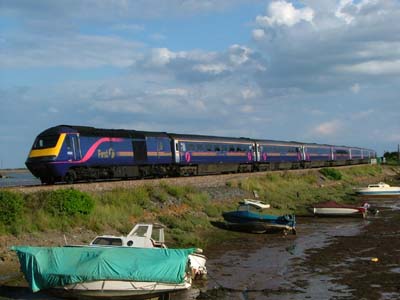
London-bound FGW HST at Cockwood harbour

You can even watch the trains from the beer garden!

Meanwhile, Ginger Stampley talks about moving from a car-based sprawl to a city where you can actually walk to places.

There’s a tradeoff between conveniences and inconveniences in any transportation arrangement. What generally pisses me off about suburbanites (and did even when I lived in a car city) is that so many of them seem to think they shouldn’t have to bear up under any of the downsides of car culture. Life isn’t like that, though. It’s merely a matter of choosing the pains in your rear, not of dispensing with them altogether.

Posted in Railways | 3 Comments

More Pendolino Opinions

Patrick Crozier has been on board one of Virgin Trains’ shiny new Pendolinos, and thinks much the same about the interior as I did. Neither of are impressed.

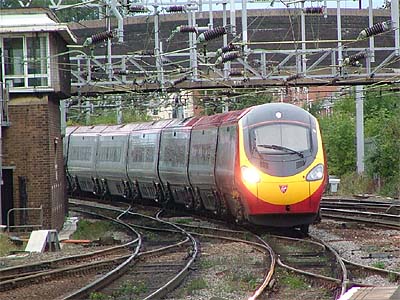
Virgin Pendolino at Stafford

He likes the exterior, though. I’m not so sure; while they’ve spend some effort styling the thing rather than being purely functional like many other train designs. It doesn’t have the style of the Pininfarina-designed Swiss Re460s,though.

Posted in Railways | 2 Comments

Carpool Lanes = Communist Gulags

I’m not sure whether this is clever satire, or whether this guy is for real. It’s very hard to tell spoof pages from genuine wingnuts nowadays. It claims that carpool lanes will destroy America.

Amid the confusion of the looming presidential elections and an unsettled war against terrorism, a subversive fifth-column movement is taking the United States in a new direction. The direction is inequality and socialism. The fifth column is the carpool lane.

For decades the carpool lane has sabotaged the political and moral course of our land. It has ingrained the red values of the Soviet Union into the subconscious of the American spirit. In doing so, it has caused Americans to accept and perpetuate the values of such socialists as Pol Pot, Fidel Castro, Robin Hood and John Kerry.

If he is for real, I shudder to think about his opinions for mass transit. (Link from Stephan Pennington from Pyramid Online)

Posted in Railways | 3 Comments

Europe by Train

Stephen Karlson of Cold Spring Shops has been riding European rails.

The express train picks its way out of the city station on rapid-transit tracks. Once out of downtown, it leaves the rapid-transit line, the motorman shuts off at the end of third rail, and power collectors reach for the overhead wire. But this express train is not an Electroliner at Crawford Avenue winding it up for Milwaukee, rather, it is a Eurostar leaving the Southern Electric for the Channel Tunnel Rail Link

There’s something incongrous about the Eurostar snaking across the rooftops of Brixton, on those sharply-curved Victorian brick viaducts. But this was never strictly a ‘rapid transit’ line; back in the days of steam Bullied pacifics would trace the same route on their way to the Kent coast.

Then he’s off to Germany.

Once across the Hohenzollern Bridge and onto the new German high-speed line, however, it’s off to the races, with speeds hovering near 300 km/h, definitely world-class. What’s that old song about “passing cars like they were standing still?” The high-speed line follows an Autobahn route and there are many opportunities to leave the motorists behind.

Running the line parallel to the Autobahn was a clever idea; leave those BWMs and Mercedes standing!. I think it beats the 110mph section of the West Coast Mainline paralleling the M1 at Watford Gap!

I’ve never been on any of the German high-speed lines; my sightings of ICE trains have been on the decidedly not high-speed single track Interlaken branch in Switzerland with the daily Hamburg to Interlaken “Thunersee”

Stephen is not so impressed with the internal seating layout.

I have come to the conclusion, however, that fixed seating with half the seats facing aft, although expedient, is a paradigm of rapid transit barbarism that doesn’t belong on an intercity train. In defense of the Europeans, many trains reverse directions at stub-end stations: imagine passing through the old St. Louis or Boston stations as routine.

Older European trains have seats in facing pairs; it’s only the newer stock that had so-called ‘airline style’ seating, which allows them to cram more seats in a given space. To this European, the idea that all seats should face forwards seems hopelessly impractical; you’d have to turn the entire train on a triangle at each end of the run! This might not be much of an overhead for a train taking two days and two nights to run from Chicago to Los Angeles, but the majority of European trains have total end to end runs of just three or four hours. For this type of run, the same set of coaches is expected to make several return trips a day. Already most shorter runs are multiple units or push/pull formations to save attaching and removing locomotives at each end; just imagine the overhead of turning the trains round! The extended turnround time could easily increase the number of coaches required by 50% or more!

Posted in Railways | 6 Comments