Railways Blog

A blog about trains, covering photography, railway history, transport politics and modelling, in no particular order.

Some things we do better over here

Cold Spring Shops reflects on the difference in connections and timekeeping between the two sides of the Atlantic.

Amtrak and the railroads could do more for their credibility by scheduling trains to connect, and enforcing the discipline to make the connections more reliably. Amtrak will not guarantee a connection with less than two hours between trains in Chicago. Although the Europeans pin Vienna to London in a day on six minutes in Cologne, there has to be a better solution.

One of these days I’m going to have to travel to Switzerland going by rail all the way instead of flying to Zurich and turning France into ‘flyover country’. French, German and Swiss timekeeping is such that those sorts of connections can actually be relied upon. Even if they can’t, the consequence of missing a connection is usually a delay of an hour, rather than being stranded until the next day.

Posted in Railways | 3 Comments

Schermo blu della morte

Not even Reginald Perrin was that late.

A minute before my train to work was due, it’s headlight appeared on the horizon. The train came to a stand, as often happens, to let a Manchester-bound train come off the Macclesfield line across it’s bows. But the signal didn’t clear, and the points didn’t change.

Minutes passed. The train still sat within sight of the station. Nothing moved.

Then one of the down signals started showing flashing red aspects. As far as I know, this isn’t a legitimate signal aspect, but seemed more like a distress signal from the signalling system itself.

More minutes passed. Eventually the station staff informed us that due to signal failure all trains were at a stand, and he had no idea when anything would be on the move again. The dodgy Italian computerised signalling centre that doesn’t work properly had suffered a Blue Screen of Death, and nobody knew how to press Ctrl+Alt+Delete to restart it.

Another hour passed. By this time all of the Manchester-bound passengers departed for the local bus services which would at least get them to Stockport, from which there might be some trains. The number of people waiting for the Crewe train had diminished, but there was always the feeling that the moment you decided to walk half a mile to the nearest bus stop for the very slow bus to Wilmslow, that train you could see just outside the station would finally start moving.

By the time the signals turned finally green again, that train was 85 minutes late.

For what should have been an eleven minute journey.

Don’t buy signalling systems from Ansaldo. They don’t work.

Posted in Railways | Comments Off

Dawlish Sea Wall Under Threat

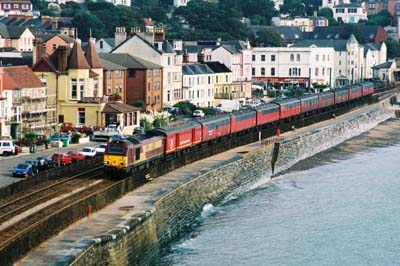
The sea wall at Dawlish is one of the classic stretches of main line in Britain. Generations of enthusiasts have made the pilgrimage to this scenic location, and taken probably millions of photographs over the years.

EWS class 67 at Dawlish

But now the famous location living on borrowed time, thanks to global warming.

Most travellers get their first glimpse of the sea as trains thunder over the line’s most dramatic stretch at Dawlish, where the line runs below sandstone cliffs only a few feet from the English Channel. At other times of the year, the trains get soaked by waves and trains arrive in Exeter and Teignmouth with seaweed still clinging to the carriages.

Such glories may not last much longer, however – for climatologists, transport experts and politicians have warned that rising sea levels and increasingly ferocious sea surges, triggered by global warming, now threaten the existence of the line along some of south Devon’s most beautiful coastline.

‘It is not going to be possible to run trains over that stretch for much longer,’ said the Conservative MP for Totnes, Anthony Steen. ‘Climate change is going to see to that. We need Network Rail and the Department of Transport to act now. At this rate Devon and Cornwall will lose its only rail link with the rest of England.’

There have been proposals for many years to replace this scenic stretch with a completely new inland route, probably mostly in tunnel. While it will be sad to see the end of the sea wall, keeping a rail link to Plymouth and Cornwall must ultimately come first. Let’s hope it actually gets built before it becomes impossible to keep the sea wall stretch open to traffic.

Posted in Railways | 1 Comment

Schadenfreude

The Guardian’s Paul Harris looks at the history behind America’s obsession with the car, including the deliberate destruction of mass-transit systems across much of the country in favour of massive state-subsidised highway construction. He gets a sense of schadenfreude at the fallout from rising fuel prices.

The focus on the car was a tragedy of human planning. Nor is it ending. Though much has been written about the revitalisation of American downtowns in recent years, by far the more important socio-economic phenomenon is the growth of the exurbs. These are the suburbs of the suburbs and – believe it or not – or even more car dependant. They are so spread out, so distanced from city centres and so utterly car-centric that mass transit is inconceivable for them.

But they are also now in pain. The current American obsession is not Iraq, it is not NSA wiretapping or even the never-ending abortion debate. It is quite simply petrol prices. Americans are being squeezed at the pump, now paying more than $3 a gallon. That is still cheap by most European standards but the shock is palpable in America. It also undercuts the economic model of the exurbs, rendering commuting costs so painful that suddenly, at long last, living by the car alone is starting to become unattractive.

Thank God, I say. There is little political or cultural will in America to tackle the love of the car. But brutal economics might just achieve it. Whenever I see those petrol prices ticking higher I give a lonely little cheer. I keep it quiet of course. I’m already seen as nuts just for liking small cars.

Of course I expect most petrolheads to dismiss this as typical Guardian posturing. I would guess most Americans from outside of half-a-dozen of the oldest cities are about as aware of their own car-dependence as a fish is aware of it’s dependence on water. Where else in the world is “Looser Cruiser” slang for a bus?

Posted in Railways | 8 Comments

Incompetence

For a while there’s been a lot of evidence that there’s an awful lot money being wasted through incompetent project management in the railway industry. Now this Guardian article on idle jobs shows just how bad things have got.

Two of these jobs are on the railways, and it seems that in this particular sector, old 1970s-style jobs with lots of tea breaks and standing around in groups looking at bits of metal are still very much alive, despite today’s weaker trade unions.

Our first reader, who we shall keep anonymous, lovingly describes the progress of a typical shift.

“I was rostered to be on site from 4pm till 4am. When we arrived, the boss didn’t know what we were supposed to be doing, and nor did we. We sat in our van drinking coffee till 11.30pm.

“By that time, you have lost the will to work, it is cold, you are in a nice warm van swapping stories and watching silly video clips on phones. We had to get out of the van for 20 minutes and then the boss let us go.”

Our reader says that he does one or two shifts each weekend, which leaves the rest of his week free to be idle. Another railway worker says that he gets paid for an eight-hour shift even though the work is usually done in three or four hours.

Furthermore, he adds: “Because of massive amounts of bureaucracy, I reckon that about a quarter of all shifts are cancelled as soon as we turn up on site. So, we get paid for doing eight hours’ work for doing bugger all.”

As a rail user and taxpayer, I’m footing the bill for this nonsense. I once counted 43 people in orange safety hats wandering around Alderley Edge, and not one of them actually seemed to be doing anything.

However, I don’t agree with the author that this sort of practice is a holdover from the 1970s. I think it’s got very much worse after privatisation, when the railway was fragmented into a million pieces. Privatisation was supposed to bring greater efficiency through the ‘disclipline of the market’, or so the crackpot ideologues told us. What rot!

Posted in Railways | 2 Comments

Kettles and Castles

After travelling to North Wales to see Mostly Autumn on the Friday, I decided to make a weekend of it. Not that I didn’t head out of Rhyl on the first train out of town on Saturday morning…

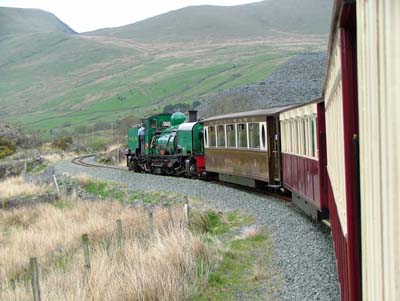
I travelled west to Caernarfon, capital of Gwynedd, starting point of the 60cm gauge Welsh Highland Railway. The original WHR ran from Dinas Junction, a few miles south of Caernarfon, through twenty miles of spectacular mountain scenery to Porthmadoc. The northern section dated from 1875, but the extension to Porthmadoc wasn’t completed until 1923, by which time it couldn’t really compete with buses for local traffic. The entire system closed in 1937, too early to benefit from the postwar tourist boom.

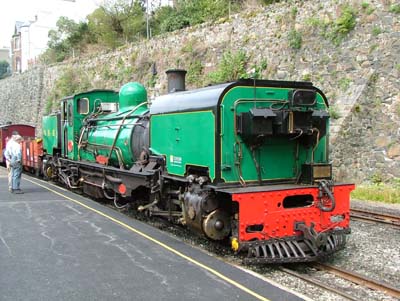
Beyer-Garratt at Caernarfon

The new WHR begins in Caernarfon itself, and runs on the trackbed of a former standard gauge line to Dinas Junction, before running on the original WHR formation.

The engine is by far the largest narrow gauge locomotive running in Britain. It’s an ex-South African 2-6-2 + 2-6-2 Beyer-Garratt, built, I think, in Manchester. It’s more than double the size of the sole surviving locomotive from the original WHR.

Beyer-Garratt South of Rhyd Ddu

The current terminus is Rhyd Ddu, about half-way to Porthmadoc, and half a mile short of the summit of the original line. The remaining section through Beddgelert to Porthmadoc is still under construction, and is due to open in 2009. When complete it will be the longest narrow-gauge line in Britain by a long way.

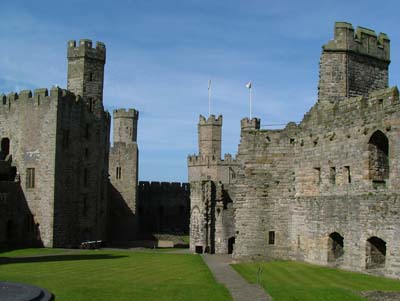
Caernarfon Castle

Long before the coming of the WHR, Caernarfon has been famous for it’s magnificent castle. There are several well-preserved castles in north Wales, but Caernarfon is not only the most impressive, but the most complete. While it was build by Edward I to oppress the conquered Welsh, I notice it’s now flying the Welsh national flag, not the British one.

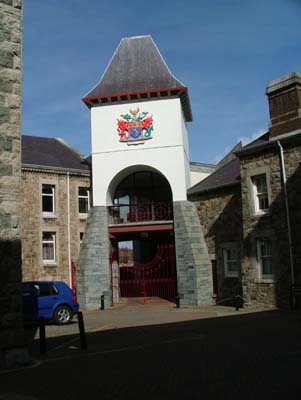
Gwynedd Council Building

I’m not sure what to make of this building. It’s the offices of Gwynedd Council, the unitary authority for the top left-hand corner of Wales. The design is so cod-medieval it looks like something out of a Katherine Kurtz novel.

Posted in Photos, Railways | Tagged , , | 2 Comments

Notwork Rail

Looks like my rail replacement bus nightmare is going to last a lot longer than I’d originally hoped. As reported on the North Wales Railway notice board, things are going from bad to worse.

As already rumoured in some quarters, reliable reports indicate that the Cheadle Hulme – Crewe line, which has been closed to all traffic since December 2005, will not be opening in June 2006 (already delayed from March for ‘software testing’ as has been publicly promised. It seems that some sort of temporary service might now be in place by August, with a full timetable not restored until December 2006.

This shambolic situation has been brought about by the attempt to re-signal this line with Ansaldo equipment from Italy, intended to be controlled from the existing signal centre at Stockport which has already proved unequal to the task of dealing with the Stockport station area and has so far been confined to a small area around Cheadle Hulme.

The Cheadle Hulme – Crewe line has been controlled from power signalboxes at Wilmslow and Sandbach, built about fifty years ago and featuring large numbers of electro-mechanical relays (suffering from metal migration in their contacts) and miles of wiring whose insulation had deteriorated to such an extent that anyone disturbing it for maintenance was in danger of causing a short-circuit with potentially fatal results. We imagine that it was decided that the re-signalling project had to go ahead with the only design available, even though engineers were sceptical about the results. The two signalboxes contained asbestos, and both were dismantled and taken away at the beginning of the current project.

Any further comments we could make here would not be suitable for a family audience

This is getting more and more like a ‘heads need to roll’ situation. An unnamed source within the rail industry has told me there were a lot of screwups in the early stages, such as severing the track despite needing access for engineering trains on other parts of the line. I wondered why they took out the old pointwork at Alderley Edge and replaced it with plan line, and spliced in the new pointwork a few weeks later. I hadn’t heard of the contractors putting a crane jib through the overhead catenery (ouch!). But the real problem seems to the fundamental incompatability of the software interlocking with the existing signalling at each end of the line. As Chadders has said, quoting The Daily WTF, it’s not sufficiently Enterprise

It’s difficult not to come to the conclusion that this fiasco is ultimately a consequence of the fragementation of the railway resulting from botched privatisation pursuded by the lamentably clueless administration of John Major. I can’t imagine a fiasco on this scale happening in the days of British Rail.

When the trains will finally return is anyone’s guess. It wouldn’t surprise me in the least if they never do return to the smaller stations on the rural southern end of the line. The slow and meandering rail replacement bus usually runs empty south of Alderley Edge, the 90+ minute journey time (compared with the 25 minutes of the train) mean that most passengers have found other ways to travel.

Posted in Railways | 2 Comments

What makes a good layout?

There’s been some discussion recently on the ModMod mailing list about what makes a good exhibition layout. While different people have different tastes, I can sum up what appeals to me in four words.

  • Atmosphere
  • Verisimilitude
  • Movement
  • Distinctiveness

Layouts that appeal to me always have a clear sense of time and place. They should have a good but consistent standard of modelling. They don’t have to be huge monsters, sometimes small but well-detailed layouts can be inspirational (as in ‘I could build something like this’). But they do have to work, and need operators that know what they’re doing.

I have some pet hates as well. There are too many layouts that feature some or all of the following ‘features’:

  • Layouts that look good but run badly.
  • Architecturally impossible structures, especially bridges.
  • Obvious anachronisms.
  • Layouts where 50% of the locos is one-off depot specials or short-lived prototypes, which would never have been seen together at the same time and place.
  • No attempt to run prototypical train formations despite the correct stock being available off the shelf (N gauge layouts seem to be bad offenders at this; how many malformed Virgin Cross-Country locomotive-hauled sets have you seen?)
  • Unpainted brass kettles (I’m surprised how often you see this on finescale kettle layouts)

These are some examples of layouts I’ve liked, all of which display differing degrees of Atmosphere, Verisimilitude, Movement and Distinctiveness.

Dewsbury Midland
The Manchester Model Railway Club’s massive 00 gauge slice of urban West Yorkshire. It alternates between 60s steam and 70s blue diesels at different shows, but the big draw is the superb architectural modelling.

Chee Tor
The MMRC again, this time 2mm finescale. Set in the limestone hills of Derbyshire in the mid-60s, it’s the sort of thing you can only build in a small scale, where the scenery dwarfs the trains.

Dduallt
Yes, I know it’s a narra gauge kettle layout, but it’s an actual prototype, well-researched and well-modelled. Just about the only really good model of a preserved line I’ve ever seen. Set in 1988, it represents the Ffestiniog’s famous spiral.

Acton Main Line
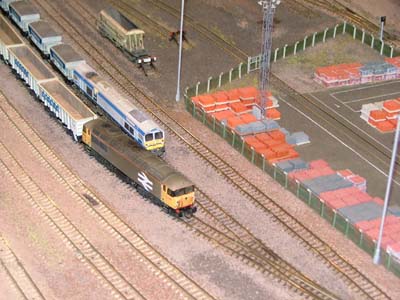
Acton Main Line

One of the first really high quality diesel era N gauge exhibition layouts, now retired from the exhibition circuit, sadly. It’s a very well-researched and well-detailed model of the real location in west London circa 1989. With six running lines there’s always something moving, making the layout a crowd-puller.

Hedges Hill Cutting
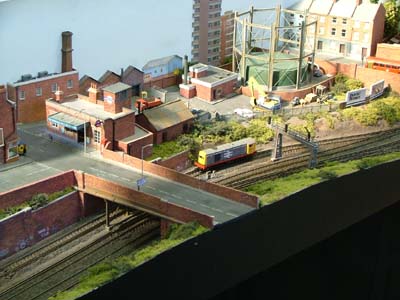
Hedges Hill Cutting

A prime example of minimum space N inspirational for people who didn’t think they had space for a layout. It’s very small but extremely well-detailed slice of south London that just oozes atmosphere.

Woodhead
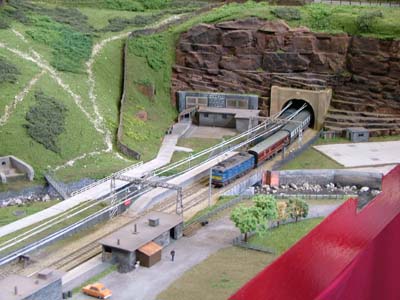
Woodhead

Another example of the minimum space N genre, this one evokes the bleak hills of the Pennines, on the now closed Woodhead line, featuring the distinctive 1500V DC locomotives that were unique to this line.

Shaweport

Another smallish N gauge model, representing the North Staffordshire main line in the early privatisation era. Although it’s not a model of any specific real life location, it’s firmly anchored in time and place by the rolling stock.

Därlingen
Being into Swiss-outline modelling myself, I have to include a Swiss N gauge layout, and this is the best one I’ve seen on the circuit. It’s a model of a prototype location, a small passing station on the single-track branch from Speiz to Interlaken.

Europ 3
Another big all-action crowd-pleaser, a large HO layout based on an Italian electrified main line. I don’t know enough about Italian prototypes to know how accurate it is, but it certainly looks impressive, with a high standard of scenic modelling and plenty of movement.

Stoke Summit
This is one of those layouts where it’s the stock rather than the scenery that makes it. The layout is set on the East Coast Main Line between Peterborough and Grantham, and consists of a long straight line in a cutting fed by a massive set of off-stage storage roads. The owner clearly loves building coach kits, and has gone to a lot of effort researching accurate train formations. It really captures the experience of watching the trains go past on a busy main line, never knowing what’s going to turn up next.
Posted in Railways | 3 Comments

It Must Be Mine!

Trouble with big model railway exhibitions is that I turn into Igor. Last weekend’s Alexandra Palace show was no exception.

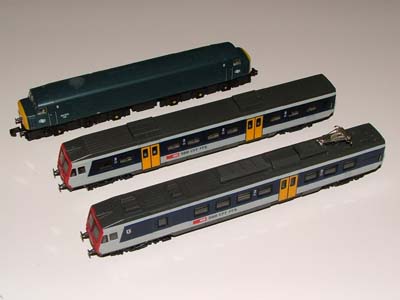
Lima NPZ and Bachfar Peak

At the top is a new Bachmann class 46 “Peak” for my next British layout. In the 1970s Plymouth Laira had a sizable allocation of these locos. Bachmann’s N gauge offering looks like a scaling down of their 00 gauge model, which Electric Nose was very scathing about. Scaled down to half the size, any faults are far less apparent, resulting in a more than satisfactory model as far as I’m concerned. One compromise is the bogies are somewhat overwide, but this results in a model that will negotiate 8½” curves. Running qualities are excellent, great slow running out of the box without any need to ‘improve after running in’.

For my current layout rather than the next one, I also picked up a Lima Minitrain Swiss NPZ set. (There are actually a pair of intermediate coaches too, converted from loco-hauled stock). These are now getting hard to get hold of, since Lima are no longer in business, so I was pleased to find one on sale. There’s some scary-looking sprues of detailing parts I have yet to add, including cab-to-shore radio aerials, windscreen wipers(!) and assorted gubbins around the pantrograph. Hours of fun await!

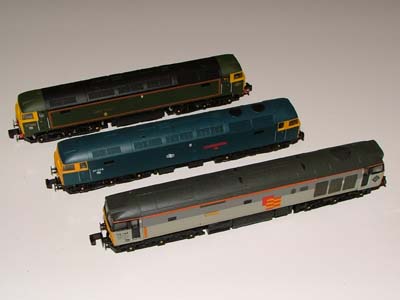
3 CJM Locos

Since I’ve travelled south, I’ve taken a few more of my British outline stock out of storage. These three are all modelled as running in 1988, all the work of CJM. In the foreground is 50149 “Defiance”, the one-off experimental class 50/1 freight conversion, which spent that year working based at St Blazey, working china clay trains. Behind are a pair of 47s, 47508 “SS Great Britain” in “banger blue”, and 47500 “Great Western” in Great Western green. Both were named as part of the 150th anniversary of the GWR in 1985, and both were allocated to the Inter-City sector in 1988. 50149 and 47508 are detailed and resprayed Farish shells on CJM Saturn chassis; the third loco still has a Farish chassis.

Posted in Railways | 4 Comments

Containers

Cold Spring Shops tells us it’s the 50th anniversery of the container. He remarks that deep-sea container traffic is one of the biggest growth areas for the US railroads

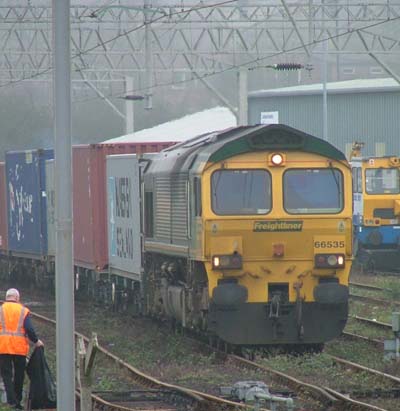
Freightliner 66 at Colchester

It’s true in Britain as well; this one of Freightliner’s GM-built class 66s at Colchester, bound for the port of Felixtowe. Knowing the state of British manufacturing industry, it’s likely that most of the containers will be empty.

Freightliner has an interesting history. It started out as a domestic intermodal service in the 1960s, intended as the long-term replacement for internal wagonload freight. That never happened; the distances involved meant that it couldn’t compete with direct road haulage as the motorway network expanded, and the domestic traffic slowly faded away. But Freighliner repositioned itself in a new market hauling boxes from ports, and traffic is now booming.

Posted in Railways | Comments Off