Railways Blog

A blog about trains, covering photography, railway history, transport politics and modelling, in no particular order.

Return of the Nose

After too long a silence, Electric Nose is back. His most recent post commemorates the 50th anniversary of Cyril Freezer’s Minories.

I wouldn’t presume to second-guess Cyril’s original intentions, but, whether by accident or design, for my money one of the most significant factors that has made Minories consistently attractive over five decades is it’s do-ability. It’s buildable by anyone, regardless of scale or gauge. It’ll work with everything from set-track upwards, and uses standard pointwork cleverly, arranged in such a way that dog-legs and reverse-curves are minimised. All too frequently, published track plans show flowing pointwork on sweeping curves, artistic license painting an idyllic picture that, whilst prototypical, just isn’t attainable when you start nailing the savage corners of commercial trackwork to your baseboard. In a hobby where 99.99% of plans seem to be aimed at the 0.01% who think hand-building track is a worthwhile use of their leisure time, Minories stays with the mainstream. The sharper than scale bends inherent in commercial pointwork are masked as much as possible by using them where a train needs to turn a fairly sharp corner anway. The design works with these limitations, using them as features rather than obstacles.

Cyril Freezer’s plans get a lot of stick, and many of them look cramped and rather toy-like compared with the more recent designs from the likes of Iain Rice. But I was greatly inspired in my teenage years by the likes of “60 plans for small layouts” and “Plans for Larger Layouts” published by Peco Publications in the 1960s. I think a lot of his smaller ones would actually work very well in N if you built them to the same physical area as his 00 plans, with adjustments for track centres. Then his 3-4 coach trains become 6-8 coaches, and visible 18″ curves don’t look quite so horrible.

Saying that, I’ve never tried to build anything based on a CJF trackplan. All my British outline N gauge layouts have been attempts to reproduce prototypes.

BTW, I’ve always thought that Cyril Freezer is to model railways what E Gary Gygax is to roleplaying. And I have (briefly) met both of them.
Posted in Railways | Comments Off

Just Appalling

Just over two years ago, four rail workers died in an accident at Tebay, when they were run down by a runaway wagon. The head of a maintenance firm has just been convicted of manslaughter.

Opening the case for the crown, Robert Smith QC told the panel of six men and six women that Connolly was “grossly negligent” in his actions.

He said Connolly, who ran MAC Machinery Services, had “scant regard” for railway safety and had deliberately disconnected the hydraulic brakes on two wagons.

He had dismantled the brakes for “financial gain” because it was cheaper than repairing the wagons properly.

Connolly’s firm was subcontracted to work for the rail maintenance company Carillion, which was working with Network Rail.

He had driven a low-loader truck with a railway crane and two wagons to Scout Green in Cumbria to lift ageing track from the west coast mainline on to railway wagons.

Shortly before 6am on February 15 2004, Kennett began using the large crane – known as a road rail vehicle – to lift lengths of steel on to the wagons. While he worked, Connolly slept in the back of his lorry.

Connolly had deliberately disconnected the brakes on the two wagons because both the hydraulic systems were in such a bad way they would not work properly in conjunction with the crane.

He then filled the cables connecting the wagons to the crane – usually full of hydraulic brake fluid – with ball bearings, giving the impression to an onlooker that everything was above board.

This is simply appalling. I hope the judge throws the book at him when it comes to sentencing.

But it goes further than that. It’s a terrible indictment of the way the railway industry has been fragmented that cowboys like Connolly are allowed to get anywhere near the tracks or anything else. This is like something out of the 1840s, when life was cheap.

I hope the buck goes further up the food chain than Connolly. Not that he deserves to be let off the hook, buy how did his awful little cowboy outfit get to perform work for the railway in the first place? While I would guess there’s little prospect of further criminal prosecutions, heads need to roll at Carillion, at least.

Posted in Railways | 3 Comments

Crocodiles

Cold Spring Shops talks Crocodiles.

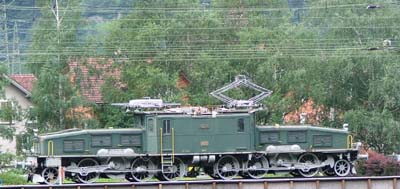
SBB Crocodile plinthed at Erstfeld

This is the genuine article. It’s an SBB Ce6/8, preserved on a plinth at Erstfeld, Switzerland. I took this from the station platform, from where it’s only just possible to photograph it without than infernal sound barrier wall getting in the way. It has the two definine features of the genus, ‘snouts’ that pivot independently of the central cab section, and rod-coupled driving wheels.

Other genuine crocs include a similar Austrian class, the metre-gauge Ge6/6s of the Rhätichebahn, and the small Berninabahn locomotive. The German E94, which also ran in Austria as the 1020 class, is not a proper Crocodile, because, although it’s got the pivoting snouts, it lacks the outside coupling rods, being a more conventional Co-Co.

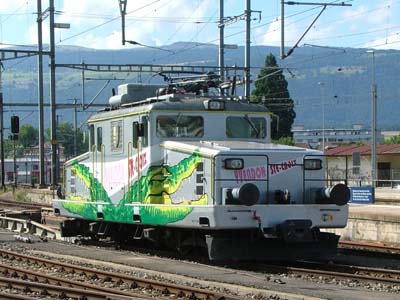
YStC Ge4/4 at Yverdon

This is most emphatially not a crocodile, and no amount of cartoon crocodile graphics will make it so. It lacks both distinguising features; not only is it not articulated, but it also isn’t rod-coupled either.

It’s actually the Ge4/4 of the Yverdon St.Croix railway, photographed at Yverdon. When I visited the line last July there wasn’t much evidence of any freight traffic, so I wonder how much this odd-looking machine gets used.

Posted in Railways | Comments Off

Trains of Ticino

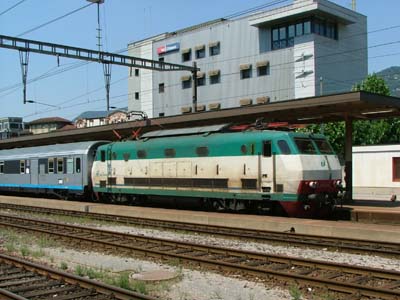
FS E444 at Chiasso

After too long a delay, I’ve put some more pictures from last summer on my Fotopic Site, of SBB and FS motive power in Lugano and Chiasso, in the Italian-speaking south of Switzerland.

Lugano is the lakeside resort where I stayed from the first few days; it’s a remarkably compact and very modellogenic station, on a very busy line.

Chiasso, a few miles further south, is the frontier station with the Italian network where all trains must change locomotives due to the different electrification systems of the two countries; Swiss 15kv AC locomotives give way to Italian 3kv DC ones.

Posted in Photos, Railways | 5 Comments

Book Review: Slam Doors on the Southern

The humble electric multiple unit has always been overlooked by enthusiasts and photographers, who have always concentrated on locomotives. Michael Welch’s Slam Doors on the Southern makes an attempt to redress the balance.

The book covers just about every class of slam-door Southern Railway and Southern Region unit, from the really ancient 4-SUBs converted from Edwardian loco-hauled stock, through the 30s Brighton line 6-PULs and 4-LAVs and Portsmouth line 4-CORs to the BR Mk1 based 4-VEP and 4-CIG units only recently retired from service.

The 150-odd colour images in this album are superb. The earliest images date from the mid 50s, with a couple of views of the very earliest wooden-bodies 4-SUB units, then on their last legs. At the other end of the time scale, the surviving 4-VEP, 4-CIG and 4-CEP units are shown in the post-privatisation liveries of Connex, Southern, and Stagecoach.

Unlike many photo albums, this volume is quite text-heavy, with extensive captions giving the history of the various types of unit. It features quite a few oddballs, such as the 2-BILs with postwar HAL driving trailers (a consequence of accident damage), the short-lived 6-REPs, and even the one-off 6-TC, a push-pull set formed in the mid-60s from redundant EMU stock.

While the routes of the Southern Region lack the epic grandeur of some of the classic routes in the Scottish Highlands or Cornwall, it’s not all suburban back gardens by any means. There are still plenty of attractive scenic locations in such places as the New Forest, the North Downs or the south coast, many of which have tended to be overlooked by photographers. Of course there are plenty of images in the Big Smoke; one of the best being a superbly evocative interior shot of Cannon Street in 1957. And many of the urban images just ooze atmosphere, setting the trains firmly in their social and economic context. There’s a lot to interest people who aren’t even that interested in the trains themselves.

Altogether an excellent volume, whose appeal isn’t limited to fans of the Southern third rail.

Posted in Railways | 4 Comments

Book Review: Power of the Warships

Master Railway Photographer John Vaughan’s The Power of the Warships is dedicated to the twin-engined diesel-hydraulics known as the Warships.

The “Warships” weren’t a single class of locomotive, but three. The first five, built by North British in Glasgow, were 117 ton six-axle machines, numbered from D600-D604. Vaughan refers to these as class 41s, although this class designation was never official. The more numerous class 42s and 43 were much lighter four-axle locomotives, similar in outward appearance to each other but bearing no external resemblance to the earlier machines. The D600s were short-lived, all withdrawn in 1967. The 43s and 42s lasted a few years longer, but had gone by the end of 1972. Two 42s survive in preservation, now museum pieces for far more years than they were in service.

Controversy reigns among enthusiasts as to whether the diesel-hydraulics came to a premature end as a result of internal BR politics, or whether they were flawed machines that should never have been built. Vaughan strongly subscribes to the former view, pointing out that in their later years they ran annual mileages exceeding those of comparable diesel-electrics.

But this volume is not really an academic history; it’s first and foremost a gallery of photographs. Some 240 black and white photographs show the three classes at work throughout the Western region and beyond, and continue with some shots of D831 “Greyhound” and D832 “Onslaught” in preservation on the East Lancashire, West Somerset and North York Moors railways.

The pictures of the class in BR service cover the whole of their brief careers, sharing duties with steam in the late 50s, to their rundown in the early 70s, by then largely relegated to secondary duties. We see them on West of England expresses, some of which are of as much interest to coaching stock enthusiasts as to Warship fans. One of my favourites is D811 on the up “Mayflower” in 1960, hauling a rake of immaculate Chocolate and Cream Mk1s, except for a Maroon Gresley corridor second behind the loco. We see their glorious swansong in 1968/9, when pairs of them handled accellerated Plymouth expresses. There are the obligatory (for me at least) shots of them at work on china clay, milk and parcels traffic in Cornwall. There are also plenty of shots on ex-Southern metals, not just the well-known Waterloo-Exeter trains, but also the now-closed Ilfracombe branch, and on stone traffic during construction of the M23.

Although shots of 42s and 43s predominate, there are some illustrations of the five D600s, mostly from their early years. These lumbering beasts were relegated to local workings in Cornwall as soon as there were sufficient 42s and 43s in service. Operating in an area fully dieselised as early as 1962, and working low mileages, it’s not surprising that they were seldom photographed. There’s still no photographic evidence of D600 in BR blue actually hauling a train.

There are just one or two slightly blurry or grainy shots, included for historical interest, as well as some images that have been published before. I noticed one or two minor errors in captions; in one photo at Battledown in Hampshire the SE Bullied coach behind the loco is wrongly described as a BFK rather than a BCK. But these a minor quibbles. If you like Warships, you will want this book.

Posted in Railways | Comments Off

Bet the warranty doesn’t cover this!

There are some things that you really shouldn’t do with a JCB. Will Nizlopi write a song about it?

Posted in Railways | 3 Comments

Notwork Rail

Depressing press release of the week, from Notwork Rail. (I can’t find it on their site; but it was on the BBC North-West news. I’ve quoted it from the uk.railway newsgroup.

The reopening of the railway line between Sandbach and Wilmslow has been delayed to enable the completion of infrastructure improvement works. The line will now not open until early June whilst vital testing work is carried out on a new signalling system.

The line has been closed since December and was due to reopen on March 26, once the existing life-expired signalling system was replaced by a new computer based interlocking system. However a number of compatibility issues between the Italian system and the UK railway infrastructure have meant further testing is required to enable completion.

John Armitt, Chief Executive, Network Rail said today, “On behalf of Network Rail, I sincerely apologise to passengers for the inconvenience that this will cause. We are working round the clock to find solutions to the problems we are having with this new system to ensure we get the line reopened as soon as is possible. We will keep you fully informed of developments and as soon as we have more information we will release it to you.”

As has been the case since the blockade began in December, long distance services are being diverted with replacement coaches running between Wilmslow and Macclesfield. Local trains will continue to be replaced by a <sarcasm>high quality</sarcasm&gt coach/bus service, with links to Congleton Station from Holmes Chapel and Sandbach during peak periods. Trains will also continue to run between Manchester Piccadilly and Manchester Airport until the works are completed.

Trains will also continue to run between Wilmslow and Manchester Piccadilly via the Styal line (Wilmslow to Manchester via Heald Green) during weekdays. A direct service is also available between Crewe and Manchester Oxford Road during weekdays.

This is the third multi-month blockade that’s affected my daily commute, since I got hit by the Stockport refurbishment as well as the track relaying. At the end of all of this, there will have been a total of more than a year’s worth of rail replacement buses, more than doubling the length of my commute, adding an hour to my day. I’d been counting down days until March 26th, when the work was finally supposed to be finished. Now it’s back to some indefinite time in ‘early June’. What’s the odds that it will slip further, back to July, August, December?

Seems they’re using that same untried, untested system that was proposed and then rejected for Stockport a year ago. And it’s looking like the whole thing still doesn’t bloody work.

Heads deserve to roll over this.

Posted in Railways | 1 Comment

Scale Differences

For historical reasons that have a lot to do with modelling outside valve gear on British ‘kettles’, British N gauge models are made to a different scale to those of continental Europe or North America. While everyone else’s models are 1:160, ours are the larger 1:148. The difference is obvious when models of similar prototypes are placed next to one another.

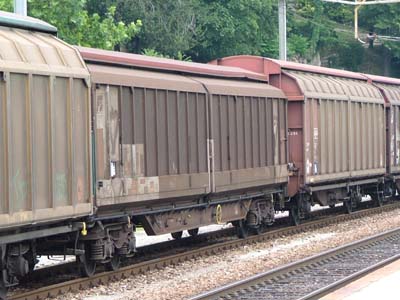
FS British loading gauge wagon at Lugano

Posted in Railways | Comments Off

Leeds

Norm is unimpressed by Leeds railway station.

Here’s a word of advice. If you travel by train from Manchester to Leeds at the weekend and have it in mind to return, then find another way of travelling back.

The first thing is that Leeds station is not a great place to spend time. It never has been. It had a makeover some years ago, but it’s still a cold, unwelcoming place, not like Manchester Piccadilly – though Manchester Victoria does have something of the same feel about it.

By coincidence I travelled from Leeds to Manchester yesterday evening, although I spend something like zero time waiting; I had to leg it across the footbridge from platform 1 (where my connection from Harrogate deposited me) all the way to platform 16, where I caught the train with about a minute to spare. I suspect this was not advertised as a connection, as it’s less than the regulation ten minutes that’s supposed to be allowed.

Of course, I missed the connection to Cheadle Hulme at the other end, and had to kill 30 minutes at a Manchester Piccadilly that was absolutely crawling with police, presumably because of the bloody football. I wonder who comes up with these timetables? It’s roughtly a half-hourly service on all three legs of the journey, but each change involves the maximum possible wait at both interchanges, in both directions. Presumably not many people travel from Cheadle Hulme to Harrogate and back.

On my regulation half-hour wait on the way out, I had the first opportunity to sample the rebuild Leeds station, which was still a building site on my last visit about five years ago. It’s a steel and concrete ‘New Brutalist’ style edifice; as Norm says, not a patch on the superb Manchester Piccadilly. At least they’ve gone for a proper train shed and avoided the temptation of a Birmingham New Street style underground car park. Unfortunately, the platform facilities are a little lacking, even in the buffet, where there are virtually no seats.

Posted in Railways | Comments Off