Railways Blog

A blog about trains, covering photography, railway history, transport politics and modelling, in no particular order.

Dapol and their livery choices

George Smith of Dapol is complaining about poor sales of their Dogfish ballast hopper. I think this is a lovely model, which is marred by Dapol’s bizarre decisions on liveries, which in turn has depressed sales. The first release was in a dubious all-over grey which I think is supposed to represent faded olive green, but it’s with TOPS data panels which makes it inappropriate for 50s/60s era modellers. They’ve not done it in actual olive green, or in the later ‘Dutch’ grey/yellow colours. They’re claiming that the ‘body is wrong’ for the latter livery because it had an ‘extra panel’. I’m highly sceptical of this; all photographs of dutch liveried Dogfish look exactly like the Dapol wagon to me, and the wagon experts on the ModMod list all insist that there was only ever one body design, and none were rebodied when repainted into Dutch. Have Dapol done some dubious research?

He’s also moaning yet again that modern modellers have ‘deep pockets and short arms’, and is (again) threatening to stop making modern models unless ‘we’ buy them. He’s citing the poor sales of the BR blue class 73 as an example. Personally I think one problem is that Dapol are releasing too many models in too short a period, and are forgetting people only have finite spare cash at any one time. Something like a blue 73 in a long-lived but historical livery is likely to be the sort of thing that sells slowly and steadily over a long period. It’s not a good fit for the limited edition ‘feeding frenzy’ approach which is more suited to short-lived contemporary liveries. BR blue really should have been one of the first liveries, not the last.

I want Dapol to succeed, and I want to encourage them to continue producing diesel and electric era models. But I also want them to learn from mistakes, and don’t want to be bullied into paying good money for flawed models, or things I don’t actually want.
Posted in Railways | 2 Comments

Trains in the Cowshed

I’m recovering today from the N gauge show in the Leamington ‘Cowshed’. Many excellent layouts; one of my favourites was the narrow gauge French one, using Z gauge track. Most of the best diesel era layouts I’ve seen before; the ever excellent Kings Park with it’s eight running lines where there’s always something moving, or the compact but atmospheric Shaweport set in 1990s potteries area. Morpeth is new to me, a big layout set in pre-electrification East Coast main line when the Deltics pulled the top expresses.

As well as being an show of layouts, it’s a major opportunity for the trade to show their wares; Bachmann and Dapol had big display stands, and most of the smaller cottage industry people were there too. I finally got to look at the finished version of Dave Jones’ class 121 bubble car (not terribly impressed, I’m afraid)

Over at the Bachmann stand the Metro-Cammell Pullman cars look magnificent, especially the blue/grey ones I remember seeing at Kings Cross in the 1970s. It’s really, really hard to justify them on a 70s/80s/90s/00s layout set in Cornwall. Early test shots of the TTA look good; the Peco model was good for it’s day, but is now rather long in the tooth.

Rather outside my era are the Dapol Gresley coaches, although they certainly look impressive. They’re the first British outline coaches that really come up to the standards of continental models by Fleischmann, Minitrix and Roco. They’ll also be selling at Fleischmann-level prices, so we’ll have to see if the allegedly price-sensitive British market is prepared to pay for quality.

Dapol actually had three new steam/early diesel era wagons on sale, a 21t hopper, a 12′wb 21t mineral, and the grain wagon. They look nice, especially the grain hopper. Not sure if I can justify any of these in Cornwall.

The preproduction sample of the Cargowaggon looks an impressive beast, although they’ve allegedly missed an umlaut from the tri-lingual lettering. I’m still not convinced that the shade of blue is quite correct, and might well need a bit of weathering to darken it.

Posted in Railways | 2 Comments

EMUs

Electric Nose thinks EMUs.

Talking of multiple units, I travelled from London Waterloo to Woking the other day, and was reminded just how intense suburban operations can be. With other trains frequently passing mine on both sides, this fascinating experience is about as far removed from the typical model railway stereotype as it’s possible to get. Exactly why I use a computer and DCC to provide a more realistic traffic density around whatever train I happen to be running.

Clapham junction in the rush hour is something that has to be seen to be believed; twelve running lines with trains at something like three minute headways on each one. That works out at one train every 15 seconds, with up to five or six moving trains visible at any moment.

I don’t think I’ve ever seen that sort of really intensive suburban EMU operations modelled. This probably isn’t helped by the fact that EMUs have always been the poor relation to everything else when it comes to ready-to-run models. Yes, there are kits, but not everyone has the time or skill to build them all. The complex modern liveries aren’t always easy for the average modeller to paint convincingly, especially when you’re talking not about one or two units, but an extensive fleet.

Something like the approaches to Waterloo would take up an inordinate amount of space in 00, but might be feasible in N if only the stock was available.

Posted in Railways | Comments Off

One Woes

One Railway know how to make a drama out of crisis.

Police were called in at Liverpool Street to keep order, because rail staff found it difficult to deal with the situation, he added.

Mr Attoe said: “The staff had no clue what was going on.

“We were arriving at stations and passengers who had been delayed for the best part of five to six hours were literally screaming at the one member of staff that they could find demanding taxis.

“The staff were saying ‘no’ they were ignorant and arrogant. One member of staff swore at me. They just didn’t want to know and they really didn’t care.”

All caused by overhead line failure, courtesy of Notwork Rail. Not our fault, guv. Typical ongoing result of John Major’s stupid fragmentation of the railways. Train companies shaving staff and capacity to the bare minimum to operate the normal timetable, with no contingency to cope with problems. And then when something does go wrong, it’s always somebody else’s fault when it all goes into meltdown.

Posted in Railways | Comments Off

Snakes on a Train!

One snake, anyway. As reported by BBC News

A Swiss train has been taken out of service after a pet snake escaped from its owner and hid in a carriage, a local train company has said.

Experts have so far failed to catch the reptile, which vanished on Saturday, said Eric Luthy, a spokesman for the Neuchatel Regional Transport company.

I’ve seen a surprisingly large number of guinea pigs on Swiss trains, but never a snake.

(Link from Rob)

Posted in Railways | 1 Comment

Switzerland 2006

I realised it’s been a month since I went to Switzerland, and I’ve never posted any of the photos I took on the trip

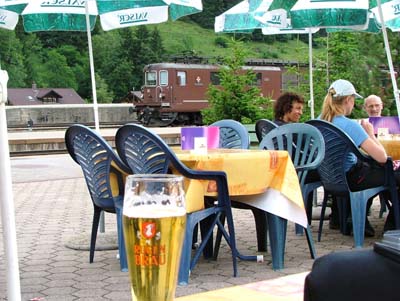
Rugen Brau and Re4/4

Here’s the very first one I took on the trip, at the station buffet in Kandersteg. I can’t imagine anywhere quite like this in Britain. What railway station has a beer garden with a view of a very busy main line surrounded by magnificent scenery?

Above Kandersteg

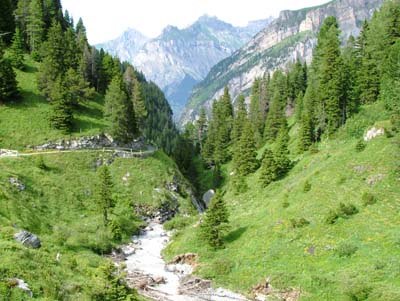
Just one without any trains in it. This is in the mountains above Kandersteg at the top of the Sunnbuel cable car. If you think the scene is somewhere in the Misty Mountains of Middle Earth, remember that Tolkein used to go on hiking holidays in this part of the world. Did JRRT once stand here?

Bieschental Viaduct

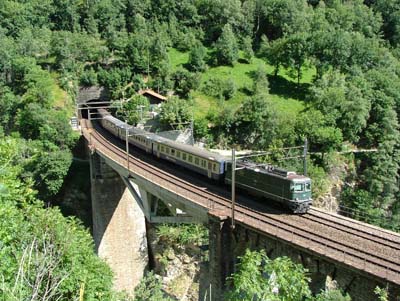
Back to trains again, this is the famous Baltschieder viaduct, on the south ramp of the Lötchberg main line. The train is the Brig to Goppenstein local, hauled by one of the twelve ex-SBB Re4/4 sold to the BLS. While many of them now wear BLS new silver and green colours, this one’s still in the old SBB dark green.

Re460 near Kandergrund

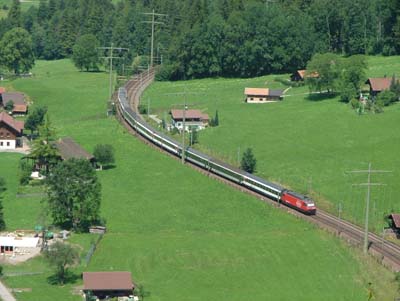
On the north ramp this time, here’s one of the hourly Basel-Brig expresses, taken from the footpath that parallels the railway.

Posted in Photos, Railways | 1 Comment

Parliamentary Mysteries

The Guardian’s David McKie investigates the mysterious world of parliamentary trains.

Even they, though, are better served than users of Reddish South and Denton, which for years have been serviced by one train a week, sometimes running from Stockport to Stalybridge, and sometimes the other way round. In recent months these trains have run out of Stockport at 11.23 every Saturday morning, reaching Reddish South five minutes later. No figure for either station is provided in the ORR report. Could it be that in the year 2004-5 no one used them at all?

I’ve actually ridden that line, when it ran on a Friday afternoon. This is one of the so-called ‘parliamentary trains’ that runs once a day or once a week on little used lines so that the operators don’t need to go through formal closure procedures. Many of these are short sections of line with no stations, such as the short stretch of line between Heald Green and Styal avoiding Manchester Airport. The famous Stockport to Stalybridge line is still used by freight trains, and for occasional weekend diversions, so little money would be saved by not running the one weekly passenger service.

I have no explaination for the great mystery of Watford West. Who can tell us how 25 people a year can use a station which has not only had no trains since 2001, but no longer even has any tracks?

Posted in Railways | 2 Comments

Quote of the Day

Transport books are a bit like heavy metal music. They are “specialist”, so much so that there are specialist transport bookshops, where browsers can be assured that they won’t have to look at such nonsense as fiction or biography, but can just stick with Branch Lines to East Grinstead or Vintage Tractors in Colour. As a consequence, there are specialist transport publishers, such as Ian Allan or David and Charles, to cater to their needs

From a review of Battle for the North by Charles McKean.

Posted in Railways | Comments Off

The Future that Was after all?

Remember the science fiction of half a century ago? With all those Art Deco monorails and aircars? Those stories were set in the times we ought to be living in today. Where did that future go?

Japan, it seems.

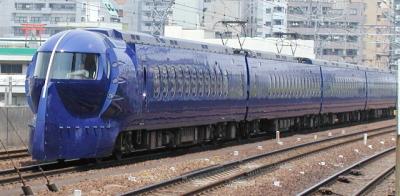
Japanese Rap:it airport express

Photo by Dick Harris, used with permission

OK, so it’s not actually a monorail, but the styling is pure Flash Gordon. I can see this appearing on a Traveller planet as the shuttle between the starport and the city.

Notice that dirty great flange on the font end. Surely this is the ultimate solution to level crossing accidents, straight out of the “Think of it as evolution in action” school of design. Don’t get your ground car in front of that thing….

Posted in Railways, Science Fiction | 1 Comment

Destroy all Canards

On the Ngauge mailing list, a new poster asked for advice on what sort of model railway layout to build in a 15′ x 2′ area. One regular poster, a steam age modeller came up with the following…

A steam era layout is much better than modern image for a small area if you want shunting interest (lets face it, there is no shunting on the current railways), as it is much easier to justify lots of different facilities in a small area.

This oft-repeated canard needs skewering with extreme prejudice!

If you choose an appropriate location, there are plenty of opportunities for shunting in a post-1968 layout. Wagonload freight may have diminished a bit since the end of Speedlink in 1991, but still isn’t completely extinct even today. Rather than the hackneyed rural branch line terminus, there are plenty of opportunities for focussing a model on a single industry that uses multiple types of wagon. Combine that with all or part of a passenger station and/or a through route with passing traffic, and you’ll get a pretty interesting layout.

Some obvious examples for the industry:

  • A cement works, in incoming coal either in HAA hoppers or MEA ‘box’ wagons, and outgoing cement in a mixture of bulk powder wagons, and bogie vans carrying bagged cement.
  • A steel terminal, with incoming steel on bogie bolsters, SPAs, ferry vans and telescopic roof steel carriers.
  • A paper mill, which receives timber and china clay, and dispatches finished paper
  • The inevitable china clay works, which dispatches it’s product in bulk powder form in covered hoppers, slurry form in tankers, and bagged in vans.

I can think of a couple of prototypes as inspiration just off the top of my head. One is the exchange sidings at Hope in Derbyshire. Set in a highly scenic rural location, it’s the point where the privately-operated branch from the Blue Circle cement works meets the Manchester-Sheffield main line. A Blue Circle owned shunting locomotive shuttles between the cement works and the sidings with coal wagons, cement tankers and bogie ferry vans, which are then formed into trains (many of them mixes of vans and cement tanks) running to various parts of the country. Through traffic on the main line includes stone from Peak Forest (using the N-gauge society RMC hopper kit), the Manchester Binliner (refuse containers) and class 158 and 170 DMUs for passenger. And it’s even still got semaphore signalling!

If you want an urban, industrial setting, what about the steel terminal at Wolverhampton? This would make a great two-level layout. At the lower level you have the steel depot itself, with a variety of wagon types and a resident class 08 shunter. On the upper level you’ve got the double track electrified main line between Birmingham and Stafford, with a variety of traffic. There’s also trams on the main road, the street-running section of the West Midlands Metro. I’d model it just prior to 2002, when the Virgin Trains passenger services were still loco-hauled.

Posted in Railways | Comments Off