Railways Blog

A blog about trains, covering photography, railway history, transport politics and modelling, in no particular order.

Gotthard Spirals

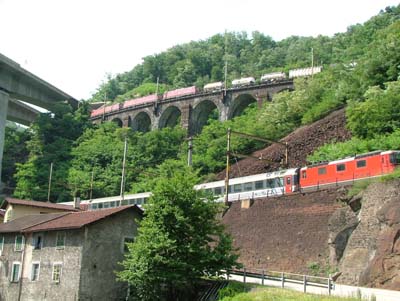
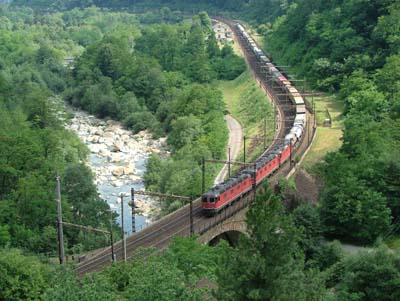
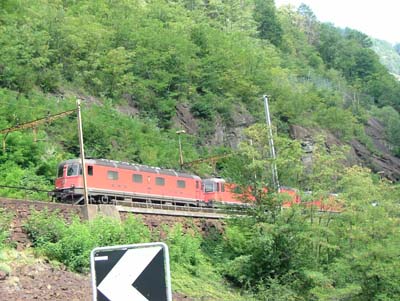
This sequence of pictures shows the effort the 19th century engineers had to go through to run a railways through the barrier of the Alps. It on the south ramp of the Gotthard line, between Giornico and Lavorgo, where the very busy double track line loops round in two complete spirals to gain height.

I took all three pictures from the same viewpoint, on the main road near the post bus stop.

Giornico Spirals

A northbound intermodal approaches on the lowest level. The presence of three locomotives, two Re6/6s and a smaller Re4/4, is unusual; I would assume the train is booked for an Re10/10 (one Re6/6 and one Re4/4), and the second Re6/6 is a balancing working to save a light engine path.

Giornico Spirals

A few minutes later, the same train appears at the middle level having passed through the Travi spiral tunnel.

Giornico Spirals

Finally the train appears at the top level having passed through the Pianotondo spiral tunnel. The southbound passenger train on the middle level rather took me by surprise!

Posted in Photos, Railways | 7 Comments

Back from Switzerland

I’ve got back from two weeks in (mostly) sunny Switzerland. Coming back to this cold damp island is a bit of shock to the system, especially with the weather the past few days.

I’ve travelled on a vast number of trains, from Inter-City expresses to rural narrow gauge branches, classic alpine main lines and preserved steam lines. I’ve even ridden threatened routes like the old Hauenstein line from Olten to Sissach.

I can think of quite a few ways in which Switzerland is better than Britain, apart from the obvious ones like the trains running on time. For instance:

  • A town about the size of, say, Lostwithiel has a station buffet that’s open all day. Not only that, if you order a beer, you get cold draught beer in a proper glass, not a can of warm Stella and plastic cup.
  • The SBB’s ICN tilting trains knock the spots of Richard Branson’s Pendolinos. They even manage to make the seats line up with the windows in 2nd class, so everyone can see out. Come to think about it, so do the Italian/Swiss “Cisalpino” Pendolinos. On the other hand, you could argue that passengers are more interested in seeing magnificent Swiss mountains than their British equivalents are of seeing the grotty parts of Birmingham or Stoke on Trent.

I’ll start uploading some of my 400+ digital photos once I’ve had the change to choose the best ones.

Posted in Railways | Comments Off

Israeli Train Crash

BBC News are reporting seven dead in a level crossing collision between a train and a truck. Judging from the TV pictures the train looks like a Danish-designed IC3 DMU. Most of one side of a carraige was ripped out; it’s a miracle the death toll isn’t higher, given reports that the train was standing room only.

Like the recent crashes at Ufton Nervet in Britain, and Los Angeles in the US, the cause was a road vehicle on a level crossing. According to a report by Haaretz, the authorities have ruled out terrorism. The truck driver was among the dead.

As technology improves, and trains get safer, the one remaining big risk factor is the interface with untrained and sometimes reckless members of the general public. Road crossings are one of the most dangerous of those interfaces. I don’t know if the crossing in Israel had barriers, but reports of the accident being a long way from major roads suggests it’s a minor road, possibly a minor farm track, likely to be without barriers.

My sympathies to the injured and the families of the dead.

Posted in Railways | Comments Off

Book Review: Kevin Robertson – Blue Pullman

Kevin Robertson: Blue Pullman

With their distinctive Nanking Blue livery, the Blue Pullmans were an iconic train from the early 1960s. BR marketed them as Britain’s attempt at a exclusive luxury train in the mould of the continental TEE. Just five units were built, technical problems meant that they lasted a mere thirteen years in service, and sadly none survive in preservation.

Author and bookseller Kevin Robertson is a familiar sight at railway shows up and down the country. He’s previously written books on GWR gas turbines and the ill-fated Bullied “Leader”. His latest book tells the complete history of the Blue Pullmans, from their original concept, their operations to Manchester, Birmingham, Bristol and Cardiff, through to their eventual decline towards withdrawal.

It’s extensively illustrated, including sixteen page colour section, which not only includes some superb colour photographs, but also a lot of the 1960 BR publicity material. There are many good black and white photos as well; one of my favourite shots in the book is of a set leaving Paddington taken from one of the high road overbridges. It manages to include a Hall class 4-6-0, a class 117 DMU and a Metropolitan line COP train all on adjacent tracks to the Pullman. It’s not just action shots of the trains in service, there are also plenty of detail shots, essential for anyone wanting to model one of these trains. The book also contains 4mm scale drawings the cars, both exterior and interior layouts.

The text is packed with historical and technical information, from details of the equipment of the trains to the catering menus. A lot of space is devoted to what may consider the Achilles heel of the trains, the rough riding of the Swiss-designed bogies. These may have worked well under Swiss EwIIs on SBB’s well-maintained track, but they proved allergic to the rough trackwork of the Midland Main Line. Robertson notes that the rough riding was nowhere nears as bad on the better maintained WR lines out of Paddington.

On operations, we’re told of the services run over the years, as well as some proposed runs that never saw the light of day, such as extending the Midland Pullman to Liverpool, or the proposals to use the Midland sets on the East Coast Line following withdrawal of the Midland Pullman. Robertson implies that the livery change in the late sixties that saw the Nanking Blue replaced by reversed BR blue/grey (the so called “Silver Pullman”) marked the beginning of the end. We’re told of the train formations in their declining years, when cars were swapped around between different sets in order to turn out enough complete trains as individual vehicles got sidelined.

Robertson concludes the story with some thoughts on their influence and legacy. He largely dismisses the popular idea that they were any kind of technical precursor to the wildly successful HST that entered service shortly after the demise of the Pullmans. He does however recognise that the Blue Pullman, despite the technical failings that contributed towards their downfall, proved the concept of the fixed-formation multiple unit for inter-city services, now the predominant form of train on today’s railway.

Overall, an excellent book, well researched and superbly illustrated.

Posted in Railways | 1 Comment

GM Nobabs

Cold Spring Shops mentions the classic GM Nobab locomotives, once seen in Denmark, Norway, Belgium, Luxembourg and Hungary, looking very much like a double-ended version of the classic EMD F-Unit.

I have always associated these locomotives with a family holiday in Denmark, when I was nine years old. They were the first foreign trains I had ever seen, and my first sight was one waiting to leave Esbjerg with what I presume was a boat train. They seemed pretty much ubiquitous in the country, with just about everything loco-hauled I remember seeing having one of these maroon beasts on the front. I even had haulage behind one, from Roskilde to Copenhagen and back.

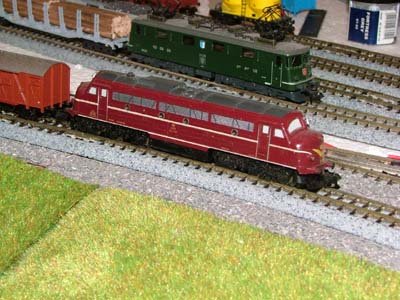
Minitrix DSB GM Nohab

Not exactly appropriate for Switzerland, but I couldn’t resist running one in the classic Epoch III livery of maroon with gold ‘go faster’ stripes. Unfortunately the Minitrix model is one of their older, cruder models. This is a iconic loco (a bit like the equally iconic SBB Ae6/6 visible in the background) that really cries out for a state of the art model.

Posted in Railways | Comments Off

Round the Bend at Wominsee

I haven’t made much more progress on Wöminsee, but here’s what I have been up to.

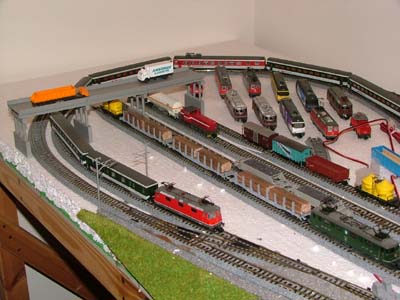
Round the bend at Wominsee

New scenic addition is the new Rix Models road bridge. Very nice if somewhat pricey kit, even if it’s intended for the American market. It’s intended to act as a scenic break, hiding the 180 degree curve. At the moment it’s not fixed down permanently, and will have to be painted to make it look as though it’s made of concrete rather than plastic. I also intent to ‘Europeanise’ the bridge by adding European-style guardrails. Once I’ve added a backscene behind it, it should succeed in hiding the ‘hole in the sky’ across both the main lines and the end of the yard. The ‘locomotive park’ at the back will also be hidden!

To scare curve-phobic American modellers, the inner track on which the train is running on has Kato R216 (8½”) curves at the centre, with 11″ transition curves at each end. It’s the only way I can get a 180° double track curve on a baseboard just two feet wide. The 9-car train of Roco 85′ coaches has no difficulty negotiating it, and the Fleischmann loco has no trouble pulling them either.

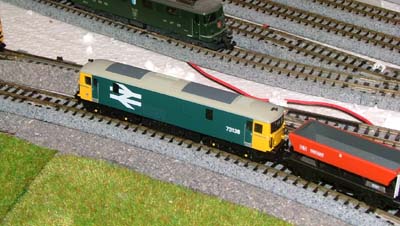
73 at Wominsee

While it’s supposed to be Swiss layout, I do sometimes test-run British outline stock. This is the excellent Dapol class 73 electro-diesel I bought at the DEMU showcase exhibition last year.

Wessex 158 at Wominsee

And Bachmann’s latest offering, a class 158 DMU in the multicoloured livery of Wessex Trains. Both these models are far better than the rather clunky and dated Minitrix Ae6/6 in the siding behind, but rather left behind by recent European models.

Posted in Railways | 13 Comments

Sprawlophilia vs. Sprawlophobia

Ginger Stampley has a long post on suburban sprawl and it’s downsides:

Where my theoretical libertarianism often stops and my theoretical liberalism begins is in places where public bads and public goods need to be distributed. Unchecked development isn’t a public bad in Houston because my snarky inner-Loop self doesn’t like it. It’s a public bad because it gets me and my neighbors flooded and it makes me spend my time lobbying the state and the county not to tear up my neighbors’ homes to make it easier for folks from the Woodlands to commute downtown. If that’s not a taking and a transfer of value from me to developers and new homeowners that I should be able to fight, I don’t know what is.

Some folks act like outbound development is the way God intended things and it’s natural for inner-Loopers and in-town folks to get screwed. The idea seems to be that it was our own fault for being stupid enough to buy there. But I can remember when the Beltway and Highway 6 were smugly new and now they’re about to get the short end of the stick. I hope they, like the inner-Loopers, will insist that the county and state kiss them first.

Meanwhile Patrick Crozier wants to turn the whole of southern and central England into one massive American-style sprawl:

The other alternative is, if the old urban areas are found wanting, to build new ones. This is the big idea of South California academic, Peter Gordon. As he points out: people like sprawl (to use the pejorative term). They like it domestically and, as jobs move out of city centres, they like it economically. And because they are new developments they tend to have the right amount of road space.

The problem with sprawls (which just doesn’t occur to car-owning sprawlophiles) is that anyone who, for any reason, doesn’t have access to a car is completely marginalised. They’ll have trouble getting work, won’t be able to shop, and will have to forget about having any sort of social life. There may be some people who think this is a feature rather than a bug, who think reducing the mobility of the poor is a good thing. The latter group are probably the same sort of wingnuts who think gated communities are a good idea.

The real dilemma is that the optimal design of a city for car users and public transit users is completely opposite.

Public transport requires businesses to cluster around transit nodes, each of which needs a critical mass of homes and businesses within walking distance in order to be economically viable. This is best achieved through relatively high density.

Car users require the complete opposite; everything spread out, with no congested nodes. This requires a low density; often too low for public transport to survive without massive subsidies.

I’m sure it’s possible for a city to achieve the optimum balance of the two. But I don’t expect the blind god of Market Forces to build it.

I suspect America has gone the way it has not because of pure market forces, but as a result of political decisions to subsidise road usage and let public transport wither away. There are also geographical and cultural factors that don’t apply so much in Europe; the fact that cities have room to sprawl, and the implied racism of the ‘white flight’ phenomenon. (Not that Europe is totally immune to the latter).

Britain’s looming transport gridlock is caused by the fact that we’ve failed to invest adequately in transport infrastructure for decades, especially public transport. And when we have invested, much of the money has been wasted by bad management and stupid political meddling. Good examples are the 1955 modernisation plan, when they bought new trains like Imelda Marcos in a shoe shop. Or the more recent gross financial incompetance of Railtrack and Network Rail. Most European countries with equivalent population density not only have better rail networks, but have better roads as well.

Posted in Railways | 1 Comment

Bookmeme!

This meme appeared on Ken Macloed’s blog, although it doesn’t seem to have spread very far, at least through the sections of the blogosphere I read. It appears to be a mutation of the earlier music meme.

1. How many books to you own
Never tried counting them all, but adding up all the SF novels, railway books and RPG rulebooks probably comes up with a figure in the high hundreds. Don’t think it’s in four figures yet.

2. Last book read
Neil Stevenson’s Quicksilver I’m about halfway through so far.

3. Last book purchased
Blue Pullman, by Kevin Robertson, purchased yesterday at the DEMU showcase.

4. Name five books that mean a lot to you

The Book of the New Sun, Gene Wolfe.
An epic in the true sense of the world. I can’t think of any other fantasy or science fiction work that rivals this for atmosphere; it’s been a big influence on my own RPG worldbuilding.

Pebble in the Sky, Isaac Asimov.
Asimov’s first novel, not his best work by any means. Probably very dated now, like so much ‘golden age’ SF. The reason I’m listing it is because it’s the book that first got me hooked on SF, borrowed from the school library when I was about 14.

Red for Danger, L T C Rolt.
Tom Rolt’s history of railway accidents. Rolt avoids the tabloid-style lurid descriptions, and concentrates the technical aspects. He shows how the worlds railways are a safe means of travel today because of the lessons learned from the past.

Diesels in the Duchy, John A M Vaughan
An odd choice for “Books That Changed My Life”. When I returned to railway modelling in the mid 80s, I was looking for a suitable prototype to follow; John Vaughan’s wonderful photographs of class 37s, 50s, and Westerns in the beautiful Cornish scenery made that choice for me; the end result was several Cornish holidays doing ‘research’, and far too many N gauge locomotives.

The Bible.
Read the whole thing, and discover how the random verses the fundies love to quote often mean something quite different when read in their proper context.

5. Five people to tag
Since I didn’t wait to be tagged, anyone not on this list who wants to pick up the meme shouldn’t need to wait either! I’m still going to pass on the baton anyway, to Carl Cravens (responded), Ken Hite, Patrick Crozier (responded), Ginger Stampley (responded), and of course, Scott
Posted in Memes, Railways, Science Fiction | 1 Comment

R*v*t C**nt*rs

Electric Nose goes Rivet Counting. Not really work-safe, especially if you work in Texas.

Posted in Railways | 3 Comments

Cheating

Wominsee goes green

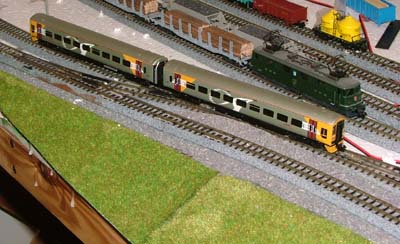
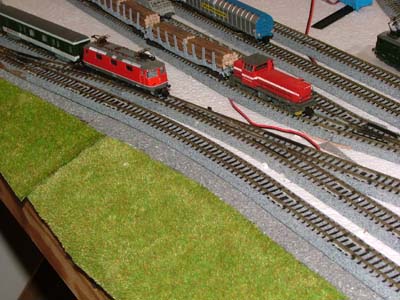
Living in rented accomodation with fitted carpets tends to preclude the sort of messy scenic work I’ve used on layouts in the past. No plaster Mod-Roc scenery, no green emulsion as a base for scatter materials, and no loose ballast fixed with watered-down PVA glue.

On Wöminsee, I’ve been using Kato Unitrack to avoid ballasting, and I’ve been experimenting with Heki grass mats for ground cover. The results can be seen above. I still need to do some trimming of the edges.

The result looks passable, though it’s not what I’d call exhibition standard. But this layout isn’t planned as an exhibition layout. The join between the two pieces is unfortunately rather noticable. I’ll have to hide that with some lichen bushes.

Posted in Railways | 8 Comments