Railways Blog

A blog about trains, covering photography, railway history, transport politics and modelling, in no particular order.

Electric Nose on MRM

Steve Jones, quite possible the Amadán of model railways, celebrates the all-too-brief reign of Nigel Burkin as editor of Modern Railway Modelling.

A magazine is very much a reflection of it’s editor, someone who has vision of how the finished product should look and where it’s supposed to be going. Nigel’s editorial direction has been close to what I want from a magazine and, I’d suggest, the excellent sales show it has struck a chord with many other modellers disenfranchised by the increasingly out-of-touch UK press. It’s a direction refreshingly different to that historically favoured by UK publishers, closer to overseas magazines that have moved with the times. Nigel isn’t, of course, the only person capable of doing this job, but it’s vital to attract and keep such new blood, and this is clearly not happening.

I’ve always thought the market leader, the “Railway Modeller” actually has one thing in common with “Playboy” i.e. nobody reads it for the articles. RM seems to driven by advertising, which means it’s product reviews are useless; they don’t want to upset their advertisers, so all reviews are about as much use as an NME review of a neo-prog band. And their editor seems to think that history ended in 1968.

I hope MRM doesn’t descend into “Toddler” land.

Posted in Railways | 2 Comments

Customer Service, Not.

Can somebody explain to whoever is responsible for training London Underground ticket barrier staff at Paddington that you should never, even answer a question about why a ticket is allegedly not valid with the insulting “What part of ‘It’s not valid’ do you not understand?”.

Especially when the correct answer is “Because Northern Trains failed to print a ‘+’ next to ‘via London’ despite the customer having paid the correct fare”.

I have never encountered such a rude, insulting and offensive attitude from the platform staff of any privatised rail companies. Perhaps it’s because LUL is an old-fashioned nationalised industry that a (hopefully) small minority of staff feel they can get away treating paying customers in such an offensive manner. It’s almost enough to make one believe in privatisation.

I take offense at being treated like some combination of criminal and idiot when I haven’t personally done anything wrong. I find that far worse than the inconvenience of having to queue up just to have the National Rail ticket clerk confirm that I had indeed paid the correct fare and rubber stamp my ticket as valid on the Underground. Even though the latter caused me to miss my connection out of Euston, and add no less than 90 minutes to my journey.

Posted in Railways | 3 Comments

The Saga of Polly

I’m not the only person who into both RPGs and Trains. Here’s what one of my PBeM players has been up to. It’s currently got as far as a working chassis. No boiler yet, and five more installments to go.

I think I’ll stick to N gauge. Though with the invoice I’ve recently had from CJM, I don’t think it’s any cheaper in the long run.

Posted in Railways | 4 Comments

Nürnburg Fire

Many preserved locomotives have been damaged or destroyed in a disastrous fire at a railway museum in Nuremburg.

This shows news photos of the fire at it’s height, and this railfan site shows the aftermath. Both sites are in German, but the pictures are pretty much self-explainatory. It’s a sad sight.

Some of the steam locomotives looks to be recoverable, but many of the diesel and electric locomotives appear to be totally lost.

Update: A post on Trainnet gives more detail of what happened.

Posted in Railways | Comments Off

Guided Busways? No Way!

AMG of Live from the Third Rail links to a very silly article in Rupert Murdoch’s Times. It starts with this risible line:

Tracks on branch railway lines are to be torn up and replaced with concrete channels, under plans to attract people out of cars by replacing trains with buses.

Needless to say, AMG gives it the fisking it deserves.

Guided busways are one of those silly technologies that gets periodically trundled out by those people who entertain fantasies of concreting over the whole of the nation’s railway network. These people always seem to originate from the lunatic fringe of libertarianism. It reality, guided busways are a cheap and nasty substitute for light rail that has all the disadvantages of buses and trains, and none of the advantages of either. I wish I knew where that sort of visceral hatred of steel rails comes from. Is it just an extension of popular distain for train spotters?

The Times ridiculous article suggests than many miles of branch lines up and down the country are about to be replaced with this useless system. But nowhere does it say there’s any specific proposal for this. It mentions the Dunstanble and Cambridge-St Ives-Huntingdon proposals, both of which are on lines disused for some time, and have been talked about for years. Nothing ever came of the Dunstable scheme, and the St Ives plan has met serious opposition from those who want a rail-based solution, such as Cast Iron.

The only worrying one is the Bristol to Severn Beach line, on which there’s supposed to be a “study”. There’s no mention of the results of this study; hopefully it will prove such a scheme is impractical. I note that the last few miles of the Severn Beach line share the main line tracks into Bristol with main line trains. The guided buses won’t be able to do this, and therefore will have to negotiate Bristol’s congested roads into the city centre.

The financial black hole in the railway network is real, and things do need to be done to make things more efficient. I’m sure there are economies which can be made. I’d favour Swiss style light rail for many self-contained rural line, with modern lightweight railcars specifically designed for such routes, and independent local management who will be in a better position than some faraway bureaucrat to determine the needs of the local customers.

Posted in Railways | 3 Comments

The Gap Is Too Wide

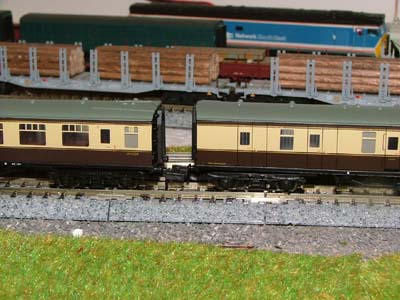
Yesterday I bought some of the new Bachmann-Farish Mk1 coaches, with the correct-pattern B1 bogies. They look good, event though all the detail on the BSK is printed on a flush clear shell. This may be shades of the ‘Super Detail’ Hornby Dublo Mk1s of the 1950s, but this is half the size, and fits the impressionistic style of N gauge.

They look good, that is, until you couple two of them together.

Mind the Gap, Farish-style

You could drive a bus through that gap! Anyone wanting to get to the buffet car would need to be an Olympic long-jumper. The Super BGs with B4 bogies were bad enough, but this is worse. It’s a step back into the dark ages. My 1960s Lone Star 000 stock was as close coupled as that.

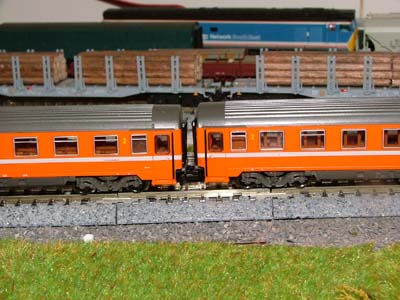
Mind the Gap, Roco-style

It doesn’t have to be like this. These Roco SNCB Eurofimas show what can be done, and they’re considerably longer vehicles. And their close coupling mechanism means they’ll still go round 8″ radius curves.

Posted in Railways | 5 Comments

Crewe: The Gathering

Last weekend Crewe Works hosted an event called “The Gathering”.

More than sixty preserved locomotives were present, brought in from all over the country, representing steam, diesel and electric. Star attendees included The Flying Scotsman, a pair of Stanier pacifics, “Olten Hall” still in Hogwarts livery (which was giving rides), a Woodhead line EM2 and the sole surviving Metrovick Co-Bo, which was displayed suspended from the workshop’s overhead crane. The representative of the group restoring this veteran told me that getting it’s first bogie lift for 40 years was the condition of it’s attendance.

One fenced off corner contained crash-damaged rolling stock, including the burned-out class 143 railbus which caught fire near Bristol a few months back, fortunately without fatalities. Rather more disturbing was the misshapen carraige covered in tarpaulins, which I realised must have been the wrecked restraunt car from the Hatfield derailment four years ago.

I didn’t take many photographs of the day, partly because the weather was dull for much of the day, and partly because my camera batteries ran out shortly after it did brighten up.

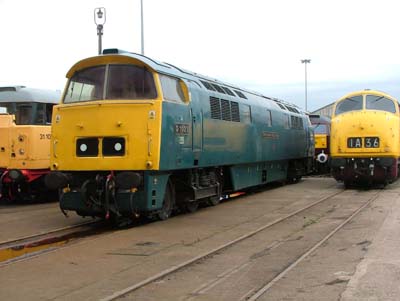
Western Fusilier at Crewe

It makes me feel old to realise that this locomotive has now been a museum piece for 28 years. I remember waiting at Slough on a cold February morning way back in 1977 to see the passing of the last “Western”, an enthusiast special hauled by this very locomotive, D1023 “Western Fusilier”. The Warship class locomotive on the right has been preserved even longer, since 1972.

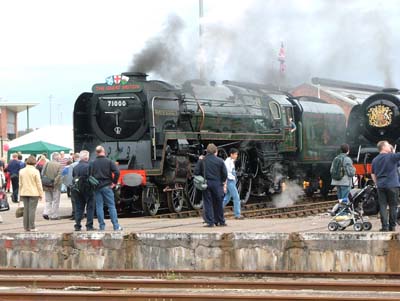
Duke of Gloucester at Crewe

Star “Kettle” was the unique No 71000 “Duke of Gloucester”. It’s BR career was even shorter than that of the Warships, lasting just eight years from 1954 to 1962. It then spent as many years languising in Barry scrapyard in south Wales, before being preserved and restored to main line working order.

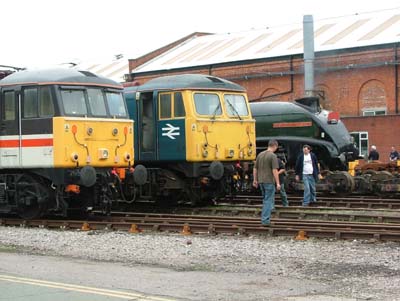
Trio at Crewe

Believe it or not, all three of these locomotives are now preserved. The A4 Pacific “Union of South Africa” was preserved when the two electrics in the foreground were built.

Scammell Scarab at Crewe

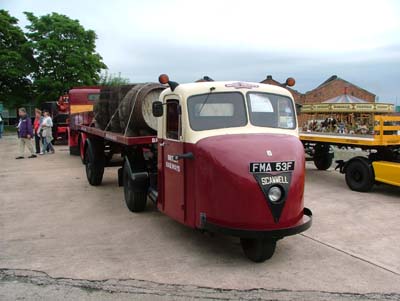
There was also a small display for road vehicles, including a couple of Scammell Mechanical Horses. These strange-looking vehicles with three-wheeled tractor units used to be a common sight around railway goods depots.

Posted in Railways | 3 Comments

Bachmann’s Super BG

One of the first completely new items of rolling stock produced by Bachmann since taking over the old Graham Farish range has now been in the shops for a while, the so-called “Super BG”.

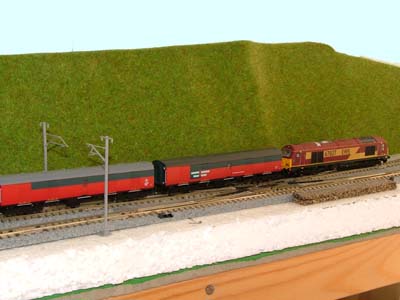
CJM 67 + Bachmann Super BGs

The prototype for this model is the 1990s conversion of Mk1 full brakes with roller-shutter doors for use on mail traffic. They were relatively short lived, due to EWS losing the Royal Mail contract.

Bachmann’s new product, while still a long way behind the standard of continental or American models, is a step forward from what has gone before; with finer detailed underframes, well reproduced bodyside detailing, and a good semi-matt finish with well-printed lettering. Speaking of lettering, there are four different variants available, representing different branding they’ve had over the years; the Rail Express Systems version with the blue flashes (the leading vehicle) comes with or without Royal Mail logos, and the debranded post-privatisation version comes with or without the EWS “Three Beasties” logo.

The two biggest faults are a lack of weight which increases the risk of derailment, and the excessive gap between the coaches. The close-coupling mechanisms of all major continental makes, which still go round 8″ radius curves, isn’t rocket science nowadays, and I’d like to see Bachmann do the same on British stock.

They make a nice complement for my CJM class 67, and an 8 car rake in full cry is an impressive sight. Not that they ever ran in Switzerland, though.

Posted in Railways | 2 Comments

Bubbles!

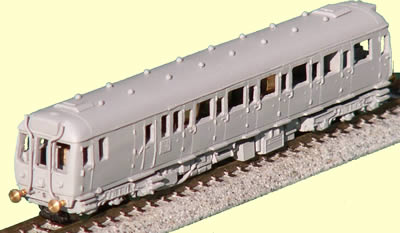
Dave “Blimp” Jones of N-Thusiast Resprays have put some pictures of his new class 121 “Bubble Car” railcar online.

NTR bubble car

Like earlier kits of his, the body is cast in resin. I have to say it’s an improvement on his earlier class 22 diesel, but I’ll reserve judgement until I see a fully painted and finished model in the flesh. It’s promised for December’s Warley exhibition.

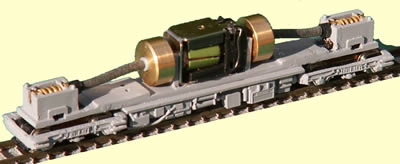
NTR bubble chassis

The chassis uses Lifelike motor and bogies. I’ll be interested to see how robust and reliable it proves in operation. I don’t know whether it’s cast in resin or metal; if it’s resin it looks a bit on the fragile side.

Posted in Railways | Comments Off

Tellenburg

Tellenburg castle, a mile south of Frutigen in Switzerland, is a superb place to watch trains when the weather is good. It affords a splendid view of the kander viaduct on the north ramp of the Lötchberg line, with a steady procession of passenger and freight trains grinding up and down the 3% grade. For most of the afternoon, the sun is right behind your shoulder, making the light perfect for photos of the viaduct. It’s ideal if you’re an N gauge modeller, because the trains appear to be N gauge sized from this vantage point as they head up and down the valley.

As you should be able to seem from the pictures, there are actually two viaducts. The elegant masonry structure in front dates from the original construction of the line in the early years of the 20th century. The uglier concrete bridge behind dates from the late 1970s when the route was widened to double track in order to handle the ever increasing volumes of traffic. The line is now very busy indeed, with a train every 10-15 minutes at busy times.
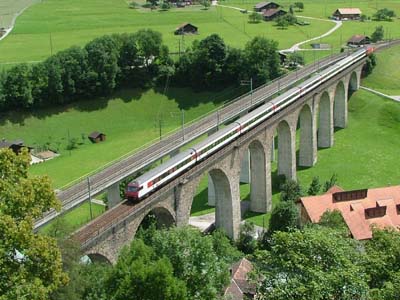
Kander Viaduct

One of the hourly “Pendelzug” trains from Brig, propelled by an SBB Re460 locomotive. This is the only train I saw with the entire formation in the new black and white livery. From the most recent timetable change, SBB have taken over all passenger workings on the line from BLS, and BLS blue and cream trains are a thing of the past on the Lötchberg proper.
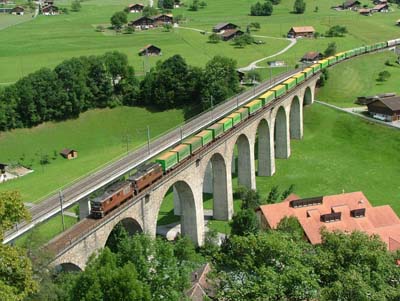
Kander Viaduct

Despite losing the passenger traffic, BLS continue to operate plenty of freight. Here, a pair of their “Browns”, the BLS’s distinctive Re4/4s head a northbound “Hangartner” Intermodal.
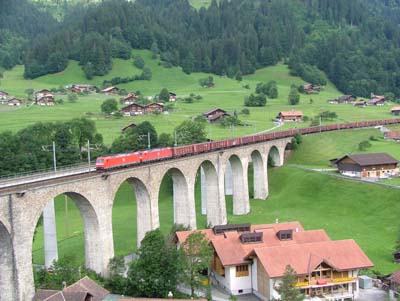
Kander Viaduct

The Reggio to Limburg clay empties headed by a pair of DBAG class 185s. These locomotives have four pantographs to enable them to work under both German and Swiss electrification.
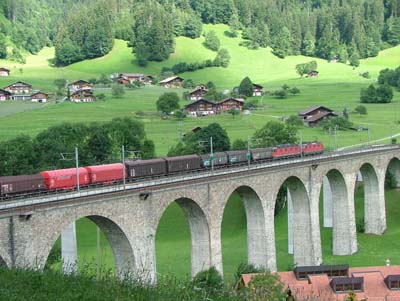
Kander Viaduct

An SBB Re10/10 combo (one Re4/4 and one Re6/6) head a southbound wagonload freight made up mostly of steel wagons.
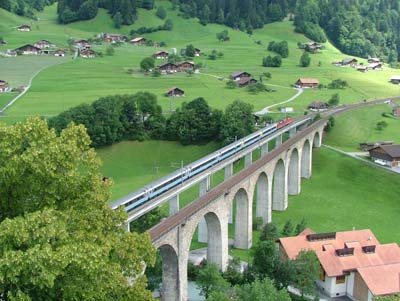
Kander Viaduct

One new type of train in 2005 is the international workings to Italy operated by Cisalpino, with coaches in a striking blue and silver livery. This six coach train appears to need the power two SBB Re4/4s
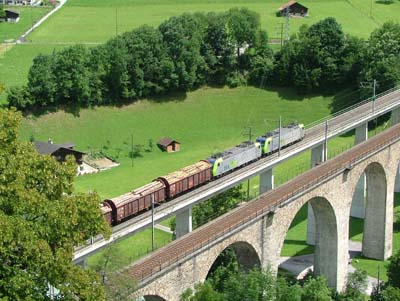
Kander Viaduct

BLS’s Re485s are much in evidence in the attractive lime green and silver colour scheme. Here a pair of them slog up the grade with a southbound wagonload freight, made up mostly of timber wagons.
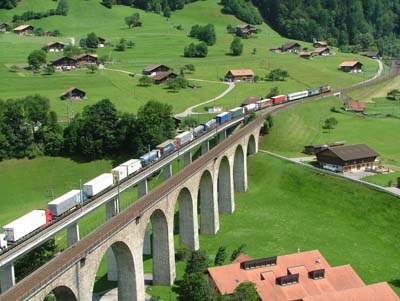
Kander Viaduct

The “Rolling Road” trains are a great success, carrying lorries (and their drivers) across the Alps, keeping their vehicles off Swiss roads. It’s headed by the odd-looking combination of an Re465 and a “Brown”, which was the power on all rolling road trains I saw that day.

Larger versions of these pictures can be found on my fotopic site
Posted in Photos, Railways | 4 Comments