Music Blog

All the music-related posts gathered together in one place.

2013 Classic Rock Society Awards

Yatim Halimi

Congratulations for Panic Room’s Yatim Halimi for being voted best bass player at the Classic Rock Society awards, and also for Riversea as Best Newcomer. Both are very well deserved.

Alison Henderson posted the full list of winners on her Facebook page. The list does seem a little less predictable that some years, although Magenta still did very well, and Mostly Autumn seem to win best band every year.

Best gigMagenta
Best newcomer- Riversea
Best trackLovers End Pt 3, Moon Safari
Best keyboard playerMike Varty
Best bassistYatim Halimi
Best drummerHenry Rogers
Best guitaristChris Fry
Best albumBeneath The Waves, Kompendium
Best male vocalistDamian Wilson
Best female vocalistChristina Booth
Best bandMostly Autumn
Unsung heroJon Patrick
Outstanding ContributionAndy Tillison.

I think it needs to be recognised that the CRS awards celebrate the UK grass-roots rock scene in the UK, which is why you won’t see higher-profile artists like Steve Wilson, Opeth or Rush, or many US or Euro prog bands. Yes, you could criticise the awards for parochialism at times, or the way that some artists win year after year, which is why I applaud John Jowitt’s decision to rule himself out of contention this year.

Still, I’ll take this over The Brits any year.

Posted in Music News | Tagged , | 1 Comment

The Brits 2013 – Music for Bean-Counters

The Guardian’s Alexis Petridis has penned a splendidly snarky piece about the predictable nature of the Brit Awards.

In Wednesday’s Guardian, the outgoing chairman of the Brits, David Joseph, proudly announced that during his three-year tenure he had successfully rid the awards of their “chaotic” element and introduced “more gravitas”. There’s a compelling argument to suggest that gravitas isn’t necessarily the thing you’re looking for in an event that’s supposed to be celebrating a thrilling youth phenomenon, but what Joseph seemed to mean was that the Brit awards ceremony no longer has an interest in delivering surprises of any kind.

I’m assuming the “chaotic elements” include Iron Maiden winning Best Live Act a few years back, which immediately prompted that particular award to be dropped the following year, lest rock gatecrashed the party again.

“The lineup goes from pop to discovery to indie,” added Joseph, puffing the event’s supposed variety. Leaving aside the fact that he appears to have invented a hitherto-unheard-of genre called discovery, it’s perhaps worth noting that the winners aren’t really as eclectic as all that. What holds sway in the British musical mainstream in 2013 isn’t a genre so much as a certain earnestness: it’s perhaps the only thing that links Sandé’s pop-soul and Mumford & Sons’ tweedy take on acoustic folk rock.

Leaving aside the imaginary genre of “Discovery”, does anyone actually believe that manufactured pop and three-chord indie are the only forms of music that currently exist?

As Alexis Petridis makes clear, the Brits is all about celebrating commercial success. And anyone who actually knows a thing about music will recognise that mainstream success has far more to do with the amount of money thrown at promoting an act than the actual quality of the music. So anyone who accuses you of being a musical snob if you dare to suggest that the Brit Awards does not represent the best of British music is merely parading their ignorance.

The sad truth is that the majority of “mainstream” audience is now made up from people who are unaware of the existence of anything other than whatever music those who count the money want them to hear.

Unfortuately it’s still difficult to counter someone gushing about how wonderful Mumford and Sons are without sounding patronising. Or people saying Adele is one of the greatest singers because everything else they’ve heard is autotuned pop or tuneless indie. There is a whole world of great music out there, and they’re oblivious to it. Ultimately, I suppose, it’s their loss.

Posted in Music Opinion | Tagged , , , | 1 Comment

The Brit Awards are the musical equivalent of Tesco’s horse burgers – discuss.

Posted on by Tim Hall | 2 Comments

Understanding Bad Music Journalist Clichés

The Stool Pigeon Guide to Music Journalist Bullshit lists a lot of bad clichés that aspiring music writers really ought to avoid. Unfortunately there are one or two in there I have a horrible feeling I’ve used in the past. Oh dear.

Bastard lovechild — Is sex out of wedlock still considered edgy? So why would anyone still be writing that albums ‘sound like the bastard lovechild of X and Y musicians’? I mean, there’s a good chance your parents hadn’t gotten round to tying the knot by the time you were conceived. But so what? It doesn’t make you a latter-day Edmund from King Lear. Hell, it doesn’t even make you Jon Snow off Game Of Thrones.

Uh-oh. I’ve used that one. But not in a musical context; I think I described American conservatism as the bastard love-child of Cyrus Schofield and Ayn Rand. The wingnuts are probably still capable of being offended at being called bastard love children. So I’ll let that one stand.

Songstress — As opposed to what, ‘songster’? Reading between the lines, this faintly kinky usage is a subliminal reflection of male music hacks’ rampant castration fear. See also: chanteuse

If I dared used such a word, I can guarantee that the songstresses or chanteuses would lynch me.

Sophomore — Ridiculous, US collegiate term used as a stand-in for “second” when describing albums, e.g. “The Stone Roses’ second album The Sophomore Coming was a let-down for many”.

If there is one word guaranteed to set my teeth on edge in a review, it’s this one. It implies that either the reviewer’s frame of reference doesn’t extend beyond American student-indie, or they’re a semi-literate hack who doens’t even know the meaning of the clichés they parrot. Either way it’s strong indication not to take the writer’s opinions seriously.

So, if Anne-Marie Helder ever releases a follow-up to “The Contact”, I had better not write “The chanteuse’ sophomore album is the bastard love-child of…

There are lots of other bad ones in that list, and the whole thing is worth reading. What really bad music writing clichés do you think really need to die?

Posted in Music Opinion | Tagged | 1 Comment

Crimson Sky + The Mighty Bard, The Railway, Winchester

Crimson Sky have returned to the live stage with a couple of co-headline gigs with The Mighty Bard, each band playing an hour-long set. The first of these was at The Old Firestation in Windsor, and a week later the two bands came to The Railway in Winchester.

The Mighty Bard at The Railway in Winchester

The Mighty Bard were on first. The six-piece could be described as “Morrissey covering Grendel” although to be fair they’re a lot more than that. Certainly some of the arrangements, especially the keyboard sounds and ornate soloing strongly recalled very early Marillion. There was a slight folk-rock edge at times, although 80s neo-prog was by the strongest flavour. They certainly had their moments, but there were other times when I wasn’t completely convinced. They were at their best when the material fitted the singer’s vocal style rather than pulling in a different direction. The electric violin added an extra dimension; too many of today’s prog bands don’t stray enough from the standard keys and guitars frontline, but I felt it was a little underused. Still an enjoyable set, despite a few areas that need work.

Crimson Sky at The Railway, Winchester

Crimson Sky are on an upward trajectory at the moment. The new lineup with Jane Setter on lead vocals and Moray McDonald on keys is started to gel nicely, and the new members are making more and more of a stamp on their sound. They’ve still got that 70s classic rock meets 80s new-wave sound, where you hear influences as diverse as Uriah Heep and The Teardrop Explodes. To my ears they still fall under the broad umbrella of progressive rock, but they avoid all of the worst prog clichés. Like most good bands, you can hear influences, but their sound is their own.

Crimson Sky at The Railway, Winchester

Jane Setter has now established herself as frontwoman, and has taken the older songs and made them hers. The setlist naturally includes the two new songs from last years’s EP “Dawn”, though the rest of the set comes from 2009′s “Misunderstood”. While they’ve got some great songs, especially the closing “Misunderstood III”, the band have now reached the stage where they could do with some new material in the live set.

Crimson Sky at The Railway, Winchester

While Martin Leamon’s superb fluid guitar playing still dominates, Moray McDonald’s often understated keyboard playing fills out the sound, and has gradually become more of an integral part of the band. He plays some great classical-style piano fills, some of his Hammond organ riffs recall Uriah Heep’s Ken Hensley, and there’s a hint of Marillion’s Mark Kelly too.

Crimson Sky have matured into a strong live band who deserve a wider audience, and I hope the new album the band are currently writing will take them to the next level.

Posted in Live Reviews | Tagged , , | 3 Comments

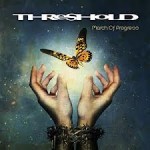
Threshold – March of Progress

Over a twenty-plus year career Threshold have established themselves as one of Britain’s premier prog-metal bands; a sort of British version of Dream Theater, only with a greater emphasis on solid songwriting rather than technical showboating. The band has changed lineups over the years with guitarist Karl Groom and keyboard player Richard West the only constant members, although the rhythm section of Johanne James and Steve Anderson have now been in the band for many years.

Their ninth studio album “March of Progress”, is the first since the return of the band’s original singer Damien Wilson in 2007, replacing Andrew “Mac” McDermott who sadly died in 2011. It also sees the band back to a six-piece twin-guitar linuep with the addition Pete Marten. After the attempt at something slightly different with the rawer production of 2007′s “Dead Reckoning”, this new release sees the band revert to the more polished approach of earlier albums.

All the Threshold ingredients are here; the lengthy and complex song structures, the big anthemic choruses, the soaring solos and, as ever, immaculate playing. Damien Wilson’s voice has an impressive power and range, and sometimes it’s a relief to hear some old-style ‘proper singing’ on a metal record. There is perhaps slightly more emphasis on atmospherics on this record, but it’s still balanced by plenty of metallic riffery, and quite a few vocal hooks get stuck in your head. There are big epics such as the closing “The Rubicon”, and the obligatory power-ballad in “That’s Why We Came”. Though song titles like “Return of the Though Police” and “Liberty, Complacency, Dependency” imply a political line, the lyrics are far more thought-provoking than preachy.

Threshold certainly have a clearly identifiable sound, which is both their greatest strength and their greatest weakness. There quality is consistent throughout, no filler, but neither is there much that we haven’t heard on previous Threshold albums, and there’s a feeling that we’ve heard a lot of it before. When other bands are taking progressive metal in new and more challenging directions, they leave Threshold’s old-school style perhaps sounding a little dated by comparison.

On the other hand, Threshold are still very, very good at what they do. If you’ve liked their previous albums, there’s a lot to like about this one too, and after a long absence a new album is very welcome indeed. If you’re a Threshold fan, you probably have this album already. And if you’re completely unfamiliar with their music, this is as good a place to start as any.

Posted in Record Reviews | Tagged | Comments Off

Shut Up, The Band Is Playing

From The Guardian’s Michael Hann’s review of Kraftwerk at Tate Modern:

Three times I move around the front of the hall – one of the wonderful things about the arrangement of these shows is the ability to move without any hindrance to wherever you want – to escape groups of people not just exchanging the occasional word but having full and loud conversations. Hang on, you sold your mother’s soul to get a ticket for one of these events, and now you’re going to talk through it? It’s music-as-social-event writ large.

Seriously, what is it about some people? It does give the impression that there were far too many people at the Tate Modern that weren’t actually there for the music, but because it was the place to be seen. I’d like to say one advantage of like obsure progressive rock bands is that they don’t attract the poseurs, but sadly prog gigs aren’t immune to loud talking either.

Posted in Music Opinion | Tagged , | 5 Comments

Is Your Music Organic?

Fiona Brice asks Is Your Music Organic?.

Are you listening to an artist or a band performing a song that they wrote themselves (I’d call that organic), or are you listening to a pop tune co-written by a conglomerate of industrial co-writers and performed by some battery hens in heels, or a genetically modified beast (see ‘Jedward’)? What are your children listening to?

If you are one of the large percentage of people approaching middle age whose music taste stagnated after they got married and put the Ikea CD shelving up, and whose only exposure to music is now via the XFactor or a few minutes of BBC radio, then it might be time to think about exploring some alternative choices

When comparing fans of independent music with foodies, there are a lot of amusing parallels, and she does make some good points. Who of us doesn’t know a few of the Ikea shelving people she refers to? But taking the food analogy to it’s logical conclusion, if Simon Cowell is Burger King, a lot of awful indie bands are closer to that dodgy late night takeaway with a freezer full of alsatian carcasses than a reputable organic restaurant.

It is, of course, very tongue-in-cheek, a sort of parody of Nigella Lawson doing music writing, rather than a Samantha Brick style lack of self-awareness. But the humour was clearly lost on far too many of Twitter’s indie hipsters, who were so up themselves they didn’t realised they’ve been Poe’d.

There’s certainly no excuse for the level of vitriol we saw on Twitter, which went from arch sneering at Brice’s mention of Queen (that one actually came from an indie singer-songwriter too) to what looked like an actual death threat. Not surprising that the author shut down her Twitter account.

Now, where did I put that Muse album?

Posted in Music Opinion | Tagged | 3 Comments

A well-known music publication has recently printed a strongly negative and damaging review of gig I went to but didn’t have time to review myself for this site. No, I don’t expect every reviewer to agree 100% with me, but trust me, I can tell the difference between a sincere but critical review and an agenda-driven hatchet job. I sometimes feel bad about not reviewing as many albums and gigs as I could. Especially when there are bands who are very clearly not getting the positive press their music deserves.

Posted on by Tim Hall | 4 Comments

Golden Rules for an Independent Band

An entertaining Guardian Music Blog piece by a band called Mazes about the 10 golden rules of being in a DIY indie band. It’s about independent bands touring the club circuit rather than “indie” as a style of music, so many of these are application to any genre. The whole thing’s worth reading (As is typical, the comments rather less so), but there are a few that jump out.

1: You probably don’t need a sound engineer
The in-house engineer at the venue invariably knows the room and sound desk better than the guy you’re paying £100 a day to drink your rider. No offence to travelling engineers, but anyone who would rather sit in a van all day for less money than they’d get for showing up to a static venue at 6pm is a sociopath

Well, perhaps not so much this one. Certainly for prog bands playing small clubs, the sound engineer is as important as anyone on stage, and can be the difference between a great gig and an unlistenable one.

I can speak from the experience having been to many gigs in small clubs, and seen people who either (a) don’t know the room or (b) don’t know the music, and screw it up very, very badly.

If your band is, to quote a musician I know, “Crash bang wallop, you’ve my Wonderwall thank you goodnight”, then it might not matter, but if the music is any more sophisticated than that…

6. Don’t slag off other bands
They will find out, or, when you bump into them buying kale in at the grocer’s and they tell you they like your new record, you will feel like dying.

Let’s not mention any names, shall we? Also don’t forget some of their fans might also be your own fans…

10. Have fun
The record industry was ruined by expense accounts and arrogance. Don’t even try to make money or think about quitting your day job. You should be doing this because you want to experience new things, to see new places, to meet like-minded people and to scratch the creative itch many of us have … the primal misguided quest to leave something when you die or for people to think you’re “cool”. Make music that you’d like to hear.

The last line needs to be engraved on the heart of everyone who wants to make great music.

Posted in Music Opinion | Tagged , | Comments Off