Games Blog

Reviews, thoughts and options from the word of paper-and-pencil roleplaying games.

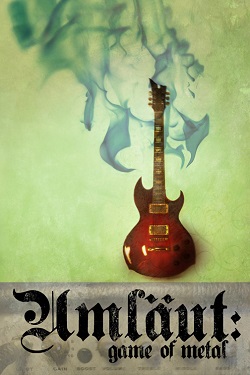
Umläut: The Game of Metal

One of the most entertaining games I’ve played recently has to be Umläut: The Game of Metal, the collaborative storytelling game of competing metal bands. We played this game at Stabcon in Stockport this year, with four players, the ideal number according to the rules.

You start by making up a band, giving them a name, sub-genre, membership and setlist, then distributing seven points between the three performance traits of Technique, Stagecraft and Power.

Over the course of the game these figures can go up and down, as the band also accumulates scores in Cash, Fanbase, Ego and Hope. Ego is the double-edged score; there are circumstances in which a high ego can benefit the band, but let it get too high and you risk the band splitting.

On the grounds that the your band didn’t have to be any sub-genre of metal, and the first time I played the game at last year’s Stabcon Phil Masters ended up winning the game with an avant-garde French pop band, I came up with the band “Clown Car”, whose genre wasn’t metal at all, but “Neo-Prog My Arse”.

They started out with the following membership

Sharon, prog diva
Nigel, poet and audience frightener
Kevin, keytar player with cape
Vlad, bass player, with too many strings
Bob, guitarist, with too many necks
Brian, drummer, who’s also in 17 other bands

I could use the usual disclaimer stating that any resemblance to any members of real bands is pure coincidence, but somehow I don’t think you’d believe me.

Their songs just happened to contain a lot of software testing in-jokes, with songs like “Blue Screen of Death”, “Object Reference Not Set To An Instance Of This Object”, “Clown Car Abandoned In A Field” and “It Works On My Machine”.

I distributed the starting Performance Traits in the ratio 3/3/1, which seemed about right for a somewhat theatrical prog band, good technique and stagecraft, but a bit lacking in oomph.

Their rivals included the “Agricultural Thresh Metal” of Iridium Tractor, with their mascot Flossy the sheep, and The Risen, a band of zombies of famous dead people.

Having created your bands, gameplay is divided into scenes, going round the table with each player choosing a type of scene for their band. You can have work scenes, describing an episode in the character’s day job, rehearsal scenes in which the band improve their performance stats, publicity stunts in which the band try to drum up support, and so on. In most scenes there’s some kind of conflict, which is resolved by drawing cards; the player with the most black cards “wins” the scene, but the player with the highest value card gets to narrate the scene.

In this game we had things like the great brussels sprout avalanche of Sainsbury’s (a work scene). We also had a situation with members of two different bands having day jobs at the same software house, and a project going pear-shaped saw a conflict scene in the shape of a very fraught team meeting, followed by a split scene as Clown Car’s lead singer emigrated to Hawaii as part of the fallout. That’s what happens if you let Ego get too high.

The key moments are the Gig Scenes, where a pair of bands play co-headline gigs and try to blow each other off stage by accumulating the most Glory over the course of the three rounds of the gig, using the same card-based mechanism, and what strikes me is just how well the rules mirror reality. For example:

At first sight, many people assume that the best way to play is simply to load all your performance traits into Technique, and play Ballads at every opportunity. The theory is that since you’re always drawing loads of cards during the attention check, you ought to pretty much shut your opponent out. Even if you don’t manage to get any Glory (because your power is low and you only get one Shred from the Ballad), you’ll eventually get lucky and score one or two and your opponent has no chance to score anything.

In practice, not only is this very boring, but it doesn’t actually work. Even if you draw more cards during the Attention Check you can’t guarantee your opponent getting a lucky draw and beating you. They get one good Attention Check and they’re usually going to get a whole lot of Glory because you didn’t really put anything into Stagecraft.

I’ve been to gigs where that is precisely what happened.

The game ends after a set time (we set this as three hours after the start, since the game was in a four-hour convention slot), after which we trigger the endgame, which take the form of a final round of gigs scenes involving all the bands. Clown Car, with their new lead singer Tracy blew Iridium Tractor off stage, but even that wasn’t quite enough to win the game for them.

But saying that, the game isn’t really about winning or losing, but telling an entertaining story. At the end of the game the band with the highest score in Fanbase is the most successful (Did you end up touring stadiums? Did you let it go too far? Or did you never really get beyond the toilet circuit), and the band with the lowest Ego relative to their Hope is the happiest, even if they never did make it big.

As a game and a rock fan, Umläut: The Game of Metal is one of those games that demands to be played as soon as you read the rules, and makes for both a highly entertaining game and a suprisingly accurate view into the world of rock’n'roll.

Posted in Games | Tagged , , | 12 Comments

The Doom That Came To The Doom That Came To Atlantic City

So the Kickstarter for The Doom That Came To Atlantic City has gone pear-shaped amidst accusations that Forking Path had used most of the kickstarter funds to fund the founder’s living expenses rather than on the development of the game.

It’s a reminder that backing any crowdfunded project is a risk which funders need to assess based on how nuch they trust the people behind the project to deliver. Sadly it’s also likely to be used by people with vested interests in the old-fashioned big-publisher driven model to discredit the whole concept of crowdfunding.

I’ve backed a lot of Crowdfunded music projects over the past few years, including Marillion who pioneered the whole concept a decade ago yet seldom seem to get the credit for it. I’m happy to pay £25-£30 months in advance for the deluxe edition of an album from the likes of Marillion, Mostly Autumn or Fish because I trust those artists to deliver. It’s the same with games; I trusted the Evil Hat crew to deliver on FATE Core, and they did.

Traditional publishing (or record companies) are not going away. But neither is crowdfunding, especially for things that have a lot of fan support but seem too risky to appeal to the bean-counters.

Arguments rage over whether Kickstarter is a pre-order mechanism or more like an investment in a startup. Certainly the bands I’ve mentioned above have all sold their projects as pre-orders. But, as the failure of TDTCTAC shows, there are elements of risk and trust involved. Back enough projects and you risk getting burned occasionally. But provided enough of them do deliver, I think it’s a risk worth taking.

Posted in Games | Tagged | 1 Comment

Why The Harassment Discussion is Toxic?

If you’ve ready any of the recent discussions on Google+, forums and elsewhere regarding harrassment at conventions, you will notice things have turned very toxic. It’a a bit like those discussion on the ethics of filesharing, in which positions have become so entrenced that nobody is interested in dialogue leading to mutual enlightenment, but in shouting down anyone that disagrees with them. You only have to look at the hostile reactions to this blog by Sarah Pinborough to see how things have spiralled.

Here’s my take on why the debate about harassment policies at gaming conventions has turned so toxic.

(1) Having a policy covering things like stalking and groping is a good thing provided it’s not too clumsily or vaguely-worded or gives a false impression that such harassment is more widespread than it is.

(2) Censorship of the actual content of games sold, displayed or played at the convention under the guise of a harassment policy is not a good thing.

(3) A lot of sensible and reasonable people are supporting John Scalzi’s initiative to make having a policy regarding (1) the expected standard for anyone running a convention.

(4) There is a small but very loud minority advocating (2), and they’re using misrepresentations, lies, ad-hominems and conclusions drawn more from dogma than evidence to justify this.

(5) The behaviour of (4) has created a backlash again harassment policies of any kind.

(6) In any internet debate it’s always the loudest and shrillest voices that get the most attention.

Does this make sense?

Posted in Games | Tagged | 6 Comments

6 Board Games That Ruined It for Everyone

Why is it that board games have such a terrible reputation with the general public? According to Cracked.com, the problem is so many of the perennially-popular family games are very poor examples of game design, and bad memories of wet Saturday afternoons have coloured perceptions so much that nobody is aware that far better games exist.

6 Board Games That Ruined It for Everyone starts out by eviscerating Snakes and Ladders

Snakes and Ladders is the original sin of board games, the first mistake that curses innocents with the knowledge that things suck. It takes the infinite imagination engines that are children and makes them to do the same thing over and over until they’re done or done even trying. The last person to destroy fantasy worlds so brutally was Sauron.

But saves it’s worst for that horror of horrors, Monopoly:

The whole point of the game is proving that capitalism is utterly broken and unfair, and people still play it to get their go at winning. Parents would be better off buying their kids a rack and a My Little Inquisition scalpel set. There’s the same aspect of taking turns to torture each other, and at least that way the kids learn about anatomy.

The author then goes on to suggest other, better games, amongst them Settlers of Catan and Power Grid.

Saying that, designing a good family game, as opposed to one aimed at boardgame enthusiasts isn’t easy. Gamers are comfortable with complex rules and games that take all day to play. Also hobby games don’t need to remain playable with a group of players of widely-variable skill, which probably the main reason why so many family games rely heavily on luck rather than on strategy.

So what is the reason Monopoly remains a popular seller, and why haven’t games like Settlers of Catan superceded it?

Posted in Games | Tagged , | 5 Comments

Races and Fantasy RPGs

There has been some discussion of late over whether the concept of traditional Tolkien-via-Gygax fantasy races is inherently racist. Are orcs really racist caricatures of black people?

Unfortunately, the internet being the internet, it’s been the most shrill and uncompomising voices that got too much of the attention, and things turned predictably ugly.

Which is why Jim Henley’s thoughtful post on the subject is most welcome.

Posted in Games | Tagged | 6 Comments

Games Workshop – Copyright Trolls.

From Making Light.

MCA Hogarth, an author and artist …. recently discovered that one of her books, Spots the Space Marine has been blocked from sale on Amazon, after a claim of trademark infringement from Games Workshop.

Since 1987, GW has published a series of games (and ancillary merchandise) get in their “Warhammer 40,000” setting, full of spike-covered pseudo-elves and pseudo-orcs amd chainswords and the like, all set in space (instead of on a planet like their original Warhammer setting). GW has apparently decided that, since they’ve got space marines in their setting, they own the very concept of space marines.

While the copyright lobby screeches about “piracy” and demands ever stricter laws, it’s nonsense like this that demonstrate how badly the current intellectual property regime is broken. Opinion on Making Light (and trust me, these people do know what they’re talking about) is that Games Workshop’s attempts to claim ownership of the name “Space Marine” is unlikely to stand up in court. But they’re targetting people who can’t afford the expense of costly lawyers to defend themselves. This is a company that has issued DCMA takedown notices on people publishing their own photographs of their own Games Workshop chaos spiky creatures.

They should not be allowed to get away with this sort of bullying.

Update: And they haven’t. Amazon have now backed down, belatedly recognising GW’s claim for the trolling it is. Hopefully GW will also realise that all this bad publicity is damaging their brand -  See the Electronic Frontier Foundation for the full story.

Posted in Games | Tagged , | 2 Comments

Worst RPGs ever

A comment left on another post sent me down the rabbit-hole of the worst RPGs ever.

The less said about “The Unholy Trinity”, the better; all are self-published efforts that as far as I know never saw print editions, and arguably shouldn’t really be considered as proper published games. The first two are notorious purely for the offensive nature of the game content, and only deserve to be flushed down the memory hole. The third, “Hybrid”, is quite literally complete gibberish from beginning to end, and it’s difficult to tell if it’s the ramblings of someone with zero SAN, or the whole thing is an elaborate practical joke by a troll.

Some of those intended as serious games bring back memories. I remember occasional commenter Amadán’s review of Senzar (A rilly kewl game if you’re 14). As for Wraeththu, well, I’ve actually played a convention game using that setting, something I signed up for largely on the reputation of the GM, knowing little or nothing about the game’s background.

At the top of the “bizarre setting” list is this game, based on a series of novels by Storm Constantine. The Wraeththu are hermaphrodite bishonen ubermenschen who are apparently slowly taking over the Earth—and, along the way, converting the occasional human into one of them by transfusing blood into them. Oh yeah, there are only male Wraeththu—and their genitalia look like flowers or anemones.

Although that RPG.net piece more or less admits that the problem with the Wraeththu game was more down to the clunky system that didn’t fit the setting. The game I played didn’t use that system, fortunately. Don’t remember much about the actual game now, suspect it may even pre-date the publication of the official RPG, except I think the player characters were all human, and the hermaphrodite bishonen ubermenschen of the setting were the opposition. Perhaps that premise would have made for a better RPG?

Posted in Games | 1 Comment

Fate Core

Just as crowdfunding has revolutionised the independent music sector, it’s been having a similar effect on the world of roleplaying games. Most recently, Evil Hat Productions‘ Kickstarter for Fate Core has been a runaway success, reaching it’s initial target within hours, then hitting stretch goal after stretch goal.

Fate has to be one of the most revolutionaly pencil-and-paper game engines to be developed over the past decade or so. It grew out of Fudge, with “Aspects” as a very elegant mechanic improving on what I felt were Fudge’s weaknesses. Games such as the two-fisted pulp action Spirit of the Century, the hard-SF space opera of Diaspora, and the licenced monster-mash urban fantasy of Dresden Files built on Fate’s core engine adding new mechanics and game tools to support many genres and styles of play. It developed the so-called “Fate Fractal”, in which everything from equipment to an entire nation can be modelled as a character. Fate Core aims to be an improved and streamlined core engine on which the next generation of Fate games can be built.

Pledge just a quid (although most people seem to have pledged far more than this) in order to get the finished printed book), and you can download the current laid-out version of the core rules. No art, and some details may be tweaked for the final release, but it’s a complete game.

If Fate is your sort of game, and you haven’t contributed yet, what are you waiting for?

Posted in Games | Tagged , , | 1 Comment

When you have The Monster From The ID from Forbidden Planet hauled up before Joe McCarthy’s House Unamerican Activities Committee, you know you’re in a game run by Marcus L Rowland.

Posted on by Tim Hall | Comments Off

Monte Cook bails on Dungeons and Dragons 5th Edition

Wizards of the Coast have been working away on a new edition of the iconic tabletop pencil-and-paper roleplaying game Dungeons and Dragons for some time. It’s prompted much speculation on the net over direction the new edition might take.

The previous 4th edition had radically changed many aspects of the game, and had rather divided the fanbase. To make things worst, they open-sourced the rules for the previous third edition, which resulted in them competing with several rival versions of the game, from Paizo’s well-supported Pathfinder RPG based on the superseded Third Edition, to a slew of small-press games under the loose banner of the “Old School Renaissance”, all based on much earlier editions.

With the new edition, they announced ambitious plans to reunify the whole thing, a seeming impossible task of reconciling different groups of fans who really want to play what had in effect become several completely different games. One wonders whether such a thing is even possible, let alone desirable.

When the lead designer quits mid-project, it’s a sign things are not going well.

On Monte Cook’s Livejournal:

Last week I decided that I would leave my contract position with Wizards of the Coast. I am no longer working on Dungeons & Dragons, although I may provide occasional consultation in the future. My decision is one based on differences of opinion with the company. However, I want to take this time to stress that my differences were not with my fellow designers, Rob Schwalb and Bruce Cordell. I enjoyed every moment of working with them over the past year. I have faith that they’ll create a fun game. I’m rooting for them.

Due to my non-disclosure agreement, as well as a desire to keep things on a professional level, I have no intention of going into further detail at this time. (Mostly, I just hate drama, and would rather talk about more interesting things.)

The net is awash with talk of the whole thing going horribly pear-shaped. Now, I know nothing about the direction the game was supposed to be taking, and haven’t played much D&D since 1st/2nd edition (I’m that old!). But it does sound a bit like an archetypal failed large-scale IT project, doomed from the start by over-ambitious and contradictory requirements. Add a few egos and some corporate politics, and it’s easy to see how easily such a project might run into trouble.

It’s worth noting that Dungeons and Dragons is relatively unusual in that the entire game has changed almost out of all recognition between editions, and other games which had done similar things had unhappy histories. Call of Chulhu, for example is still recognisably the same game as it was back in the early 1980s, while Traveller, after a complicated and somewhat messy history has now reverted to something looking a lot like the classic late 70s rules, under the stewardship of Mongoose games.

I don’t really have a dog in this fight, since my tastes have moved away from the rules-heavy combat-centric approach of D&D to more lightweight games that emphasise story and setting. But it will be very interesting to see how this all pans out.

Posted in Games | Tagged | 7 Comments