Religion and Politics Blog

Card-carrying Liberal Democrat. My views are my own, and do not necessarily reflect party policy.

Donald Trump

TrumpDonald Trump frightens me.

When he started his presidential campaign he was running as the Id of the Republican Party. Now he’s morphed into the closest thing to full-blown Fascism I’ve seen in a non-fringe American politician in my lifetime. I know comparisons were made between George W Bush’s coalition of religious conservatives, militaristic nationalists and big business looking for subsidies and that of Benito Mussolini in the 30s. But Trump is far, far closer to the real thing.

What’s telling is that none of his Republicans rivals will call him out on anything he says. It’s as if they fear that his ignorant xenophobia resonates so well with the Republican base that criticising him might hurt their own chances.

Given the way leading Republicans have spent years stoking up ignorance and fear for short-term electoral advantage, how much is Donald Trump a Frankenstein’s Monster of their own creation?

It’s tempting to dismiss him as a joke, but even if his campaign eventually implodes he’s still doing a lot of harm in Overton window terms. And I don’t think anyone can totally rule up him winning; nobody ever expected him to get this far.

A Trump presidency will be a terrifying thing, even more dangerous for the stability of the world than Islamic State.

Posted in Religion and Politics | Tagged | 2 Comments

Mark Clarke, the Tory Requires Hate?

The story of Mark Clarke and his bullying of young Conservative Party activist Elliott Johnson to suicide is horrifying. While I’m sure there are people with a sense of schadenfreude at internal problems within the Tory party, that’s an entirely wrong reaction. Anyone with a shred of empathy should feel for Elliott Johnson and his grieving parents. It’s not as though destructive bullies are confined to any one party; look at the behaviour of the late Cyril Smith in the Liberals. Politics is particularly vulnerable to these sorts of charismatic sociopaths, and all too often people overlook the harm these sorts of people can do.

I am struck by the parallels between Mark Clarke and the individual within the Science Fiction community who went under the name of “Requires Hate”. Both showed the amount of damage a manipulative sociopath in a position of influence can do to an organisation or community.

There are differences of course; Clarke was a public figure and some of his bullying took the form of public confrontations, while Requires Hate was an anonymous internet presence whose true identity wasn’t publicly known at the time.

But they had a lot in common too. Clarke embedded himself in a influential position in a estabilshed power structure, while Requires Hate constructed an extensive web of acolytes and sycophants in a community that lacked a formal hierarchy. Both used malicious false allegations and threats of blackmail as a weapon, and both ruthlessly gamed the rules of the social systems they were part of. And neither would admit their wealthy and privileged backgrounds; Clarke spun a fiction about growing up on a council estate, while Ms Hate wore her minority status on her sleeve while neglecting to mention that she was a scion of one of Thailand’s most wealthy and powerful families.

It’s easy to say that organisations and communities should get better at seeing through these sorts of people, but that’s far easier said than done. It’s much harder to spot a bad actor when they appear to share your own values.

Posted in Religion and Politics | Tagged , , | 4 Comments

Vince Cable on Syria

Some wise words from Vince Cable on Syria

With so much complexity and confusion, the public debate should be characterised by humility and open-mindedness.  That is what makes so unforgivable the crude and abusive campaigning.  There is no room in civilised discourse for the Internet trolls and the thuggish activists threatening MPs who voted for air strikes or accusing them of murdering babies.  No less disreputable is the attempt by David Cameron to smear those who oppose strikes, even in his own party, as “terrorist sympathisers”.   Shrill self-righteousness is a poor substitute for the moral high ground.

So, what should the sceptic do who is unimpressed by simplistic and emotive calls to arms or to militant pacifism? It is very tempting to say ‘no’ and to say it is all a terrible mess which we should try to steer clear of.   Having voted against the Iraq War, with my Lib Dem colleagues, I can see worrying parallels in the lack of strategic clarity and the potential for blundering into a Middle Eastern swamp with no obvious exit. I find that most of my friends and party supporters assume that my party would automatically repeat its opposition.

But there are some big differences from the Iraq war.  There is no question, here, of defying international law.  This is not about regime change (indeed we are now de facto allies of the awful Assad regime).  Saddam, however odious, was not attacking us. And we are not on the coat tails of a crass, ideologically driven, US administration. On the contrary, the Obama administration has shown admirable restraint and a marked reluctance to extend its military role.

The whole quite lengthy post is well worth a read.  For such a complex shades-of-grey lesser-of-two-evils situation. those people who are so morally certain are quite frightening. I do wonder how much their bluster and aggressive dismissal of alternative viewpoints is a cover for their own doubts.

Posted in Religion and Politics | Tagged , | Comments Off

And the sign at the side of the road pointed to Mars

I have taken what should hopefully be a brief absence from Twitter. The alternative would have been to unfollow or mute significant numbers of genuine friends, and I’m not willing to do that. It’s alll got very ugly since Parliament voted on airstrikes against ISIS in Syria. The mood reminds me of the days immediately after the death of Princess Diana, and not in a good way. Twitter is not the place for nuance.

Labour MP Jess Phillips sums up how I feel quite accurately.

My husband was once asked which super power he would have if he could pick. He gave the utterly unbombastic answer “the power of hindsight”. While I’m spying on you with the invisibility power that I picked, he will be resting on the laurels of never making a mistake. Mine is more fun in the short term but his eliminates a life of pain and hand-wringing. What a clever man he is.

Without this power I remain uncertain. What I am certain of is that those who are so certain that they are right are certainly not as clever or good as they think they are.

Indeed. As was said on Twitter a while back about a completely unrelated issue, if you really don’t know all the answers, it’s better to be zero than a minus one.

In this time of great uncertainty, we need some proper grown-ups in charge, and the people we do have don’t measure up. David Cameron comes over as little more than an opportunistic spiv with no underlying principles, who wants to go to war in an exercise of nationalist willy-waving. Even if he’s right, he’s probably right for the wrong reasons, and it’s hard to blame anyone for not buying what he’s selling.

But Corbyn is no better, an inflexible ideologue who, even if he’s a decent person at heart, is too weak a leader to be able to control the more thuggish elements amongst his own supporters. The personal abuse I’ve seen on Twitter towards those who supported the Government, especially women, has been quite appalling. And these people claim to be on the side of “peace”.

In terms of weighing up whether action or inaction is the lesser of two evils, among party leaders Tim Farron comes over as the only adult in the room. Even he may be wrong, but I’m more inclined to trust his judgement than that of Cameron or Corbyn.

It’s not as if a tiny number of planes is going to make a great deal of difference anyway. To defeat ISIS, something that does need to be done whatever the “peace” movement might say, will require putting together some sort of anti-ISIS alliance on the ground. That will need a lot of diplomacy and may well require treading on the toes of some of our supposed allies. And even that would be a fruitless game of whack-a-mole unless we also discredit their ideology, something that may take a generation to accomplish.

Posted in Religion and Politics | Tagged , , , | Comments Off

Goldsmiths College – It Just Gets Worse

On the surface, this is Bizarro World stuff. A bunch of reactionary male religious fundamentalists attempt to disrupt a talk by an ethnic minority woman they don’t like after claiming the event was “violation of their safe space”. And then the same college’s Feminist Society issues a statement of solidarity with these men. What in Cthulhu’s name is going on?

Who else thought the disgraced Welfare & Diversity Officer Bahar Mustafa wasn’t just a single bad apple but a symptom of something more deeply rotten at the heart of Goldsmith’s College?

Some people try to shut down us white male liberals when we criticise the excesses of identity politics or the misuse of “safe spaces”. But the terrible events in Paris ought to serve as a reminder of why extremism is everyone’s business and everyone’s problem. The people who were gunned down in cold blood at The Bataclan did not enjoy the luxury of a safe space. And the mealy-mouthed victim-blaming response to the earlier Charlie Hebdo massacre by the repellent Arthur Chu serves to remind us that some so-called “Social Justice Warriors” are themselves part of the problem.

I have no idea whether or not Goldsmith’s College is a hotbed of ISIS sympathisers, but I would not be the least bit surprised if it was. And when London suffers the inevitable Paris-style attack, I wouldn’t surprised either if any of the terrorists turned out to have some connection with Goldsmith’s.

Posted in Religion and Politics | Tagged , , | 2 Comments

I have no idea which option out of inaction, or bombing ISIS in Syria will prove to be the lesser of two evils. But be honest, do you know? Or are you just standing with your political tribe? Supporting or opposing anything on the basis of taking the opposite position to those people over there you don’t like is not a stance of moral courage.

Posted on by Tim Hall | 4 Comments

Will Oldham be Labour’s Eastleigh?

The Oldham by-election is going to be interesting. I’m not going to try and predict the result; maybe Labour will hold on with a much-reduced majority, or maybe Jeremy Corbyn’s Labour will get a very bloody nose at the hands of UKIP. Labour activists are speaking of his unpopularity on the doorsteps, and some Corbyn loyalists are shooting the messenger. Labour Twitter is ugly at the moment.

But even if Labour hold on, it will still be their Eastleigh.

Eastleigh, if you remember, was the by-election following Chris Huhne’s resignation, narrowly retained by the Liberal Democrats with the help of the opposing vote being split. But it was a pyrrhic victory, which allowed the party to remain in denial about the electoral consequences of coalition with the Tories and sleepwalk into electoral disaster this May.

A defeat at the hands of UKIP might actually be better for Labour, and for Britain.

Even though the Liberal Democrats have no chance of winning, they’re still taking this by-election seriously. This is a constituency where they came second in 2010, only to fall to fourth in 2015. If they manage to increase the share of the vote it will be a sign of the party’s slow recovery. It’s not inconceivable that they might even push the Tories into fourth place, especially if UKIP manages to squeeze the Tory vote.

Posted in Religion and Politics | Tagged , , | Comments Off

David Auerbach on GamerGate and the Clickbait Media

Slate journalist David Auerbach posted a couple of quite significant things on Twitter a few days ago. It’s a screencap, which I know will have accessibility issues, but I couldn’t find the original text anywhere. There is a larger resolution version which is slighly more readable
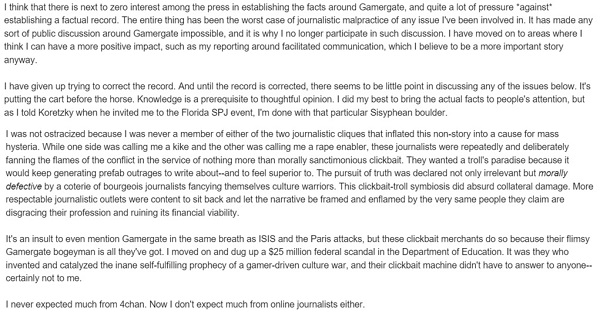
Auerbach

When we finally write the history of the Twitter wars I hope that history covers the role of the clickbait media and the way they’ve often been willing to pour petrol on flames in order to monetise faux-outrage. The infamous #Shirtstorm was one of the most notorious; where a clickbait “news” website went with the cynically inflammatory headine “I don’t care they you just landed a probe on a comet, your shirt is alienating“, thus guaranteeing the internet would explode in a flame war that would end in people getting hurt.

As for Gamergate. I’ve been watching the issue from the sidelines for the past year, and it’s becoming increasingly clear that both the “Gamegame is a hate group targeting women and minorities” and the “It’s all about ethics in game journalism” are at best gross oversimplifications of a complex and confusing mess, and at worst deliberate and cynical lies.

My perception (which may be wrong) is that the persistence of Gamergate owes a lot to the nature of some of their more publicly vocal opponents, at least some of whom appear to be attention-seekers looking for their fifteen minutes of fame, who take Gamergate’s public mocking of them as validation. When more than one journalist has told me they won’t cover Gamergate because of the harassment and personal abuse they get from GG’s opponents, it paints a rather different picture to the narrative’s we’ve seen in the media.

As far as I can tell, Gamergate seems to consist of three groups. The first are gamers who, rightly or wrongly, had an axe to grind against the gaming press which they saw as agenda-driven and riven with conflicts of interest, much like the British music press of the 1980s. Second are opportunistic right wing types who had little connection with the gaming hobby but saw it as another front in a wider cultural war against “Social Justice Warriors”. Third were the malevolent trolls for whom the whole thing provided perfect cover to ruin people’s lives while letting others take the blame. The media narrative only acknowledges the last two of these three. Meanwhile the Ganergaters for whom it’s all about ethics are too quick to deny any connection with the trolls who have gathered under their banner.

The problem with Gamergate is that the only media outlets who have been covering the story are those who were themselves part of the story, on both sides, or are repeating their talking points without doing any investigation themselves. Nobody without a pre-existing agenda is interested in touching it.

The truth is eventually going to come out.

Given the contentious nature of this subject, I’m going to be strict on moderating comments. I’ll probably approve most comments from people I know and trust, but drive-bys with canned talking points may not be so lucky.

Posted in Religion and Politics | Tagged , | Comments Off

Ken Livingstone has a lot in common with Richard Dawkins. The recent public pronouncements of both seem to come from their unfiltered Id. Saying the July 7th bombers “Gave their lives to protest against the war” is at best grossly tone-deaf, and at worst something I really don’t want to think about.

Posted on by Tim Hall | Comments Off

More thoughts in the aftermath of Paris

Like many others I’m still struggling to make sense of what happened in Paris. It’s wrong to pretend this act of terrorism has nothing to do with the Islamic world, but it’s just as wrong to try to demonise Islam itself. Most of those killed by ISIS are Muslims. I’ve tried to make sense of things by looking a parallels in Christian history; the Thirty Years War is an obvious one, and you could see parallels between Wahhabism and Calvinism if you squint hard enough.

But unlike some people I’m not going to pretend I actually know what I’m talking about.

ISIS, ISIL, Daesh, call them what you want. They’re an apocalyptic cult masquerading as a throwback to a earlier, purer version of Islam. There are many similar cults and sects in the Christian world, particularly parts of the US, who hold broadly similar beliefs, with a warped and selective interpretation of The Bible.

The only difference is those sects are not committing large-scale non-state violence at an international level. But it’s not impossible to imagine an alternative history where the American Civil War turned out differently and parts of the Old South are a patchwork of unstable failed states and oil-rich theocracies, subject to proxy wars and ham-fisted interventions by rival European powers. Such a world could easily spawn something looking very much like ISIS except for the religious symbols they display.

There are a lot of responses that would be completely wrong from a xenophobic backlash against Muslims to pretending nothing is wrong or blaming everything on the west. As someone once said on Twitter, it’s better to be a zero than a minus one, and one way to avoid being a minus one is to read up a bit more widely than blogs and op-eds that simply tell you what you want to hear. We may all need to absorb some uncomfortable truths and make some difficult collective decisions in the coming months and years.

Posted in Religion and Politics | Tagged , , , | Comments Off