Religion and Politics Blog

Card-carrying Liberal Democrat. My views are my own, and do not necessarily reflect party policy.

James Worrad and The Waste-Ground

James Worrad writes in general agreement with an earlier post by Mark E Lawrence on the politicisation of SF fandom.

For my own part, jumping on the right wing Sad puppies foam-fest is utterly, comprehensively unthinkable. Just no. Writing impassioned common-all-garden social justice speeches is a lot more attractive (I agree on the basic stuff after all. I consider myself left wing) and in my needier moments I’ve thought about doing so. But, ultimately, I feel it would be to betray the multicultural British city that raised me (Oddly, social justice terms and philosophies become more impractical the deeper into a multicultural provincial UK city you go, in the same manner you saw less and less jingoism and flag-waving the closer you got to the trenches in World War 1. People are too busy just getting on with things).

I have a lot of sympathy for this. I have noticed that his post coming under fire from some of the usual suspects on Twitter. which is predictable if depressing.  It gives the impression that the SF world is dominated by two rival cliques who wear rheir (American) politics on their sleeves, and those who aren’t willing to adopt the dogmas of either tribe are feeling  increasingly alienated. When you hear people implying that being a political moderate is a symptom of privilege…

Last year I bought some recently-released SF/F novels without waiting for them to come out in paperback, with a view of nominating one or more them for a Hugo award, as a supporting member. But I’m come to the conclusion that I’d probably be wasting my money. What’s the point of paying good money to nominate something you think is worthy, only to find its nomination was championed by the wrong people, and either the author will be forced to decline the nomination or be ostracised, or it will be voted down by massed no-awards.

I’m still an SF reader. But when it comes to fandom, it’s a case of not my circus, not my monkeys.

Posted in Religion and Politics, Science Fiction | Tagged , , | 3 Comments

Everything about Boris Johnson is phoney

BorisA rather splendid evisceration of Boris Johnson by Nick Cohen in The Spectator

Johnson believes in the advance of Johnson. That’s all there is. There’s nothing else. Most politicians, and many of the rest of us, are ambitious, of course. But politicians normally hope to advance a cause as they advance themselves. Johnson would have you believe that he is breaking with the establishment, risking all, because of his sincere conviction that we must advance the cause of saving Britain from the European Union.

His colleagues do not believe him. Nicholas Soames called him a liar on Twitter yesterday. Jerry Hayes called him a ‘copper-bottomed, hypocritical little shit.’ The wonder of it is that they may have been understating the case for the prosecution.

As recently as last year Boris Johnson was stating publicly that it wasn’t in the nation’s interests to leave the European Union. Which makes it very hard to see his move to be the face of the Vote Leave campaign as anything other than a cynical move which is really about his ambitions to become David Cameron’s successor as Prime Minister.

As Nick Cohen rightly says, the only thing Boris Johnson believes in is Boris Johnson. Which makes him David Cameron turned up to Eleven.

Posted in Religion and Politics | Tagged | 7 Comments

The Face of Brexit

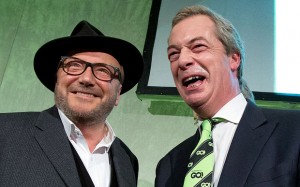
(Photo by Rex/Shuttrerstock, from linked article)

It’s a bad idea to vote for or against something purely on the grounds of the personalities who support or oppose it. But come on, look at the faces of the Out movement. George Galloway and Nigel Farage? In a campaign that also includes the repellent Iain Duncan-Smith? That picture is the embodiment of the Horseshoe Theory.

Posted in Religion and Politics | Tagged , , | Comments Off

First they came for the right-wing bellends

Following on from the shadowbanning nonsense, Twitter have now suspended the account of an aggressively anti-feminist right-winger with 90000 followers, with no hint of exactly what it was he said that crossed the line.

I am not going to defend this man’s speech or opinions, he’s an unpleasant and misogynist bigot. But again the lack of transparency suggests Twitter has adopted a policy of suspending high-profile accounts “pour encourager les autres” in a largely ad-hoc manner. And that does raise all sorts of concerns over the direction in which Twitter is heading.

This comment on Popehat sums up the concerns quite well.

Twitter’s getting too Orwellian for my tastes. No fun. I’ll be damned if I stick around if they’re going to let the likes of Arthur Chu and Anita Sarkeesian decide who gets voted off the island.

It’s probably going to be a while before the speech of liberals is threatened. Precedents in other spaces suggest that if they succeed in driving off the wingnuts the next targets are more likely to be those on the wrong side of sectarian disputes within feminism.

But the mention of Arthur Chu is a reminder that my card is already marked. I’m on his shared block list along with 30000 other people because months ago I criticised something he said. While it would be monumentally stupid for Twitter to decide one morning to suspend every single account on that blocklist, their recent behaviour means that can’t be trusted not to be that idiotic.

Posted in Religion and Politics, Social Media | Tagged , | Comments Off

The Lump of Labour Fallacy

Lump of Labour Fallacy

Not that there is any point attempting to explain the Lump of Labour fallacy to Daily Express readers. They will only assume you are talking about John Prescott.

Posted in Religion and Politics | Tagged | Comments Off

Twitter’s Shadowbans

First they came for the right-wing assholes. But I was not a right-wing asshole…

The aggressively right wing news site Breitbart has got itself into a lather over the apparent “shadowbanning” of notorious libertarians and neoreactionaries on Twitter including Milo Yiannopoulos, Vox Day, Mark Kern and others. It’s being claimed that some or all of their posts are not being shown to their own followers, and the accusation is naturally being raised that Twitter is involving itself in politically-motivated censorship

What is really going on? The truth is nobody outside Twitter really knows, but the lack of trust in Twitter’s management means the conspiracy theorists are going into overdrive.

Yes, Twitter does have a harassment problem, and individuals with substantial bully pulpits setting their followers on anyone who’s incurred their wrath is a big element of that problem. And yes, Twitter does need to so something about it.

But underhand not-quite-bans for crossing invisible lines enforced without any kind of transparency is not the answer. It only fuels suspicions of creeping political censorship.

If Twitter wants to impose stricter rules on misuse of “@” for the purposes of bullying, fine. Put something unambiguous in the Terms-of-Service and make it clear what is and isn’t allowed. Then enforce it consistently without regards to the offender’s politics.

Or better still, a relatively simple technical fix restricting the visibility of tweets tagging someone who has blocked the author of the tweet, so it can’t be used to set off dogpiles?

And if it does turn out that Twitter is censoring on the grounds of politics, then I hope enough of Twitter’s liberals remember the words of Pastor Niemöller. It might start with people few outside their own right-wing circles would wish to defend, but can you be sure it will stop there?. Will you wait until someone like Maajid Nawaz is silenced because he said something the Saudis don’t like?

Posted in Religion and Politics | Tagged , | Comments Off

Maajin Nawaz on identity politics (again)

Some strong words from Maajid Nawaz on how left-wing identity politics plays into the hands of the far right. He’s sounding like a stuck record, but he’s going to keep saying this until people listen.

In the name of their own ideological experiment driven by identity politics, the anti-fascists not only ignore, but wholeheartedly defend the stranglehold Islamists have over Europe’s Muslim communities. Theocracy and illiberalism are disguised as diversity. Multiculturalism is institutionalized across Europe. And people are petrified.

Free speech has suffered the terribly. Populists will abuse it to incite hatred of Muslims. Islamists will simultaneously argue for it, and against it, depending on whether the topic is the right to advocate theocracy or ban cartoons. The Regressive Left’s answer is typically authoritarian, preferring to silence debate rather than think uncomfortable thoughts.

Last week, exhausted by moderating the trolls, the Guardian announced that it has decided to shut down comments on its now ironically named ‘Comment is Free’ opinion page for the three topics of Islam, race and immigration.

Meanwhile, Vice revealed the existence of a private company that maintains a for-profit secret blacklist of Muslims it arbitrarily labels as terrorists. I am named on this list.

Reasonable conversation around Islam, race and immigration has become impossible.

You should pay attention to what Maajid Nawaz says, even if you don’t agree with him. And if you think his ideas are wrong, even dangerous, the onus is on you to explain why you think he’s wrong. Don’t hust try to shut down the conversation by claiming it’s actively harmful to marginalised minorities to have the conversations you don’t want to have.

Posted in Religion and Politics | Comments Off

Yet Another Political Compass

A new political compass

Today’s political landscape looks less and less like “right” versus “left” and more like something multidimensional.

Libertarians have long advocated a political compass with the individualism-collectivism and cultural-economic axes, because it highlights the differences between themselves and traditional conservatives. But culture and economics are both really about power, and the recent rise of an authoritarian cultural left leaves it looking out-of-date. When one of the four quadrants best describes two totalitarian ideologies from the second quarter of the 20th century that have both been completely discredited, is it really relevant?

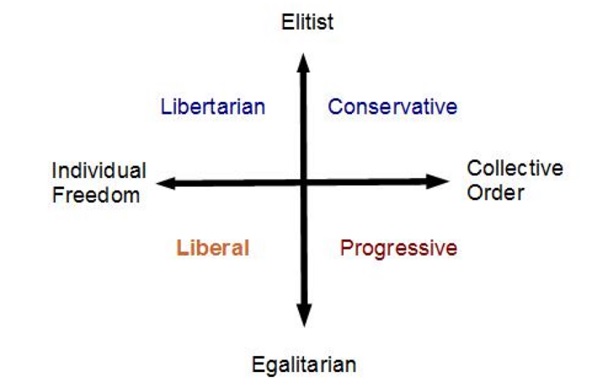
So as an alternative, what about axes of individualism-collectivism and egalitarianism-elitism instead? That make better sense of explain the fundamental split on the liberal left.

On the top right-hand corner we have traditional conservatives, who stand for order through established hierarchies. They consider the existence of a ruling class as part of the natural and proper order of things, though they do accept democracy as a means to keep those elites honest. Conservatives are prepared accept slow and gradual social change, but only when they’d obviously be on the wrong side of history if they didn’t.

On the top left-hand corner we have libertarians. They reject order and stability in favour of disruption and change, and favour the individual over the collective. But they don’t reject the concept of elites, only opposing the existing elites. Libertarians are unique in their distrust and sometimes outright rejection of democracy, because they fear the tyranny of the majority threatens the freedom of the individual.

In the bottom right-hand corner we have what I will call progressives. Progressives believe in collective action to counter established power hierarchies, and strongly support democracy as a means of empowering the people against the establishment. The belief in the collective over the individual means progressives can sometimes see dissent as an undermining of solidarity.

Finally, in the bottom left-hand corner we have liberals. Liberals share progressives’ opposition to power hierarchies, but reject their emphasis on the collective over the individual on the grounds that it can become an oppressive power in its own right. Likewise, liberals share libertarians’ belief in individual freedom, but reject their embrace of inequality and love of power. Liberalism could be considered as a centrist position between the two, but it’s more than that; a belief than egalitarianism and freedom are not polar opposites makes it a distinctive position in its own right.

Like any model, this is a simplification. They are spectrums of opinion rather than four distinct and separate political tribes, and mainstream political parties are by necessity big tents; there are both progressives and libertarians in the Liberal Democrats, for example. But just as the distinction between conservatism and libertarianism became apparent a generation ago, the distinction between liberalism and progressivism is now becoming apparent in the increasingly bitter culture wars over identity politics and freedom of speech.

Posted in Religion and Politics | Tagged , | Comments Off

Bernie vs Hilary. It gets ugly

The continuing awfulness of Donald Trump had been overshadowing the race for the Democratic nomination between Hilary Clinton and Bernie Sanders. But that race is not only very close but has become very ugly, and it does seem to highlight the fundamental schism in the liberal-left.

It’s become so ugly that comparisons are being made with GamerGate. Does this suggest that the culture wars across gaming, fandom and tech are not quite the left-right conflict as they’ve frequently been framed?

It’s not as if either side is innocent here. We’ve seen some ugly casual sexism coming from a small but noisy faction of Sanders supporters, which doesn’t do their candidate a lot of favours. The so-called “Bernie Bros” do appear to have a lot in common with the infamous Cybernats or some of the more belligerent Corbyn supporters that sometimes make the British political internet an unpleasant place.

But the Clinton campaign is no better. It is noticeable is now many of those who have invested heavily in so-called “Social Justice Warrior” middle-class identity politics are solid Clinton supporters. Their attacks on Sanders and his support appear to come from the same playbook as the attacks on GamerGate and The Sad Puppies. On the surface at least, Sanders’ politics have little in common with the conservative-libertarian bent of the Gaters or the Puppies. Is what we’re seeing just their default response when faced with what they see an intruder on territory they believe to be rightfully theirs?

Though it should be noted that Bernie Sanders has distanced himself from the so-called “Bernie Bros” in a way those other groups did not do with some of their own bad actors.

But in the end, much like with Jeremy Corbyn’s labour party, both camps appear to have forgotten that their ultimate goal is to defeat whatever horrific troglodyte ends up on top at the end of the Republican race. Posturing and self-indulgent virtue signalling will not help achieve that goal.

Posted in Religion and Politics | Tagged | Comments Off

The Guardian, Coldplay and Cultural Appropriation

The Guardian posted an article accusing Coldplay of “Cultural Appropriation” over their new music video filmed in India. Regardless of the rights and wrongs of the video itself, there was  an implied subtext that any western musicians who include elements of non-western cultures in their art are guilty of racism.

A band most of whom I know personally have recently released an album with lyrics strongly influenced by Indian spirituality. Does that mean that they too are guilty of racism? Does that mean I’m guilty by association through supporting them and giving their album a positive review?

Fortunately enough people whose opinions I trust have dismissed that piece as little more than sub-Buzzfeed button-pushing clickbait. It’s a largely fact-free thinkpiece that doesn’t cite sources or do any proper journalism. It’s the sort of thing you might expect to find on someone’s personal blog, but we ought to expect higher standards from a national newspaper with a long and illustrious history. It’s telling that under The Guardian’s new policy on articles that touch on race, the piece has no comment section, so they won’t get flooded with responses telling them how ridiculous it is. It’s also telling that the writer picked an obvious soft target, a hugely popular but deeply unfashionable band despised by much of The Guardian’s readership.

Cultural Appropriation is a bit of a minefield. It ought to be easy to understand why simplistic racist caricatures belong in the past, or why you should be careful when using sacred religious symbols outside the context of your own faith. Coldplay might even be guilty of those things. But Social Justice Warriors (I hate that term, but it seems to have stuck) take things much further; any attempt by white westerners to create art that references any aspect of non-western cultures is denounced as “problematic”, their term for “sinful”. The truth is there is an enormous grey area between those two extremes, but ideological absolutists don’t do grey areas. So much great music has arisen from cross-fertilisation between different cultures, something which would be squashed if those who would police art in this manner had their way.

There’s a whole cultural ecosystem of media pundits who earn a living playing on misplaced white liberal guilt. Nobody wants to be thought of as racist or sexist, so too much nonsense ends up going unchallenged. The whole subject of Cultural Appropriation is ideal territory for these people. It’s hardly surprising that it was meat and drink for the notorious predator Requires Hate who did so much harm within the world of science-fiction.

Posted in Religion and Politics | Tagged , , , | 1 Comment