Travel & Transport Blog

Never forget whole purpose of railways is to transport people and good from A to B. This sub-blog covers things like railway history, transport politics and book reviews.

The Advanced Passenger Train

Thirty years ago, the Advanced Passenger Train represented the future of inter-city rail travel in Britain, a revolutionary tilting train that promised far higher speeds on existing tracks than conventional trains.

Sadly the project suffered many teething troubles after the trains entered public service prematurely, and generated much negative press in the media. In a climate where the governement of the day was so hostile to the rail industry that fringe cranks who wanted the entire rail network converted into roads had the ear of ministers, the project was abandoned, and the trains scrapped.

There was a time when the Advanced Passenger Train represented the future of rail travel.

Only a few coaches now survive, on public display at the Crewe Heritage centre, where they’re formed into a shortened representation of a typical set. What’s left of the train that represents what rail travel could have been sits alongside the West Coast Main Line, the route for which it was designed.

Now Virgin Trains’ Pendolinos and Super Voyagers speed past, running between London and Liverpool, Manchester and Glasgow, delivering what the APT promised a generation before.

Posted in Travel & Transport | Tagged , | Comments Off

UK Train Fares – The Highest in Europe?

London Midland 350 at Rugeley Trent Valley

Rail fares are in the news again, with the annual announcement of above-inflation fare rises for the new year. The usual headlines emphasise how British rail fares are far higher that equivalents in most other countries. But given the complexity of British fare structures with astronomical peak-hour prices on prime business routes and extremely cheap bargains that are only available when booked weeks in advance, it’s not quite that simple.

The Man in Seat 61 has analysed a range of different journey, and concludes the real story is a lot more complex.

So the next time someone says (or you read) “Britain has the highest rail fares in Europe”, you’ll know this is only 15% of the story. The other 85% is that we have similar or even cheaper fares, too. The big picture is that Britain has the most commercially aggressive fares in Europe, with the highest fares designed to get maximum revenue from business travel, and some of the lowest fares designed to get more revenue by filling more seats. This is exactly what airlines have known, and been doing, for decades. But don’t take my word for it, see for yourself, check some UK train fares at www.nationalrail.co.uk…

But all this is academic if you actually want to make a specific journey rather than a hypothetical one.

If, for example, you need to travel from Reading to York in three days time, the fact that the peak hour fare from London to Manchester is eye-wateringly expensive or you can get a really cheap ticket to Cleethorpes on a Wednesday in November isn’t relevant. All that matters is the tickets available for your journey. And in my case the cheap advance tickets never seem to be available for the times I need to travel, and the cost of an off-peak return is a three-figure sum.

Posted in Travel & Transport | Tagged | Comments Off

Today’s new word, courtesty of a thread on RMWeb, is “Crayonista”. It’s a derogatory term for those groups or individuals who propose reopenings of railways lines that make absolutely no economic sense, but look pretty when drawn across a map in crayon. The proposal for a north-south railway across central Wales, linking Cardiff to Rhyl via Brecon, Llanidloes and Corwen is an example of the work of Crayonistas.

Posted on by Tim Hall | Comments Off

Evocative Railway Remains

Glen Ogle ViaductPhoto from Scotlandincolour.com

There’s an interesting thread on the RMweb forum about evocative railway remains.

Abandoned railways loomed large in family holidays in the sixties and seventies. Back then the Beeching closures were still very recent, and the trackbeds were still easily recognisable. Indeed, the track was still in situ for the section of the Ruabon to Barmouth line running parallel to the A5 between Llangollen and Corwen in the mid-60s when we holidayed in Angelsea. Later years saw the viaduct at Berwyn covered in half-grown trees. Now it’s restored, and trains again cross that viaduct. An even earlier holiday was on a farm adjacent to the Seaton branch in Devon, again with the track still in place. Now narrow-gauge trams pass that location.

I remember taking  a photo on my old Kodak Instamatic in the early 70s of the closed station at Dolgellau further west on the same route, and being told by a local that I shouldm’t photograph it because it was just too sad.

Nowadays, half a century on from the Beeching closures, railway remains fall into two categories.

First, there are the big spectacular structures that have survived long after they ceased to serve their original purpose. I can think of the viaduct high up the side of Glen Ogle on the closed section of the Callendar and Oban line in the Scottish highlands, along which I have walked during a holiday.  Another is the impressive structure that once carried the Dearne Valley Railway  across the Don Valley, which I see regularly from the former Great Central line between Sheffield to Doncaster on journeys between Reading and York. Then there’s the old Didcot, Newbury and Southampton viaduct south of Winchester, visible from the M3 (and before that the A33)

Second, there are those remants that offer tantalising glimpses of what had once been. One such example is the isolated bits of embankment and viaduct around Swansea Victoria. Another is the plate girder bridge than now carries the A4 across the A33 just south of Reading town centre. It’s not the sort of bridge you’d expect t see for a road-over-road bridge; that’s because the A33 uses the trackbed of the Reading South freight branch, closed in the early 1980s.  Yet another is the surviving long-abandoned track and pointwork from a narrow gauge mineral tramway on the footpath between St Blazey and Pontsmill in Cornwall.

What railway remains do you find evovative, and why?

Posted in Travel & Transport | Tagged , | 4 Comments

As reported by diamond geezer, London Undergound’s C69 trains bow out today after 44 years service on the Circle, Hammersmith and City, and the Edgware Road branch of the District Line. Makes me feel old that I can remember the COP stock they replaced.

Posted on by Tim Hall | Comments Off

Is this a Bug or an Issue?

SNCF Wide TrainThe French railways seem have have found a serious bug in integration testing. As reported in BBC news, French red faces over trains that are ‘too wide’

The error seems to have happened because the national rail operator RFF gave the wrong dimensions to train company SNCF.

Our correspondent says that they measured platforms built less than 30 years ago, overlooking the fact that many of France’s regional platforms were built more than 50 years ago when trains were a little slimmer.

This is a prime example of a bug which would have been an awful lot cheaper to fix had it been caught at the design phase of the project.

Posted in Testing & Software, Travel & Transport | Tagged | 4 Comments

Porthmadog Harbour rebuilt

Photo & Video Sharing by SmugMug

Over the winter the Ffestiniog Railway has been rebuilding Porthmadog Harbour station which had become a serious operational bottleneck since the Welsh Highland Railway finally reached Porthmadog. The works are now almost complete, and the station was open for business for the first time on the weekend of 22nd and 23rd March.

Here WHR 138 is running round having arrived with a WHR train from Caernarfon. The locomotive is running on what was originally the single platform road shared by both lines, now part of the WHR side of the station. The nearer of the two tracks is the new platform road. Trains no longer have to reverse in and out of the station as they were doing last summer.

Photo & Video Sharing by SmugMug

The Ffestiniog side of the new station. At first glance it doesn’t look that different from how it was before, but the whole layout has been shifted across the now-widened cob to make room for the new WHR platform and run-round loop.

Photo & Video Sharing by SmugMug

Slewing the tracks has made room for a new beer garden for Spooners Bar, which will be the ideal place to sup one of the region’s rather splendid ales on a summer evening after a trip up the line.

While this isn’t a construction project on quite the scale of Network Rail’s massive rebuilding of Reading Station, it’s nevertheless another example of railway infrastructure being rebuilt and enhanced to meet the needs of the 21st century.

Posted in Railway Photography, Travel & Transport | Tagged , , | Comments Off

FGW to increase Standard Class Seats

First Great Western HST at Dawlish

First Great Western announce more standard class seats and a refreshed first class environment.

First Great Western has secured agreement with the Department for Transport to increase standard class capacity on all First Great Western’s High Speed Trains, by converting some of its first class carriages.

The deal will create almost 3,000 more standard class seats a day for customers across the network and deliver nearly 16% more standard class accommodation on high speed services into London in the busy morning peak.

This is on top of an increase in peak-time seats delivered by the company in the summer of 2012, through the rebuilding and upgrading of disused buffet cars to create additional seats.

This sounds like a long-overdue move. The downside of fixed-formation trains is that the relative demand for first and second class seating varies considerably from route to route, and by time of day. This is one reason why first class tickets are sometimes heavily discounted at weekends. But there does seem to be an long-term decline in first-class travel overall, hence adjusting the ratio make sense.

The press release doesn’t make it 100% clear how many coaches are involved. Most HST formations are eight coaches with five standard class, two first class plus the seated half of the buffet car. Converting one of the two first class coaches would leave a coach and a half of first class accomodation in the train.

The HST fleet is well over 30 years old now, and the way the entire fleet is still in front line service bar a handful written off in crashes is a tribute to the original designers. The best train British Rail ever built, without a doubt.

Posted in Travel & Transport | Tagged | Comments Off

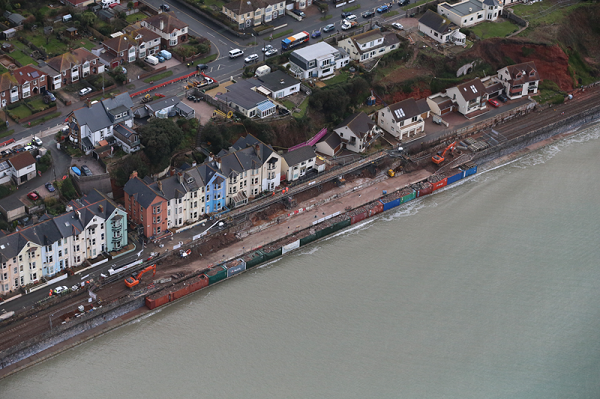
Dawlish repairs to be completed two weeks early

Dawlish RepairsPhoto from Network Rail

Easter holiday boost for south-west as Network Rail confirms Dawlish railway reopening.

Network Rail today announced an accelerated date for reopening the Great Western Main Line through Dawlish, reconnecting West Devon and Cornwall to the national rail network – Friday 4 April, almost two weeks earlier than the previous mid-April estimate.

Innovative approaches to sea defence and round-the-clock working by a team of more than 300 engineers have already seen huge amounts of rebuilding work completed along the damaged seafront. The main 100m breach has been repaired with nearly 5,000 tonnes of concrete and 150 tonnes of steel, and a new 200m track is ready-built for installation.

A tremendous job by Network Rail engineers working in very difficult circumstances.

Posted in Travel & Transport | Tagged | Comments Off

Storm Damage at Dawlish

Dawlish Damage(Photo from National Rail)

Dawlish has taken a battering in the latest storms. Marine Parade is a mess with ballast washed into the road and rails ripped up, part of the wooden station platform has been destroyed, and worst of all, there’s a 90 foot breach in the sea wall east of the station leaving the tracks suspended in mid-air.

Looking at the picture above, I can see why there are estimates of the line being closed for up to two weeks.

Here’s the same location in happier times. The middle coaches of the train are at the point of the breach in the wall.

Photo & Video Sharing by SmugMug

With global warming bringing more storms this is only going to get worse. In the long term it may prove necessary to abandon this exposed coastal section and construct a new alignment further inland. In the shorter term I think it’s time to look at reinstating one of the two alternative routes closed in the 1960s as diversionary routes for whenever the main line is closed.

While the branch from Exeter to Newton Abbot via Heathfield may never have been viable, it does look as though closing the former Southern Railway line from Exeter to Plymouth via Okehampton and Tavistock was a very short-sighted decision.

According to Nigel Harris of Rail on Twitter, the estimated cost of rebuilding the old SR route is £250 million. The cost to the south-west’s ecomomy of having the Great Western line closed for the extended period over which it’s likely to be closed has been estimated at £500m. I think you can do the sums.

Posted in Travel & Transport | Tagged , | 2 Comments