Travel & Transport Blog

Never forget whole purpose of railways is to transport people and good from A to B. This sub-blog covers things like railway history, transport politics and book reviews.

Network Rail suspends West Coast Railways

West Coast Railways (Wikimedia Commons) West Coast Railways have had their operating licence suspended following a signal passed at danger resulting in a near miss from what might have been a very serious collision.

As the RAIL piece says:

Network Rail has served West Coast Railways with a suspension notice effective from midnight on April 3.

It follows the Signal Passed at Danger (SPAD) on March 7, when a 100mph collision between a First Great Western High Speed Train and a steam excursion operated by WCR was missed by barely a minute. The SPAD ranked as the most serious this year.

This is an unprecedented suspension. Operators have been banned from certain routes, but this is the first total network ban since privatisation, indicating the gravity with which Network Rail is treating the incident.

West Coast Railways provides crews and motive power for charter trains across Britain, including the well-known Fort William to Mallaig run, and this suspension is likely to force the cancellation of many steam specials on the main line in the coming weeks. Two scheduled for this coming bank holiday weekend have already been cancelled.

There have been incidents where a bus company has had its licence suspended after a fatal accident revealed serious issue with driver training and the roadworthiness of their vehicles. But nothing like this has ever happened on the railways.
Posted in Travel & Transport | Tagged , , | Comments Off

Froxfield – A Near Miss

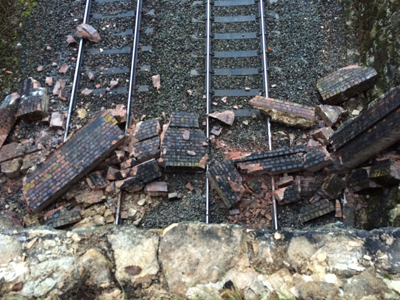
From the Rail Accident Investigation preliminary report when a heavily loaded HST struck debris on the track, and came very close to derailment at 95 mph.

The bridge parapet had originally been struck at about 17:20 hrs by a reversing articulated lorry. The lorry driver had turned off the A4 at a junction just north of the railway bridge, and crossed over the railway before encountering a canal bridge 40 metres further on which he considered to be too narrow for his vehicle. A pair of road signs located just south of the A4 junction warn vehicle drivers of a hump back bridge and double bends but there were no weight or width restriction signs. The lorry driver stopped before the canal bridge and attempted to reverse round a bend and back over the railway bridge without assistance, and was unaware when the rear of his trailer first made contact with, and then toppled, the brick parapet on the east side of the railway bridge. The entire parapet, weighing around 13 tonnes, fell onto the railway, obstructing both tracks

This was the same type of train travelling at the same speed as in the 2004 Ufton Nervet crash in which the train driver and five passengers died. What happened at Froxfield was a narrow escape from what could have been a similar disaster.

It was predictable but disappointing that lorry drivers on a forum I won’t name were keen to shout down any criticism of the driver. If you suggested that someone who recklessly endangered several hundred lives be prosecuted, you were compared with Hitler.

I can understand it’s human nature to want to circle the wagons in situations like this, but when the safety of the public is at stake the idea that “armchair critics” must not comment on “professional issues” is dangerous bullshit. As the saying goes, you don’t need to be a chicken to know when the egg is rotten.

The professionalism (or lack of such) of the road haulage industry is the business of everyone who shares a transport environment with them. Don’t let anyone persuade you otherwise.

Posted in Travel & Transport | Tagged , | Comments Off

Five of my Favourite Bridges

Liberal England is trying to resurrect the old fashioned blog meme with “Five of my Favourite Bridges“.

Not that it’s easy to pick just five, but here are five that have made an impression on me over the years.

Photo by Geoff Shepherd/Wikipedia
(Photo by Geoff Shepherd/Wikipedia Commons)

The Royal Albert Bridge

We’ll start with Brunel’s famous bridge across the Tamar linking Devon with Cornwall. Because the approach spans are on a tight curve with a 15mph speed limit you get a good view of the bridge from the train window while crossing it, and the low speed does make it feel like you’ve crossing into another country.


(Phoro by E Gammie/Wikimedia Commons)

Barmouth Bridge

Back in the late 1970s the timber viaduct across the Mawddach estuary was being eaten by worms, and the cost of repairs was used as justification to close the Cambrian Coast railway, which was said to be losing too much money. But wiser councils prevailed, the bridge was repaired, and it’s still possible to travel by train up the top left-hand corner of Wales. Crossing the bridge at high tide it feels like you’re on a boat rather than a train.

The Globe Inn in Lostwithiel, viewed from across the river in the evening light.

Lostwithiel Bridge

The only non-railway bridge of the five. This medieval pack horse bridge across the river Fowey links the railway station to the pub, neither of which existed in the 13th century when the bridge was first built. But what more can be asked of any bridge?

A pair of BLS

Tellenburg Viaduct

Switzerland is full of spectacular railway engineering, and this graceful viaduct is a faviourite of mine. It dates from 1915, built to carry the Bern Lötchberg Simplon main line across the Kander valley a mile south of Frutigen. The rather more utilitarian concrete structure alongside is a later addition, built in the 1970s when the railway was doubled to cope with increasing traffic.

Castlefield Viaduct

Castlefield Viaducts

This is not one bridge but several, and the combination of railway bridges at multiple levels and canal basins forms a kind of Victorian spaghetti junction. Some of the railway viaducts are still in use, one has been reused to carry the trams of Manchester Metrolink, though the most impressive one visible in the background has been disused since 1969, and now has trees growing on it.

What are your five favourite bridges?

Posted in Memes, Travel & Transport | Tagged , | Comments Off

Misguided Busways and their Moonbats

Misguided BuswaySo the Institute of Economic Affairs are yet again proposing converting British commuter railways to busways, using reams of dubious statistics gathered from third-world countries that can’t afford rail-based commuter networks to try and make their case.

The one case of a former railway converted to a guided busway in Cambridgeshire is widely considered to be a costly failure, providing none of the benefits of light or heavy rail while sharing all the drawbacks.

Crackpot ideas for converting perfecly good existing railways into private roads have been swilling around in right-libertarian circles and their tobacco industry funded “think tamks” for many years. Back in the 1980s British Rail spent a lot of time and effort refuting their technologically-illiterate nonsense, when there a serious worry these moonbats had the ear of a notoriously rail-hating Prime Minister.

Yet despite being throroughly debunked at the time, much like young-earth creationism, the bad idea stubbornly refuses to die.

Can they seriously never have noticed the public’s reactions whenever the words “Rail replacement bus” are heard?

What is it about these cranks? It makes you wonder if these people have never quite got over not getting a train set for Christmas when they eight years old. Or perhaps they used to get beaten up by train-spotters at school?

Posted in Travel & Transport | Tagged , , , | 2 Comments

Old and New

Trams 12 and 19 side-by-side at Priestfields, between Bilston and Wolverhampton

Old and new West Midlands Metro trams side-by-side at Priestfields, Wolverhampton. Thanks to the driver who saw me taking the photo and stopped the tram with two vehicles side-by-side.

It’s a sign than the renaissance of urban light rail has come of age when we’re now seeing the first generation of trams being replaced, even though their age is a fraction of the 30+ year economic life expected from heavy rail rolling stock. No idea whether then 1999-built AnsaldoBreda T69s will be offered for sale or scrapped.

Posted in Railway Photography, Travel & Transport | Tagged | Comments Off

Nick Clegg does not like class 142s

Northern Rail 142s at MiddlesboroughAs reported in BBC News, Nick Clegg does not like Pacers

“There are thousands boarding these so-called ‘pacer’ trains. There is nothing pacy about them at all. They are cattle trucks on wheels”.

Known by some as “Nodding Donkeys” due to their pitching motion when travelling at any speed, these trains have passed their original 20-year design life by many years, and have been in service for longer than the worn-out Modernisation Plan DMUs they were built to replace.

Clegg claims southern commuters would never have stood for the things. Well, not in the south-east anyway. A few years back First Great Western needed extra rolling stock to ease overcrowding, and a handful of hand-me-down Pacers were the only trains available. They spent a couple of years in south Devon before FGW managed to get hold of some class 150 and 153 sprinters displaced from the West Midlands, and the Pacers were sent back to Northern Rail where they’re still running today.

Had First Great Western allocated them to the London end of their network and put them to work on the Thames branches, what on earth would the blue rinse types of Henley made of them?

Posted in Travel & Transport | Tagged , | 4 Comments

When the customer changes the requirements

Before the customer added a requirement

This must be a familiar situation to any software developer. You come up with a clean, elegant design that meets the customer’s stated needs. Then at the last minute they come up with a new requirement.

After the customer added a requirement

So you end up with this. Someone I won’t name has described it as looking like “the world’s most disturbing sex toy”.

Coming up with an elegant way to add a corridor connection on the front of a train is a challenge that’s defeated generations of industrial designers. Even the better results have been functional rather than beautiful. But it does help if the door at the front had been a requirement from the start.

(Photos from Transport Briefing)

Posted in Testing & Software, Travel & Transport | Tagged , | Comments Off

Slumbering Dragons and White Elephants

The A recent Guardian piece on Welsh nationalism highlights the fact that the only major road linking south Wales and north Wales is the single-carriageway A470, “slowed to a crawl by tractors and hay wagons“, and touches on the complete lack of a north-south railway link within Wales.

In fact, there never has been a north-south main-line railway within Wales. It’s true that up to the 1960s it used to be possible to travel across Wales without passing through England, but those north-south lines were really little more than a network of local routes. What little long-distance traffic they did carry was mainly between regions of Wales and north-west England. All of them were winding single-track affairs unsuitable for high speeds or heavy traffic, not that there was much volume of traffic to start with. It was little surprise that the lines linking Afon Wen to Bangor, Carmarthen to Aberystwyth, and the meandering route from Merthyr to Moat Lane all succumbed to the Beeching axe. The only reason the Central Wales Line didn’t join them was that it ran through too many marginal constituencies.

There have been suggestions for reopening the Carmarthen to Aberystwyth line, so that it would be possible to get from Cardiff to Aberystwyth without having to pass through England. But would that journey actually be any quicker than the existing route via Shrewsbury?

A more outlandish suggestion in the comments was for an “east border” line route running along the Welsh side of the border. This would be little more than a pointless duplication of the existing Welsh Marches line that runs along the English side of the border via Hereford, Ludlow and Shrewsbury, a line that as far as rail franchises go is treated as part of the Welsh network anyway. There is no economic point building a second, parallel line just a few miles further west for purely political reasons. It would be an equivalent of the Wutachtalbahn in Germany, built for military reasons purely to avoid passing through Swiss territory.

The best way to improve rail links between north and south Wales would be to upgrade the Welsh Marches line to allow higher speeds and increased capacity. It’s just that some people might balk at spending money on infrastructure in England even if it’s for the benefit of Wales.

The truth is that Wales exists as a nation culturally, but doesn’t really function as nation economically. With half the Welsh population living close to the English border, much of Wales has far closer economic ties with neighbouring English regions than with distant parts of Wales, and transport links reflect this. Pragmatic Welsh nationalism needs to accept this reality, and abandon pipe-dreams about ambitious north-south transport links that make no economic sense and will prove to be little more than costly white elephants.

Posted in Travel & Transport | Tagged | 1 Comment

Cornbrook to Manchester Airport in two-and-a-half minutes

A driver’s eye view of the latest extension of the Manchester Metrolink network. It starts off along the long-established Altrincham line before crossing over to the re-used formation that once carried the Midland Railway main line out of Manchester Central towards London. We then branch off to the all-new formation with several street-running sections before terminating alongside the existing heavy rail terminus at Manchester Airport.

Posted in Travel & Transport | Tagged , | 1 Comment

Cambrian Coast Line Reopens

The new bridge at Pont Briwet (photo from Network Rail)
(Photo from Network Rail)

The Cambrian Coast railway is now re-opened with trains again able to run the full length of the line following completion of the railway part of the new bridge at Pont Briwet just south of Penrhyndeudraeth.

The entire line was forced to close following the severe storms in January. The southern section reopened in stages during the spring following repairs to the sea defences at Tywyn and Barmouth, but until now trains had been unable to run north of Harlech due to the ongoing bridge reconstruction work.

The reopening means that Porthmadog, Cricceth and Pwllheli are once again connected to the main line rail network, although it was still possible to reach Porthmadog via the narrow-gauge Ffestiniog Railway.

The fact that there was never any doubt over the line’s future says something abou the change in political climate towards rail over the past couple of decades. Back in the early 1970s the line was under thread of closure; indeed it got as far as closure notices posted at stations. At the end of the decade the future again hung in the balance as the mile-long Barnouth Bridge was being eaten by worms. But today, although it still runs at a loss, it’s recognised as being an important part of a regional economy that relies heavily on tourism.

Posted in Travel & Transport | Tagged , | Comments Off