Travel & Transport Blog

Never forget whole purpose of railways is to transport people and good from A to B. This sub-blog covers things like railway history, transport politics and book reviews.

Driverless Cars and Predicting the Future

There is a lot of hype about driverless cars swirling around the interwebs at the moment, but this piece of pseudo-utopian nonsense is ridiculous by any standards.

When he simultaneously talks about wholesale destruction of industries employing millions of people while declaring it’s a great time to be alive, it really does speak volumes about the combination of utopianism and sociopathy that Silicon Valley is notorious for. He does come over as someone who’s read way too much Ayn Rand.

For starters, the idea that driverless cars will make existing mass-transit obsolete and “release the prime real-estate occupied by bus stations for other purposes” suggests the author has not experienced any kind of urban environment other than the low-density suburban sprawls typical of much of North America.

The truth is that nobody really knows how soon this technology will be mature enough for widespread adoption, and what sort of economic impact it might have. We’ve had the technology for fully-automated trains for almost half a century now, but it’s not been adopted beyond a very small number of closed systems. Perhaps the evangelists for self-driving cars ought to investigate why?

Predictions of the future when potentially disruptive new technologies emerge usually turn out to be wrong.

The most ridiculous thing I’ve ever read on the subject has to be the idea that driverless vehicles will open up the industrialisation of sub-Saharan Africa through columns of automated trucks trundling across the Sahara delivering African-made goods to Europe. It never seemed to occur to them it would merely replicate what was feasible using 19th century technology in the shape of a railway. But no trans-Saharan railway has ever been built or seriously proposed, because there’s never been enough economic demand for one. It’s far easier to ship goods from Africa to to the nearest port and send it by sea.

Posted in Travel & Transport | Tagged , , | Comments Off

Farewell King Coal

Farewell King Coal

Poignant photo (taken from Facebook) from Ferrybridge signalbox marking the final shift at Kellingly Collery, the last deep coal mine in Britain.  The end of an era.

The histories of the British coal and railway industries have been intertwined from the very beginning. The first railways were built to carry coal. If you look at a historial rail atlas, all of Britain’s major coalfields were covered in a maze of lines, most of them now long closed.  Even after privatisation, coal was still one of the major freight traffics on the network.

The railways still carry a fair bit of coal, mostly foreign imports plus a handful of opencast mines in Scotland and Wales. But as CO2-emitting coal-burning power stations are being phased out it’s already in steep decline. Relatively new bogie coal wagons are  starting to go for scrap because there’s no longer enough work for them.

The closure of the last deep pit marks the beginning of the end.

Posted in Travel & Transport | Tagged | Comments Off

ORR prosecutes West Coast Railway Company

That thump you heard was the sound of The Book being thrown at The West Coast Railway Company.  ORR is to prosecute over the incident at Wootton Bassett

The Office of Rail and Road (ORR) has today started criminal proceedings against train operator West Coast Railway Company Limited (WCRC) and one of its drivers. The charges relate to breaches of Health and Safety Law which led to a train passing a signal warning at danger on 7 March 2015.

The prosecutions follow ORR’s investigation into an incident involving a steam locomotive operated by WCRC, which passed a signal at danger near Wootton Bassett junction, Wiltshire. This extremely serious incident resulted in the train coming to a stop 550 metres after the signal, across a busy junction on the Great Western main line, directly in the path of high speed trains.

The train’s driver is facing charges under section 7(a) and 8 of the Health and Safety at Work etc. Act 1974 (HSWA). This relates to his alleged intentional misuse of the Train Protection and Warning System (TPWS) equipment. ORR’s investigation found that the driver directed a colleague to turn off this essential safety system, designed to apply an emergency brake if the driver makes an error.

WCRC is separately facing charges under section 3(1) and 2(1) of the HSWA. This is on account of its alleged failure to implement managerial controls, procedures, training and monitoring to prevent staff turning off the TPWS equipment.

ORR has been closely monitoring WCRC’s operation since this incident. ORR has also today launched a review of WCRC’s safety certificate, which is needed to operate its trains on the rail network.

This comes after the West Coast Railway Company had it’s steam operators’ licence suspended a second time after another incident in which a driver isolated the TPWS system on a moving locomotive hauling a train carrying passengers.

Posted in Travel & Transport | Tagged | Comments Off

The Wootton Bassett near-miss

Battle of Britain Pacifit "Tangmere"(Wikimedia Commons)

The official report into the near-miss at Wootton Bassett (pdf) makes interesting reading, and demonstrates what I’ve often said about rail and air accident reports making useful reading for software testers.

In this case there were no injuries or indeed any damage to the train, although it could have been a very major accident; a collision at high speed with one train formed of 1950s-design rolling stock that doesn’t have the crashworthiness of modern trains.

The immediate cause of the incident was blatant disregard of rules and procedures which rightly raised questions about the levels of training and safety culture, so it wasn’t really a surprise that the operator’s licence was suspended.

Aside from the chain of events that led to the train overrunning a red signal, what makes it a worthwhile read is the details of how modern automated safety systems interface with literal steam-age techology in the shape of a 70-year old steam locomotive. It also highlights some user interface issues with the controls within the locomotive cab.

Posted in Testing & Software, Travel & Transport | Tagged | Comments Off

The Queen Opens The Borders Railway

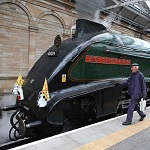
Union of South AfricaGood to see The Queen celebrating becoming Britain’s longest reigning monarch by taking Nicola Sturgeon on a train ride pulled by a locomotive whose name includes the word “Union”. I’d love to know if she had any influence in choosing No 60009 “Union of South Africa” as the locomotive to pull the train.

The Borders Railway, which runs for more than 30 miles from Edinburgh to Tweedbank via Galashiels is the most ambitious railway reopening project to date. The original line, the former Waverley Route, ran from Edinburgh through Galashiels and Hawick to Carlisle. It was one of the last and most controversial of the sixties Beeching closures, wrongly considered an unnecessary duplication of the existing west coast main line despite being an important link for communities along the route.

Hopefully Tweedbank will only be the temporary terminus, and the line will be extended in due course to Hawick and beyond. Will The Queen still reign when 60009 steams beyond Tweedbank towards Carlisle?

Posted in Travel & Transport | Tagged | 3 Comments

No Security Theatre on the Railways

SNCF "Sybic" on a Basel-Brussels international working at Luxembourg

Following the foiled terrorist attack on an interational train on the border between Belgium and France, there’s a worry that opportunistic politicians will propose airport-style security theatre for rail travellers. Anyone who actually cares about rail travel must resist and oppose such proposals by every means possible.

It’s not just that such things have the potential to make rail travel as miserable an experience as air travel has become post 9/11, but they would completely ineffective when it comes to saving actual lives. All it will achieve would be to make would-be terrorists find other softer targets. We learned that lesson fighting the IRA in the 1970s.

At worst, degrading the passenger experience of rail travel would encourage a proportion of travellers to take to their cars instead, and a proportion of them would then die in additional road accidents. Even if that doesn’t happen, how about multiplying an extra 30 minutes enforced check-in time by the many millions of rail journeys a year. Just how many lifetimes’ worth of wasted time will that add up to? All for something which will achieve precisely nothing.

It goes without saying that any politician advocating such things as policy guarantees that their party will never get my vote.

Posted in Travel & Transport | Tagged | 3 Comments

A Runway for the 1%?

Sometimes the arguments used in favour of something can be the best arguments against that thing. For an example, see this press release I received about the expansion of Heathrow Airport:

A significant amount of time, effort, and energy has been spent at arriving at the conclusions. Strong account has been taken with the need to meet EU air pollution limits, address noise pollution concerns and move most ground traffic from road to rail. What must happen is action by the politicians: further delay would significantly damage UK plc.

In context, the UK has not built a full-length runway in the South East since World War 2. Our neighbours in the EU have overtaken us – Frankfurt, Paris, and Amsterdam already have much more runway capacity. What this means is that we’re losing out in the global connectivity race: Paris already offers 50 per cent more flights to China than London, for example. This is significant, because by 2025 there will be 7,000 new $1bn companies globally, and nearly 7 in 10 will be in emerging economies. If we want to connect with these we have to act.

With the world’s biggest cities planning 50 new runways by 2036, allowing for 1bn new passenger journeys, we simply can’t afford any further political delay. Given that Dubai will soon have more capacity than all of London’s airports combined, it is clear that expansion of airport capacity in the South East is a must. The world is watching to see if London and the UK has the ambition to maintain its position as a Global trading hub – we’re losing ground to our competitors, and further political delay would be unacceptable.

I find this self-serving corporate-bureaucratic bullshit a lot more offensive than Anglo-Saxon terms for bodily functions used as expletives. Look at the way it glosses over the environmental impact with meaningless empty platitudes, and says nothing at all about how it might affect the lives of ordinary working people. It’s clearly not about the transport needs of the those who actually live and work in the south-east of England, let alone the rest of the country. It’s all about “competing as a global hub”. Who cares how many runways they have in bloody Dubai?

The whole thing speaks volumes about the worldview of big money. The only people that matter are the global elites who owe no loyalty to any nation or culture. The same people who are slowly and steadily turning London into a soulless corporate wasteland filled with luxury apartments that they occupy for a few weeks a year while ordinary Londoners are relentlessly priced out of their own city. The people who only see the rest of us through the tinted windows of the chauffeur-driven cars, except then they’re barking orders to the staff in expensive restaurants.

Screw these people. And if their needs are really the main thing  that’s driving the demand, screw their runway as well.

Posted in Travel & Transport | Tagged , , | 4 Comments

Electrification Postponed: Echoes of 1963?

Midland Main Line 222 Meridian

So the government have postponed the Midland Main Line and Trans-Pennine electrification schemes amidst suggestions that the high-profile Great Western electrification is running seriously late and way over budget.

Given the Tories pre-election promises it’s looking like their equivalent of the Liberal Democrat’s tuition fees débâcle, at least on the surface. So much for the “Northern Powerhouse”. Though in this case, since it’s widely suggested that there were plenty of warning signs that the GW project was in trouble, but bad news was being deliberately suppressed prior to the election. Which means the charge against the Tories one of deliberate lying rather than broken promises.

There is horrible echo of the 1963 appointment of Dr Beeching in response to the cost overruns of the 1955 modernisation plan, though in a time where passenger numbers are rising year upon year we’re unlikely to see Beeching-style closures. The 1955 plan was a crash programme following years of under-investment on a network that had never really recovered from being run into the ground during World War 2. It involved a lot of new and untried technology, much of which wasn’t terribly successful, from manufacturers who seemed to be chosen as much because of politics than their expertise. A lot of money was misspent, both on unsuccessful locomotive designs and on vast freight marshalling yards which soon turned into massive white elephants. And let’s not mention the unspeakable horror that is Birmingham New Street station.

Likewise we’re now playing a heavy price for the lack of any large-scale electrification schemes since the late 1980s East Coast Main Line, a full generation ago. Paul Bigland describes it well: The Labour government from 1997 to 2010 believed there was no need for electrification because some magical new technology was just around the corner. So the British railway industry lost the skills base necessary for such large and complex engineering projects, which is one reason the Great Western scheme has run into such difficulties. It’s just the same as the stop-start-stop approach to rolling stock procurement has decimated Britain’s train manufacturing industry. We’re now importing locomotives and multiple units from America, Spain, Germany and even Japan because British works went out of business during lean years.

A more rational approach would have seen a slow but steady rolling programme of electrification over the past four decades; as one project finished the teams would move on to the next, and lessons learned in past projects applied to future ones. The Midland and Transpennine routes would have been electrified years ago, along with other trunk routes who’s electrification isn’t even on the horizon.

One final point. A lot of ill-informed commentators with political axes to grind are now claiming that the MML and TPE schemes are being scrapped in order to save HS2. Paul Bigland again skewers this argument as complete cobblers, emphasising the fundamental difference between upgrading existing lines and building brand new infrastructure. And yet again the anti-HS2 mob have no answer to the fundamental rationale behind HS2, the lack of capacity on existing routes heading north out of London.

Posted in Travel & Transport | Tagged , , , , , | 2 Comments

Pacers still doomed in the North

Northern Rail's 142020 at Middlesborough. These things, bane of Northern England's commuters have long since exceeded their original 20-year design lives, but there is no replacement for them in sight.

Rumours that Northern Rail’s passengers might have to endure thirty-year old four-wheeled bus-derived Pacers for a good few years yet may be ill-founded.

In an annoucement that that’s a superb example of what Neal Stephenson’s novel “Anathem” described as “Bullshytte, Rail Minister Andrew Jones is quoted in Rail,

“All Pacer vehicles on the Northern franchise will be withdrawn by 2020 due to incompatibility of the Pacer vehicles with the vision for economic growth and prosperity in the North, as per the announcement by the Secretary of State in February 2015.”

No doubt one or two of these almost universally unloved vehicles will be preserved. And it wouldn’t surprise me in the least if their replacements turn out to be Vivarail’s D-Train, rebuilds of redundant London Underground District Line trains which are actually slighly older than the Pacers.

Posted in Travel & Transport | Tagged , , | Comments Off

100 Years Ago Today

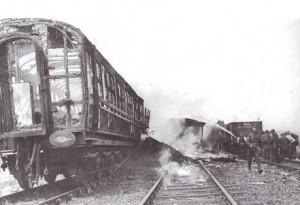
Quintinshill Today is the 100th anniversay of Britain’s worst even rail disaster at Quintinshill in Scotland, where 226 people perished in a double collision and fire, a result of criminal negligence by two signalmen.

Most of the dead were soldiers of Royal Scots en route to Liverpool bound for Gallipoli. Their troop train, composed of elderly wooden-framed coaches, collided head-on with an early morning local train. Moments later a northbound sleeping-car express ran into the wreckage. Fueled by escaping gas from the gas-lit coaches, the whole wreck caught fire.

The National Railway Museum blog has a piece about the disaster.

While the disaster is well-known in railway circles, it’s rather disappeared down the memory hole with the general public. It doesn’t loom nearly as large as the second-worst disaster at Harrow & Wealdstone in 1952, or even the Tay Bridge disaster of 1879. Probably the fact that it happened during wartime and the vast majority of dead were soldiers is a major factor.

Posted in Travel & Transport | Tagged | 1 Comment