Travel & Transport Blog

Never forget whole purpose of railways is to transport people and good from A to B. This sub-blog covers things like railway history, transport politics and book reviews.

When will people realise that higher and higher train fares aren’t “investment in better services” but the entirely avoidable overheads of the cumbersome structure of the privatised railway?

Posted on by Tim Hall | Comments Off

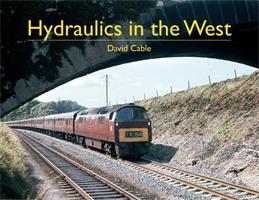
Book Review: David Cable – Hydraulics in the West

The early years of the diesel hydraulics in the west of England weren’t covered that well by photographers. With steam banished west of Exeter as early as 1962. most railway photographers spent the next six year chasing the remaining “kettles” in other parts of the country, leaving the early years of fully dieselised areas under-recorded. A pity, because this was a fascinating era, with much of the old steam-era railway surviving with little change other than the presence of diesel locomotives at the front of the trains. Which is why a book like this is very welcome indeed.

All the diesel-hydraulic classes feature quite extensively with the exception of the class 14s, with Warships and D6300s featuring particularly heavily. A few of the photos leave something to be desired on a purely technical level. With quite a few grainy photos, faded negatives and shadow-side shots this is not a book to blow many people away with stunning photography. But it more than makes up for this with the historical interest, which is surely why those less-than-perfect images were included. This isn’t to say all the pictures are poor; I love the atmospheric shot of a Warship on china clay coming round the curve from St.Blazey at Par. There are one or two howlers in the captions too; at one point, what’s described as a parcels train looks remarkably like a couple of breakdown train tool vans to me.

The vast majority of photos date from the 1960s, showing not just the express passenger workings on the West of England Main Line, but a lot of freight and branch-line workings that far too many photographers ignored. There are plenty of photos showing all or most of the train formation rather than the standard three-quarters views of the loco. This sort of thing is very useful for modellers; in the early 60s many second-string passenger workings used a real mix of pre-nationalisation coaching stock rather than uniform Mk1s. There’s even the odd pre-grouping vehicle in one photo of a SR Plymouth to Exeter working! There’s some real oddballs here too. How about a six-car “Silver Pullman” piloted over the south Devon banks with a Western? In the snow, as well. Or a rake of 1960s Metro-Cammell Pullmans in umber and cream at Truro behind a maroon Warship?

Some very interesting shots on the branches. Not only have we got D600s on china clay workings, but D6300s on the Kingsbridge and Helston branches during that brief period between the end of steam and complete closure. One that gets me is double-headed D6300s on the St Ives branch, looking for all the world as if it’s the West Highland line in Scotland until you look closely and realise the two North British locomotives aren’t class 21s but their diesel-hydraulic equivalents.

If you want a book filled entirely of technically stunning photos, you may well have reservations about this volume. But if you’re interested in a rather neglected period of British railway history, especially if you’re modelling that era, this book is for you.

Posted in Travel & Transport | Tagged , | Comments Off

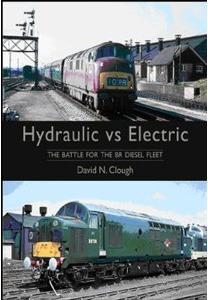
Hydraulic vs. Electric – The Battle for the BR Diesel Fleet

There are two prevailing myths about the Western Region’s diesel hydraulics locomotives. The first, propagated by partisan anti-Swindon types is that the whole project was a disastrous failure motivated by ex-GWR types wanting to be different purely for the sake of it. The second, propagated by Swindon’s own fans, is that the decision to phase out the diesel-hydraulics was a purely political one, intended to curb the Western Region’s independent spirit.

Written with the assistance of senior engineers from both BR’s Western Region, and from Voith, in this book David Clough attempts to reveal the some of the truth behind the myths. The story that emerges turns out to be a lot more complex.

David Clough starts with the early history of diesel traction in the UK, going back to the days of the Big Four and covering technological dead-ends such as the GWR gas turbines and infamous Fell diesel-mechanical No 10100, which gets an entire chapter all to itself. We then get an overview of the experience of diesel-hydraulics in Germany, which gives us the background to the choices faced by British Railways in 1955 when they decided to embark on a crash course of dieselisation.

The meat of the book covers the design and service lives of the locomotives themselves, comparing the Western Region’s hydraulic fleet with the equivalent diesel-electrics delivered to other regions, and later to the Western Region itself. A major conclusion is that, despite what’s often been written, there’s little evidence of any inherent superiority for either diesel-electrics or diesel-hydraulics transmissions, and there was a much greater difference between successful and unsuccessful designs with the same type of transmission. Of the diesel-hydraulic designs, the Westerns come in for a lot of criticism over design flaws that dogged them throughout their lives, and it’s suggested that this is a major cause of the diesel-hydraulic’s poor reputation in some quarters. In contrast, the Hymeks in particular emerge as successful and reliable locomotives, bettered in their power class only by English Electric’s class 37s.

Some of the less successful diesel-electric classes get off lightly. The ill-fated North British class 21s do get a mention, along with the fact that some got rebuilt at great cost with Paxman engines only to be outlived by their hydraulic equivalents equipped with troublesome original MANs right to the end. But the failure of classes like the Metrovick Co-Bos and the Baby Deltics is rather glossed over, and the fiasco of the Clayton class 17s, which numbered over 100 yet had shorter lives than any hydraulic classes doesn’t even get a mention. The class 24s/25s, numbering over four hundred yet withdrawn after working lives of under 20 years, little more than the longer-lived hydraulics, only get mentioned in passing.

In the end, the real reason for the premature withdrawal of the Western Region’s diesel hydraulics turns out to be a matter of economics rather than politics. The Beeching closures of the mid-60s left the railway with far more locomotives than were needed, and it made economic sense to rationalise both the number of types, and close some works, including Swindon. Had things panned out differently, it’s not inconceivable that some classes, most notably the Hymeks, might have had considerably longer working lives. Some of their German equivalents are still in traffic today.

The book recognises that the story doesn’t end with the withdrawal of the last of the “Westerns” in 1977, but continues into the following decades with the widespread adoption of hydraulic transmissions for the second generation of multiple units. Indeed, the author notes how experiences with the “Westerns” influenced the design of the 125mph class 180 “Adelantes” a generation later. It closes with the fact that diesel-hydraulic locomotives are still being built in Germany, and the age of the hydraulic is far from over.

As is typical in large-format books from this publisher, it’s extensively illustrated, with something like 150 black and white photos, mostly from the 1960s and 1970s.

Available from the Ian Allen website.
Posted in Travel & Transport | Tagged , , | Comments Off

The Week With No Planes

There seems to be no end in sight for the grounding of all aircraft over most of northern, central and eastern Europe because we seem to have upset a Norse volcano-god. Living close to Manchester airport, it’s strange to look up and see an empty sky. I did see one small low-flying light aircraft this afternoon, but you can’t fly commercial jets at treetop height.

Although this natural disaster hasn’t killed anyone, it’s still causing a huge human cost. I know people stranded in Canada, Ukraine and The Maldives at the moment, someone else putting up stranded Americans as houseguests, and someone who runs a cattery who has six customers currently stranded abroad. One wonders what the economic might be if this goes on beyond a few days. It’s quite likely we’ll see some airlines fold.

I’ve heard people saying the government “must do something” to bring stranded passengers home. The trouble is that nobody really has any idea how soon the airspace over Europe will stay closed. If it’s just a couple of days, the best thing is for people to wait and travel as soon as the planes start flying again. If it lasts for weeks, or in the worst case scenario, months, then people are going to have to get home by alternative routes; short-haul passengers by rail and ferry, long-haul passengers to whatever airports are still open just outside the cloud to continue their journeys by land.

I’m wondering how rapidly the rail and ferry operators can increase capacity in the short term if the grounding of aircraft is prolonged. Virgin Trains were operating additional Anglo-Scottish trains on Friday using their Voyager fleet which isn’t fully-deployed on weekdays, and I see that Network Rail have cancelled some weekend engineering blockades on the East and West Coast main lines, to carry the passengers displaced from internal British flights. What about Eurostar? I don’t know to what extent their train fleet is deployed at present, or whether they have the trains or train crews to operate additional services. As far as I know there’s no technical reason why French TGVs or multi-voltage German ICE trains can run though the tunnel into St.Pancras; the sticking point is the possibly over-strict fire regulations for the tunnel (rules that don’t apply to cars and lorries on the shuttles), and presumably the lack of drivers with both route and traction knowledge. And of course there will be plenty of demand for these trains in France and Germany as well.

Time will tell if becomes necessary to start reinstating mothballed rolling stock and ferries to increase capacity.

Posted in Travel & Transport | 2 Comments

The Electric Train from Platform 5 is Running 25 Years Late

So they’ve finally announced the decision to electrify the Great Western Main Line. And they’ve going right through to Swansea rather than stopping at Cardiff, which is a sensible decision. No mention of Plymouth or Penzance, although keeping the wires up on the sea wall might be an engineering challenge!main

While I have to applaud the decision, I do have to ask why this wasn’t done 20 years ago. The last major electrification project was the East Coast Main Line, which British Rail completed in 1988. So why did they disband the electrification teams rather than carry on with the next project.

In retrospect, the answer is simple: Privatisation happened.  Because of the ideologically-driven need for short-term profits, it was no time for long term investment projects. So Britain continues to lag behind the rest of Europe, with a significant proportion of main line trunk routes operated by diesels.

The other electrification project announced is the George Stevenson’s Liverpool to Manchester line, opened in 1830 as the first main line in the world.  At first glance this is an odd choice; the only trains using it’s entire length nowadays are a handful of local trains; even the Liverpool to Manchester expresses use another route. But at Newton-le-Willows there are connections both north and south with the main London-Glasgow line. These connections will enable electric to run directly between Liverpool or Manchester to Scotland, and serve as a diversionary route between Liverpool or Manchester to London when the more direct routes are closed for engineering work.

So hopefully we’ll see the end of the class 185 “Lardarse Express” diesel trains operating under the wires for 90% of the journey on Manchester to Edinburgh services. Although seeing Virgin Trains using diesel Voyagers 100% under the wires between Glasgow and Manchester doesn’t exactly convince sceptics of the value of electrification.  Neither does the percentage of freight on electrified routes hauled by diesels.

Posted in Travel & Transport | Tagged | 2 Comments

Those Noisy Americans

The train company formerly known as EWS seems to have got itself in a bit of bother over noisy coal trains.

The Falkirk West SNP member said analysis carried out by Falkirk Council showed the night coal runs by freight company DB Shenker were creating a substantial vibration problem.

He said the average vibration level for DB Schenker trains was 0.075 millimetres per second and could reach up to 0.091 mm per second.

That is in contrast to Freightliner Limited trains who also use the route to transport coal to the Fife power station. Tests revealed they created a vibration level of just 0.025 millimetres per second.

Mr Matheson said the different readings could be attributed to the speed of the trains and the different coal wagons used by the companies.

The DB Schenker (ex-EWS) trains use coal hoppers delivered shortly after privatisation to replace life-expired wagons dating from the 1960s. EWS, charismatic leader Ed Burkhart decided to ignore decades of rail experience developed for European conditions in favour of doing everything The American Way. So these new wagons had ‘more economical’ American-style heavy cast bogies rather than the lighter designs favoured up to then in Britain and Europe for a very different rail environment. He didn’t take into account the extra punishment they inflicted on tracks that carry heavy passenger traffic. And I wonder how much environmental noise was ever considered – after all, in America the rails always run though the worst bits of town inhabited by poor people whose opionions tend to be ignored.

Freightliner’s more modern wagons use far more technically sophisticated bogies designed to minimise track wear. And they also seem to be a lot quieter.

Posted in Travel & Transport | Comments Off

Make Your Own Bus Slogan

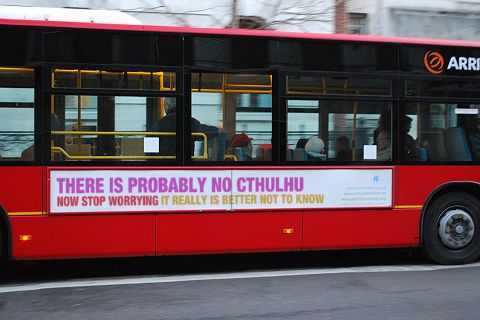
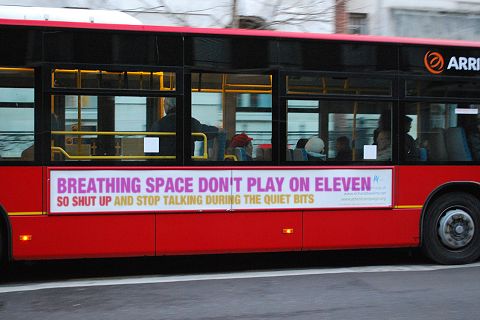
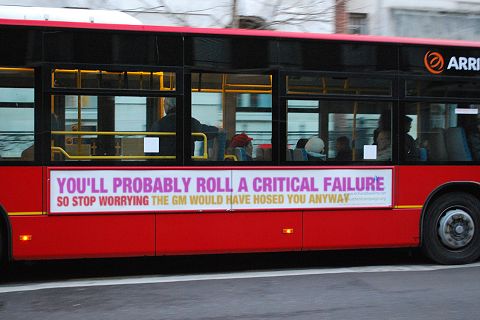
 A web-based bus slogan generator to make your own version of the infamous “atheist buses” you can see in the UK.  Unfortunately the full lyrics of Marillion’s “This is the 21st Century” don’t fit.

We’ll start with the rather obvious H.P.Lovecraft version

One for this Saturday’s gig in Lowdham

 And finally, the obligatory gamer one:

Posted in Games, Music, Science Fiction, Travel & Transport | 2 Comments