Railways Blog

A blog about trains, covering photography, railway history, transport politics and modelling, in no particular order.

25 year rule?

Cold Spring Shops gives an example of the rules for interchange traffic on US railroads

No freight car more than 25 years old may be used for interchange service on the U.S. and Canadian railroads

As far as I know, no equivalent rule exists in Europe, where some quite old equipment is still in use in some places. There are some 1950s Ferry Opens that run though the Channel Tunnel carrying wagon spares, a duty they performed in the days before the tunnel when international traffic went on the Dover to Dunkirk train ferry. There are still an awful lot of 1960s-built HAA 2-axle coal hoppers in service, although EWS are slowly replacing them with modern bogie designs.

There are also a few 1930s(!) SR built “Queen Mary” bogie brake vans in service.

The record for longevity has to be held by four ex GWR “Pollen” wagons, used to carry heavy out-of-gauge loads, and built, I think, in 1906! Probably the fact that they were use so infrequently contributed towards their long life; they weren’t retired until the 1990s, giving them a 90 year working life. All four are now preserved at the Great Western Society at Didcot
Posted in Railways | 1 Comment

This is a test

This is a test to see if I can still post

Posted in Railways | Comments Off

Cutting it fine

When viewing my new home before moving in, I measured the size of the living room to see if my Ngauge model railway layout, which is 12′ long, would fit. Taking a tape measure I found the room to be just under 13′ long

Now I’ve moved in, it’s time to put the layout up. It’s at this point I made an alarming discovery; none of the corners of the room are square! The side I had measured proved to be the long side of the room.

I put up the first two boards, and realised to my horror that there was less than four feet left to the far corner. Taking out the tape measure showed I had just 45 inches in which to fit a four-foot board. Basic arithmetic told me that this will not fit!

Fortunately by repositioning the one of the legs to avoid the corner of the protruding window sill, I could gain another two inches. Still not quite enough. I wondered if it would be possible to hack a couple of inches off the board to make things fit.

Then I remembered. The boards are actually 1200mm in length, not four feet. This is actually 47 inches. The layout just fits, with not a quarter of an inch to spare.

Posted in Railways | Comments Off

The A to Z of Excuses.

We’ve all heard the classic “Leaves on the line” and “Operating difficulties. The uk.railway FAQ now has the A to Z of excuses why your train might be late. Such excuses as “Exploding pidgeon”, “A remarkable lack of investment in the infrastructure of the railway system by government”, and scarily, “This train is delayed as the guard has been taken away by the police” (He was arrested in connection with an excess fares fraud)

No sign of Reginald Perrin’s “Escaped puma at Norwood Junction”, though

Posted in Railways | Comments Off

Australian train crash

BBC NEWS | World | Asia-Pacific | ‘Several dead’ in Sydney rail crash
From the photograph it looks like a 4 car EMU has derailed, with two coaches on their sides and one car (the leading one?) badly damaged, possibly from colliding with the overhead catenery masts.

I hope the death toll is closer to the lower estimate rather than the higher, but this looks like a bad one.

Posted in Railways | Comments Off

It’s not just network rail

From the London Evening Standard comes a story of a nasty ‘bodge job’ on the London Underground

“The repair to the northbound Victoria Line at Victoria has been carried out by bolting a length of hardwood into a section of conductor rail – which is already welded in several places. The upper surface of the wood is not flush with the top of the rail, which has been either crudely ground down in an attempt to achieve a match, or has simply been worn down by train wheels”

Train wheels? Conductor rails? Not a very good example of journalism, and a little on the hysterical side.

Not very good maintenance, but not very good journalism either. But they are taking quotes from experts on the matter.

“Islington housewife Mary O’Neil said: “It is like sticking a plaster on something and hoping it will be all right. I seriously wonder if I should be getting on this train.”

Update: A correspondant tells me this is acutually quite common practice to protect pickup shoes from damage where there’s a break in the third rail, pending a proper fix. Not sure if it’s right to leave something like that for four weeks, though.

Posted in Railways | Comments Off

Central Line shut for two weeks?

According to the BBC, the Central Line is to remain closed for at least two weeks for safety checks on the trains after last week’s derailment.

Despite much media hysteria, nobody was actually killed or even seriously hurt when a motor fell off a coach causing the rear part of the train to scrape along the sides of the tunnel.

Why is it going to take two whole weeks to check the trains are ‘safe’? I’m assuming the dreaded Health and Safety Executive is behind this nonsense, although it might be London Underground protecting themselves from lawsuits. All I can say is the nobody has factored in the number of additional road deaths caused by one of London’s major transport arteries being out of action for so long.

Posted in Railways | Comments Off

If I ran a Train Company

Patrick Crozier has already outlined what he might do if he ran a railway company. Here’s what I might do if I ran one:

  • I would make my timetable robust, optimising for reliability and punctuality. This means I will not attempt to run any services that I didn’t have the rolling stock, the staff and the track capacity to run reliably.
  • When obtaining new rolling stock I will never entertain the idea of ordering large fleets of new trains of a totally untried design straight off the drawing board, with the whole lot due for delivery before the manufacturers have time to iron out the bugs in the design.
  • When taking delivery of new trains I will not dispose of the old ones they replace until I am totally satisfied with the performance of the new trains. Even then I will keep some older trains in reserve in case of unforseen problems or sudden increases in traffic.
  • I will paint my trains in a livery that cries “train”, rather than try to pretend that my trains are buses or aircraft. I will also make every effort to keep them clean both inside and out.
  • I will foster a pride, loyalty and ‘can do’ attitude amongst my staff. I particular I will listen to any new ideas any of them come up with rather than have a ‘thats the way we’ve always done it’ culture.
  • I will consider radical new means of ticketing, such as smart cards for regular passengers that respond to transponders on the trains themselves. If these systems prove successful I will encourage their adoption thoughout the industry, especially for operators that share routes or provide connections with my own trains. However, if David Blunkett asks me to link these smart cards with his stupid national ID card I will tell him to bugger off in no uncertain terms!
  • I will build partnerships with other business whose customers are also my passengers wherever both parties benefit from such an approach.
  • I will have a positive attitude towards rail enthusiasts and the preservation movement.
  • If a public body such as a local government is prepared to give me a subsidy for a service that would otherwise not be economic for me to operate I would take the money!

Posted in Railways | Comments Off

Staffing stations

Patrick Crozier of Transport Blog describes how he’d run a railway. I’m not sure about this bit:

So, tickets and stations. Al Gore said “Every vote must be counted.” I say “Every ticket must be checked.” At the start and end of every journey. It is not simply a matter of preventing fare evasion. Manned stations show that you care about your property and passengers. They also have a role to play in curbing crime and other forms of anti-social behaviour. If I cannot staff a station (even temporarily) then I will not stop at it. If it means asking passengers to get off at a nearby station and putting them in taxis, so be it. If there is a station that proves persistently difficult to staff then I will close it down.

I can’t imagine CrozierRail operating anything outside major conurbations like that. While staffing every station at all times is ideal, in my book an unstaffed station is better than no station. Dumping passengers at the previous stop and sending them in taxis is the sort of nonsense Virgin Trains is rightly castigated for. And I personally find “open stations” where you don’t have to queue at a ticket barrier a far more pleasant passenger environment.

Checking tickets is another matter, but it’s possible to do that on board the train. It’s something some operators seem to be able to do perfectly well, even if others, such as Thames Trains, can’t be bothered.

As for having a staff presence at lesser-used stations, perhaps CrozierRail (or for that matter any real train companies) should look at what happens in Switzerland. I’ve seen some little-used local stations where you buy tickets from the conductor on the train with well-maintained buildings complete with hanging baskets full of flowers! How do they manage this? By renting the station houses to retired railwaymen. The ultimate example of this was Blausee-Mitholz on the BLS between Frutigen and Kandersteg; the station is still immaculately-maintained even though no trains stop there!

Posted in Railways | Comments Off

Farewell, Dreadnought

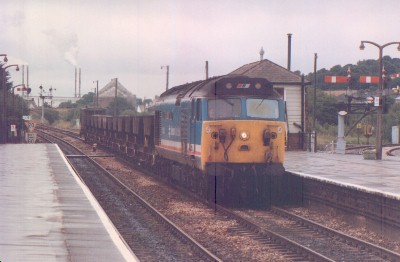
Sad news for class 50 fans. After spending several years slowly rusting away in a Sheffield scrapyard, No 50001 “Dreadnought” has been cut up for scrap. Only twenty-two (at the last count) of the fifty locomotives built now survive, not bad for a class of locomotive officially retired ten years ago. Most of those are in working order, and several are main-line certified.

I took this picture of 50001 hauling an empty ballast train back in 1989, just after the rundown of the class had commenced.

Posted in Railways | Comments Off