Railways Blog

A blog about trains, covering photography, railway history, transport politics and modelling, in no particular order.

Bye-bye Connex

Some context. At the end of the 1990s, Britain’s previously state-owned railway network was splintered into a thousand parts, with many different companies owning the trains, operating them, owning, and maintaining the tracks. And it’s all gone pear-shaped.

French-owned Connex, one of the least-loved train operating companies, has been stripped of it’s franchise. They’d already lost one franchise, South-Central, and now their South-East operation, including many of London’s busiest commuter lines, has gone the same way. Cynics will suggest that Connex were no worse than a lot of other operators, but they had the misfortune to serve an area heavily populated by powerful and influential people, who are better at complaining and live much closer to the political centres of power than the users of someone like Arriva Trains Northern.

Another stunning example of the triumph of privofragmentisation, in which we end up paying more and more (in both taxes and fares) for a service that’s getting worse and worse.

Will Hutton lays into the whole broken system of fragmentation and short-term franchises.

The truth is that if we want a great rail system, we have to have great organisations running it, organisations that are passionate about delivering a great service to their customers and passionate about being railwaymen and women. In the entire debate about the rights and wrongs of rail privatisation, this obvious point is all too rarely made.

The Conservative government under John Major created the current monstrosity because it genuinely believed that just the magic wand of being private and pursuing the profit motive would build dynamic rail organisations. New Labour has been paralysed in devising an alternative system because it genuflects to the same totemic set of beliefs.

If either government – and senior officials – had any understanding of business, they would know that successful businesses are, above all, successful organisations made dynamic by an over-riding sense of purpose at their core. The question that should be asked is whether the current structure of the rail system fosters the growth of great rail companies with such a passionate commitment and sense of purpose. The answer is an emphatic ‘No’.

You cannot build a great rail company if you know that your licence to operate is temporary and if one of the key aspects of your success – the infrastructure of railways, stations and signalling – is outside your control. You are condemned to be a franchisee with a franchisee culture.

From the opposite end of the political spectrum, on Patrick Crozier has this to say:

All this is yet one more block section on the branch line to railway Gotterdamerung. At some point, someone is going to say “enough is enough”. And then what? Railway closures, higher fares, an end to upgrades or maybe a quiet acceptance of a worse service at a greater cost? Or will the real culprit ie fragmentation ie the wheel/rail split be identified? And if it is will anyone have the gumption to stand up to the EU and demand its removal?

Meanwhile, Notwork Rail goes from worse to worse. BBC News has this classic quote:

“The administrators are accountants, they didn’t know very much about running the railway.”

If only the tabloid press had found out about John Major and Edwina Currie in the mid-90s.

But… It’s now six years since that hopeless adminstration was flushed down the toilet of history by the Great British Public. Tony Blair’s New Labour have had six years to sort out the mess, and so far have failed to bite the bullet and reform a fundementally broken structure. Not that we should really have expected anything different :(

Update: Brian Micklethwait has some ideas.
Posted in Railways | Comments Off

Yet more trains

Collected a parcel from John Brightwell today, containing two N-gauge BLS Re465s, 465.001 in plain blue, and 465.004 in “Wallis Tourism” advertising livery, along with some FS and SNCB coaches and a couple of intermodal flats.

It’s time I got a bigger layout….

Posted in Railways | Comments Off

Oops, wrong train.

Steve Karlson of Cold Spring Shops recalls getting on the wrong train at Swindon and ending up in Kemble rather than Reading. Easily done, especially since HSTs look the same at both ends, so you can’t tell which way a stationary one is supposed to be going.

I’ve ended up on the wrong train a couple of times. Ironically, one time was when I was going to Swindon, and boarded a late-running South Wales train instead of the Bristol-bound train I should have caught. I only realised this when the train didn’t start slowing down on the approach to Swindon, and then sailed through the station without stopping.

I eventually had a 90 minute wait at Bristol Temple Meads waiting for a train back to Swindon. I suppose there are worse places to be than Temple Meads on a summer Saturday in 1974!

Posted in Railways | Comments Off

Dodgy Masking Tape?

Ever resprayed a model locomotive, and used dodgy masking tape that pulls the paint off? By the look of this, the same thing happens to full-sized trains as well….

Posted in Railways | Comments Off

Beeching II?

A posting in the SWRG mailing list led me to this article in last week’s Sunday Mirror

ALASTAIR Darling has ordered a “summer summit” to pave the way for the biggest reductions in rail services since the infamous Beeching cuts of the 1960s.

The Transport Secretary is poised to close dozens of branch lines to fund a new rail “super-highway” connecting major cities.

The plan is to be discussed this week, prior to a crisis conference in July when Mr Darling will ask experts to prepare a radical overhaul of the system.

I’m sure I’m not the only person that believes that the financial crisis facing Britain’s railways isn’t because of loss-making rural branches, but the total inability to control the costs of large-scale projects on busy main lines, a consequence of John Major’s hopelessly botched ‘privofragmentisation’, and New Labour’s perpertual failure to recognise just how broken the structure is.

The Sunday Mirror lists the lines ‘under threat’

SCOTLAND

Inverness to Kyle

Inverness to Wick

Helensburgh to Fort William

Helensburgh to Mallaig

Aberdeen to Inverness

WALES

Shrewsbury to Aberystwyth

Shrewsbury to Pwllheli

Heart of Wales line between Swansea and Shrewsbury

Whitland to Pembroke

NORTH OF ENGLAND

Carlise to Carnforth via Whitehaven

Middlesbrough to Whitby

Settle to Carlisle

EAST ANGLIA

Norwich to Cromer

Norwich to Great Yarmouth

Norwich to Lowestoft

Ipswich to Lowestoft

SOUTH OF ENGLAND

Ryde to Shanklin (Isle of Wight)

DEVON AND CORNWALL

Exeter to Branstaple

Exeter to Exmouth

Newton Abbot to Torquay

Liskeard to Looe

Par to Newquay

Truro to Falmouth

St Erth to St Ives

Note that I don’t believe for one minute that the list comes from any official document; my guess it’s the product of Mirror hacks looking at a map. I notice there’s no mention of any branches in the Home Counties.

While I don’t believe every last branch line deserves to exist in perpetuity, and some, like Par-Newquay or the Central Wales line really do need to justify their existance, it should not be for some London-based bureaucrat to decide their fate. That should be up to the people of Cornwall or Wales.

Posted in Railways | Comments Off

The return of Baghdad Bob?

Virgin Trains weren’t quick enough. Looks like he’s working for the American railroad CSX.

Posted in Railways | Comments Off

The politics of transport, again

Ginger has another a good post on the politics of transport in Houston, Texas.

Posted in Railways | Comments Off

Kandersteg

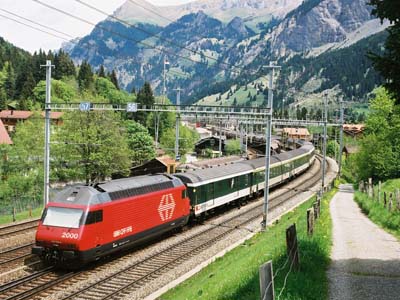
I’ve now got the ten rolls of film from Switzerland back, all scanned onto CDRoms; time to put a few of them up on the web. These are from my first day there, taken in and around Kandersteg, a holiday resort at the top of the Kandertal, and the top of the north ramp of the Lötchberg railway. A mile south of Kandersteg station the line plunges into the 9 mile Lötchberg tunnel, to emerge south of the Bernese Oberland into canton Wallis.

SBB Re460 at Kandersteg

An SBB Re460 heads one of the hourly Basel-Brig Inter City trains out of Kandersteg, formed of a push-pull set of EWiv coaches, with an ex-SNCF “Corail” baggage car behind the locomotive.

The Re460s are the most modern locomotives in the SBB fleet. They dominate inter-city and international passenger trains throughout the country, and also haul a high percentage of freight trains over the steep trans-alpine routes. The stylish design is the work of Italian designer Pininfarina.
Continue reading

Posted in Photos, Railways | 3 Comments

Another black day

Another black day for the rail industry, comparable with the ending of newspaper traffic in 1988, and the closure of the Speedlink wagonload freight network in 1991. The Royal Mail has announced today that it is to stop using the railway for the transport of mail, and transfer all traffic to road and air.

Of course, road transport is only “cheaper” because it externalises a lot more of it’s costs.

It was a lead item on BBC News, and as the EWS press release, EWS are not going to take this lying down.

EWS currently operates a high-speed and high performance rail network throughout Britain that handles 25% of first-class mail. The proposed shift of this volume would add 160,000 lorry journeys, covering 30.5 million miles, per annum, to Britain’s beleaguered road network.

The rail services have achieved high performance levels for Royal Mail. 99.9% of all trains have run over the past 17 months, and Royal Mail train punctuality for this period has been 93.5% against a 95.0% objective. In addition to issues of road congestion, pollution, safety and service reliability, the proposed move by Royal Mail threatens 500 jobs within EWS plus Royal Mail jobs at eight dedicated rail terminals and 27 other loading points across Britain.

Allen Johnson, EWS Chief Operating Officer, said: “We are shocked that Royal Mail is threatening to walk away from the railway. EWS has made numerous competitive price offers in response to changing specifications from Royal Mail. EWS will continue to press the many benefits of rail to Royal Mail as an integral part of the mail distribution solution.”

EWS has had discussions with a number of companies who are exploring mail liberalisation. These discussions have focused on providing a rail-based network for mail distribution, as the companies concerned recognise the problems with increasing road congestion affecting the reliability of a road-based network of operations.

The Royal Mail has been suffering badly from poor management and bad industrial relations; in recent months they’ve blamed late mail deliveries on rail delays, when the real reason has been strikes in sorting offices. I’ve lost count of the amount of first class mail that’s taken four or five days to arrive. I’ve sent birthday presents that have never arrived, presumed stolen by post office sorters.

Time to end their monopoly, it’s clear they don’t deserve it. Let some other company make use of those recently-built mail terminals up and down the country currently used by Royal Snail.

Posted in Railways | Comments Off

Switzerland

I realise I haven’t blogged about my holiday in Switzerland. There will be more when I get my photos back, but in the meantime, some observations about the Swiss transport system.

The trains really do run on time. The whole thing runs like clockwork, and you can actually rely on connections, more than can be said for British trains. In the whole week, only saw a single delay, of ten minutes, and that was the EC “Lötchberg” that had started from Wiesbaden in Germany. Compare that with a glance at the departure board at Stockport the weekend after returning home, with half the trains between thirty and sixty minutes late!

The basic timetable right across the country revolves around hourly services, with express services and local trains making the same connections every hour. For example, Spiez, where I stayed, was the junction of four routes. Every hour four inter-city trains from Basel, Zurich, Brig and Interlaken converged on the station, preceded by local trains from Reichenbach, Interlaken and Zwiesimmen connecting into them. After everything had connected with everything else, the seven trains would depart. For the next hour there would be nothing, then the cycle would repeat an hour later. There were some extra trains on the half hour, such as the odd international train to or from Italy, and some peak hour commuter trains from Bern.

The network of interlocking connections isn’t always perfect. One some routes, such as the Kandertal bus link or the narrow gauge Montreux Oberland Bernois line, the basic interval is two-hourly, not hourly, and you can get stuck with a long wait if you pick the ‘wrong’ hour. This happened to me at Montebovon, junction with the MOB and another metre gauge line, the Gruyere Fribourg Morat, where I had a 50 minute wait. Fortunately the pub was open!

Another thing that struck me was the volume of local freight. Many small stations had local freight depots, and just about every lineside industry has a private siding. I even saw a petrol station in Interlaken West, served by it’s own private siding with a rail tanker being unloaded. Imagine that in Britain! One day I spent a few hours away from the scenic delights of the alps at the busy traffic centre of Olten, nexus of the lines from Bern/Lötchberg, Luzern/Gotthard, Basel, Zurich and Neuchatel/Geneve, where, as well as a very intensive passenger service, there was on average a freight every ten minutes, mostly wagonload traffic.

Then there was the age of a lot of the equipment. The Swiss build trains to last, and look after them. If a locomotive doesn’t last at least 50 years, they don’t consider they’ve got their money’s worth out of them. With the exception of one victim of collision damage, the entire fleet of Ae6/6s, dating from 1952, are still in traffic. Three of the venerable Ae4/4 of the BLS, dating from the 1940s, were hard at work on the Simmental line. On an earlier visit ten years ago, there was still a lot of prewar stuff about, such as the numerous rigid-framed Ae4/7 2-Do-1s dating from 1927, and the BLS’s Ae6/8 1-Co-Co-1s from 1939.

Posted in Railways | Comments Off