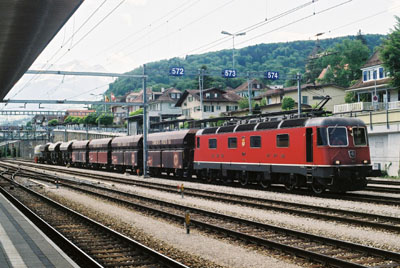
This layout idea is inspired by a combination of the superb ‘Bridport Town’ 7mm scale narrow gauge layout I saw at the Blackburn show, and recent articles in Continental Modeller on the present day Zillertalbahn in Austria. What about a layout based a present day British narrow gauge line with modern equipment, carrying a significant volume of freight traffic? Although most of the real life narrow gauge lines in Britain were originally constructed as mineral railways, all of those that survive are purely passenger operations running as tourist attractions. To come up with a ‘British Zillertalbahn’, we need some alternative history. So, What if the Cornwall Minerals Railway was built to narrow gauge?
The historical Cornwall Minerals Railway was built to standard gauge at a time when the connecting main line of the Cornwall Railway was built to Brunel’s 7′ broad gauge, making it a completely self-contained operation until the end of the broad gauge in 1892. It ran from the port of Fowey on Cornwall’s south coast, to Newquay on the Atlantic coast. The main mineral traffic was (and still is) china clay from the hills north of St Austell, which was exported via the port at Fowey, and to a lesser extent from Newquay. Although the section of line from St Blazey to Fowey closed in 1968 to be converted into a private road, the rest of the line remains in use today for both passenger and freight.
But what if it was built, not to 4’8½” gauge, but to something much narrower, such as 2’6 or 3′. How might it’s history be different? What might it look like today?
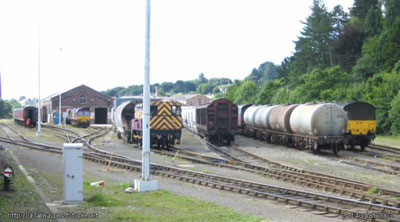
St Blazey Yard: Imagine this in narrow gauge. Photo © Martyn Read
The Imaginary HistoryThe narrow gauge CMR operated most of the same routes as in our own history, including the Stenalees, Retew and Drinnick Mill branches. The GWR built their standard gauge line from Chasewater to Newquay, and it was this line that would carry the heavy summer tourist traffic (and would not close in the 60s as the real line did). The CMR was left with purely local traffic, which withered away from competition with cars and buses. By the mid 30s, passenger had become uneconomic, and ceased, with the line becoming freight-only.China clay traffic on the eastern section of the line remained healthy enough in post-war years, but general freight traffic at the Newquay end dwindled and petered out by the mid 50s, which lead to the section from St Dennis Junction to Newquay being abandoned completely in 1957. The rest of line remained largely steam worked until 1961, when the clay companies that now owned the line were faced with three choices
1) Convert to standard gauge
2) Close it down completely
3) Modernise with new diesel locomotives and modern clay carrying rolling stock
Fortunately for enthusiasts they chose the third option. At the same time, a preservation society entered the scene; they proposed to take over the abandoned northern section and operate it using the soon to be redundant steam locomotives.
It would be another four years until the Newquay Steam Railway opened for traffic. In the meantime new diesel power took over the eastern section from St Dennis to Fowey. Bulk clay to Fowey travelled in a new design of bogie hopper wagons, while clearances on the Luxulyan valley section were enlarged to allow standard gauge wagons to conveyed on transporter wagons, using an interchange at Par.
By the end of the 70s the clay traffic from the Retew branch had dwindled, resulting in end of clay traffic west of Goonbarrow Junction. This enabled the NSR to extend their steam tourist operation over the central section of the line. Finally in 1985 the two companies made an agreement for joint running over the spectacular Luxulyan valley section, initially through to Par, but finally right the way through to Fowey.
So today we have a railway where steam power on passenger traffic rubs shoulders with modern diesels on freight, both block trains with covered hoppers, and modern standard gauge air braked wagons on transporter wagons.
Modelling potential
Any model would have to be set east of Goonbarrow on the section that sees both passenger and freight traffic, unless you’re an American with a basement to spare, in which case you can model the entire line. The headquarters at St Blazey has the most potential; you could model the existing buildings including the superb half roundhouse, although there’s no reason that the track plan need bear any resemblance to the real life standard gauge version.
Motive Power and Rolling Stock
As a narrow gauge line carrying quite heavy mineral traffic, the line could well have seen the largest and most powerful narrow gauge steam locomotives to run on the British mainland. In real history the GWR used a pair of big 52XX 2-8-0Ts on the heaviest trains. On the run between St Blazey yard and Fowey something like a Beyer-Garratt would not be out of place. Otherwise I can imagine something similar to the big County Donegal 2-6-4Ts or the even larger 4-8-4Ts delivered to the Londonderry and Lough Swilly Railway. The smaller locomotives dating back to the 19th century are unlikely to have lasted on main line work into the 60s, but perhaps one or two might have survived as shunters at St Blazey, Goonbarrow or Fowey.
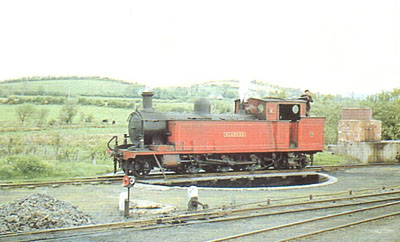
County Donegal 2-6-4T ‘Blanche’
As for the diesels, there’s no prototype for a high power narrow gauge diesel in Britain, so I would envisage something resembling the Bo-Bos on the Zillertalbahn in Austria. For the heavy clay trains they would operate in pairs, class 20 style. To justify more than one class of loco, assume the original 60s-built diesels are being replaced on the bulk clay workings by newer, more powerful second generation machines. The surviving originals are relegated to lesser duties such as shunting and permanent way work. Perhaps one has been sold to the preservation society and had been repainted into their livery.
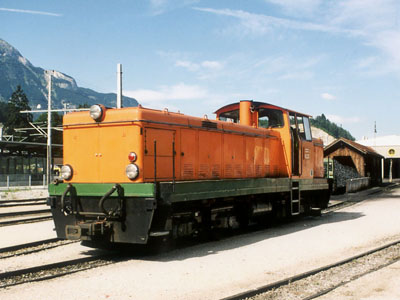
Zillertalbahn Bo-Bo at Jenbach – Photo © Albert Nagy
While modern railcars on all year round local traffic might be a bit fanciful given the survival of the standard gauge line to Newquay via Chasewater and Perranporth, some local traffic to Fowey might be feasible.
As happened with the Corris and Welshpool and Llanfair railways, it’s likely the original passenger stock would have been scrapped following the cessation of passenger traffic in the 30s, but one or two originals might have survived either as works vehicles or adapted for non-railway purposes. Perhaps enough of some of them survived to be restored. The ‘new’ passenger stock could be a real mix. There would be some cheap and nasty semi-open stock on old freight wagon underframes dating from the very early days of preservation. This fleet might be augmented by some secondhand stock from the Continent, and by some higher-quality new stock resembling the modern coaches on the Ffestiniog.
The freight stock would be the bogie clay hoppers, perhaps with one rake of brand new ones as replacements for the 60s build, and the transporter wagons which carry a variety of standard gauge wagons. An assortment of older wagons would survive on permanent way duties, shared between the two companies.