Railways Blog

A blog about trains, covering photography, railway history, transport politics and modelling, in no particular order.

Oh No, Not Again!

So said the bowl of petunias… In an earlier post I made reference to disfunctional egroups, particularly railway modelling ones. There is one group in particular, that’s been renamed twice following major flamewars, and has burned out so many moderators I’ve lost count.

Now we have a prominent member (and onetime moderator) feeling he’s being forced out of the group because of the backbiting of others. I’ve never known any other net community based around any subject that’s been as political as this one. While there are plenty of good people prepared to discuss aspects of railway modelling, there seems to be a minority that are only interested in causing trouble.

What in Ed Burkhart’s name is wrong with you people?

Posted in Railways | 3 Comments

The Sociology of Model Railways

This is what I call a rant! The Sociology of Model Railroading (Link from Cold Spring Shops)

It’s about the American scene, but a lot still seems familiar. I’ve generally avoided the British ‘grotmeet’ scene, but I haven’t heard anything about it that contradicts this:

A Weberian, rationalistic approach to swap meets would assume that they are meant to be efficient local markets for second-hand merchandise. They would, for example, be a means for hobbyists or those leaving the hobby to liquidate unneeded supplies in a fast, informal way, without the potential heavily discounted effect they would see by trying to sell them back to a hobby shop. Some swap meet vendors are able to negotiate with heirs to purchase the model railroad assets of estates and then sell these assets at swap meets.

The rationalistic assumption would be that the consumer goes to a swap meet expecting to find a lower price for merchandise that she may find acceptable, though it may be outdated or in imperfect condition. One might also assume that a seller, finding price resistance to goods at a particular level, would be prepared to negotiate in order not to have to carry the goods back from a swap meet unsold.

A major factor that contradicts these rationalistic assumptions is the fact that many hobby goods of the type that are offered at swap meets have simply lost all economic value — while hobbyists are fond of calling swap meet merchandise “junk”, much — probably a lot more than half — of what appears at swap meets can’t realistically be sold at any price. It is literally trash, kept from the landfill by the expectations of the putative sellers. Often it’s dusty, broken remnants of merchandise that was already schlock when it was new in the 1970s or earlier. The effort to restore it to operation, if it’s practical at all, is greater than the still-low cost of new, better-quality merchandise, and the original junk hasn’t even got sentimental value.

I’ve also seen the dysfunctional clubs and egroups plagued with constant flamewars. But I’ve also been a member of clubs and egroups that don’t suffer from those problems.

One thing in his rant I don’t recognise at all is the description of the exhibition circuit, which is the major difference between the American and British railway modelling scenes.

In America (if magazines are anything to go by), the best layouts are huge, permanently installed basement-busters. Except for the occasional open day, the public never gets to see these layouts. Meanwhile, portable exhibition layouts revolve around modular layouts made up from disparate modules, sometimes with with ill-matching scenery and different standards of modelling.

The British scene is totally different. I believe this is a result of a combination of two factors, our smaller houses (without those gigantic basements), and our more compact geography. Here, many of the biggest and best detailed layouts are not permanent installations, but portable exhibition ones. Quite a few are too big for the owner to be able to set up and run the whole thing at home! As a result, it’s only at public exhibitions that these layouts are ever set up and operated. Combine this with the fact that many British cities are only a couple of hours drive from a dozen other large cities, and you get a thriving exhibition scene, with a large number of high quality layouts, many of which have multiple public outings a year. For just about every model railway club, the highlight of the club’s year is the annual show; all the better shows showcase not just the best of the club’s own modelling, but many high quality visiting layouts as well. And for trade support, with a few exceptions (Doncaster?), the grotmeet junk dealers are conspicuous by their absence. Instead there are a lot of small cottage industry business selling their own products, often obscure items the average model shop doesn’t stock.

Overall, I think the British model railway scene is in pretty good shape.
Posted in Railways | 1 Comment

A Railway Modelling Meme

I’ve participated in a weekly meme for one of my two hobbies in Game WISH, this attempts to cover my other hobby, railway modelling, in the much same sort of way. It might crash and burn after just a few weeks, but let’s give it a try. I’ll see what sort of response the first one gets before making this a regular permanent addition to the Working Timetable.

I’m also stuck for a snappy title or corny acronym. Suggestions are welcome.

If you’ve got your own blog, post your response there, and either use the Moveable Type trackback facility or leave a link to your entry in the comments. If you don’t have your own blog, just post your response in the comments.

The first one’s inspired a bit by Iain Rice’s “Mainlines in Modest Spaces“, and is a development of an earlier idea of mine. Imagine you are building a model of a main line or secondary route with a reasonable variety of traffic. Rather than a generic ‘somewhere in central England’ or the equally generic ‘on the border between Switzerland and Belgium’, the layout is either a specific location, or at least a specific route, and set in a fixed year.

You have space for a fiddle yard (or staging roads, if you’re on the left hand side of the Atlantic) with six roads, giving you a maximum capacity of six complete trains.

What are those six trains? They have to represent both a representative cross-section of the traffic on your chosen location, and represent some of the ‘signature trains’ that will identify the area and period to any casual viewer that’s familiar with the prototype. A good example would be a blue class 37 on a long train of clayhoods representing Cornwall in the mid 1980s.

Continue reading

Posted in Railways | 1 Comment

Tebay Tragedy

This accident had the same death toll as the Hatfield derailment. I just hope it doesn’t produce the same overreaction.

A small rail trolley loaded with rails on one work site somehow ran away down a falling gradient. Four miles down the line it had picked up speed and ran down a group of track workers on another work site. Four were killed, and three more injured.

They were under arc lamps and the trolley would have come out of the dark.

Mark Lenderyou of the Health and Safety Executive said the runaway vehicle would have been running “virtually silently” – while the men were working amid the noise of lighting generators.

“It’s very unlikely they would have known anything about it until the trolley hit them,” he added.

First, my condolences to the families and friends of those who lost their lives in this accident. The rail industry does need to take all sensible methods to prevent a repeat of this accident. It’s wise to reexamine safety procedures when there are multiple work sites on a steeply-graded stretch of line.

But…

The aftermath of Hatfield saw the rail network crippled for months with severe speed restrictions, which probably cost more lives in additional road accidents than it saved. I hope we don’t see a similar overreaction banning all overnight maintenance work regardless of possible risks; that would only result in more daytime closures forcing passengers onto more dangerous modes of travel.

Sadly I don’t trust the HSE to see the bigger picture.

Posted in Railways | 1 Comment

Doncaster Show 2004

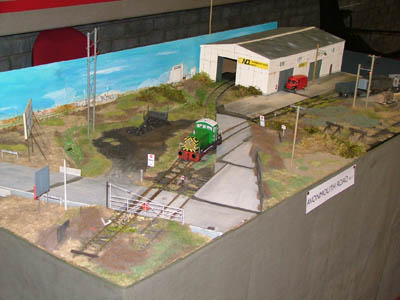
Spent yesterday at the Doncaster Festival of British Model Railways, held in the conference centre at Doncaster Racecourse. It’s a big show, but does tend to have too many traders and not enough layouts. As one who’s more interested nowadays in modelling continental Europe I was disappointed to see not a single layout with a non-British theme. On the other hand, as someone who still has a interest in the British post-steam era, there were plenty of modern era layouts; wall-to-wall GWR branchlines it was not. I liked the minimalist Avonmouth Road (see below), and Prices Street Gardens, a classic urban location on the western approach to Edinburgh Waverley station, featuring a scale model of Edinburgh Castle; this is really the sort of thing you can only do in N.

Being a UK-centric show, my wallet got off lightly. The only item of Swiss rolling stock I bought was a Minitrix SBB baggage car, although I did also buy four Bachmann HEA coal hoppers for my next British layout. Bachmann’s policy of batch production means you have to buy them while they’re available; if I’d waited for four years until I actually needed them, I would find they were no longer available.

I have a few pictures: there would have been more, if I’d remembered to charge up the spare set of camera batteries.

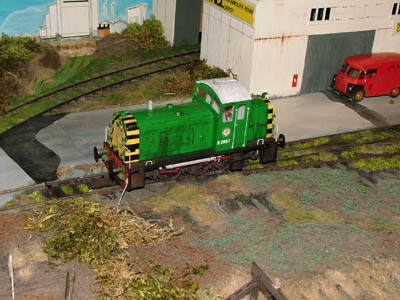
Avonmouth Road

Who says 0 gauge needs a lot of space? This is the entirety of the layout! It’s a very well-modelled piece of urban decay, set in the late sixties. In a few years time this area will be covered by out of town shopping centres, with no sign there was ever a railway there.

07 at Avonmouth Road

Closeup of the locomotive, a BR class 07, a type built for shunting in Southampton docks

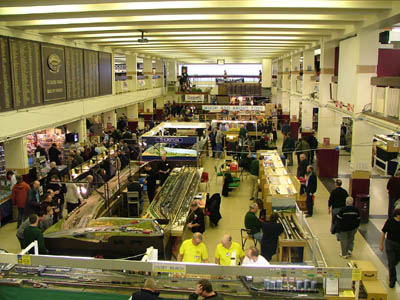
General view of the hall

A general view of the main hall. The layout in the foreground is Selsey Beach, set on the south coast in the present day, with a fleet of kitbuilt third rail EMUs in NSE and Connex liveries. Behind it on the left is the large Runswick Leamside, a big diesel era crowd-puller, set just before privatisation.

Posted in Railways | 2 Comments

Westerns of Mass Distortion

It appears that Electric Nose does not like the new Heljan Western. (No permalinks, scroll down to the Jan 30th entry)

Posted in Railways | Comments Off

Train vs. Truck

Another spot of bother for the Houston Light Rail. Be sure to look at the photo gallery, that comes from the train’s on-board camera. Ouch!

Posted in Railways | 1 Comment

Snow!

We had half an inch of snow during the night. And it was enough to make transport networks grind to a halt. Just like it always does, every time it snows.

This is the sort of time that having the rail line closed for rebuilding for five months really sucks, because the rail replacement buses have to struggle through the area’s inadequate road network.

I don’t believe the local authority has gritted a single road in the area; as a result of this the local roads were in a state of total gridlock this morning, and the rail replacement bus service simply evaporated altogether. I spent a hour at a freezing bus stop watching traffic crawl past at walking pace, with no sign of any bus, even going the other way. Up above street level I could see a steady flow of trains crossing the bridge on the other rail line to Stoke; there were significant delays, but at least the trains were moving. Unlike the buses.

After an hour I gave up waiting, having almost frozen solid, and went home to make myself a cup of coffee and attempt to thaw out. When I ventured forth again, the traffic on the road was finally moving, and I waited a further half an hour at the bus stop before a bus finally appeared. I finally got to work two and a half hours late.

It’s times like this I wish I lived in a country like Switzerland.

Posted in Railways | Comments Off

Wominsee

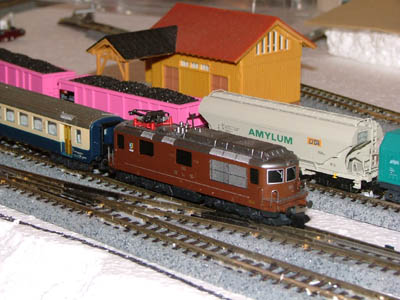
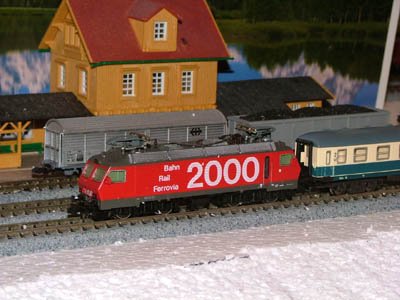
Now I’ve got a digital camera, I thought I’d post a few photos of the unfinished N gauge layout, “Wominsee”. At the moment things are in the very early stages, there’s not much apart from track, the foundations of some scenery made from carved of foam, and a few buildings. But trains are running, thanks to ready-ballasted Kato Unitrack.

BLS Re4/4 enters Wominsee

BLS Re4/4 No 193 arrives at the north end of Wominsee with a set of BLS blue and cream EW1 stock. The brown Re4/4s are very much workhorses of the BLS, and it’s a pity the only commercially produced version in N is this now-discontinued Arnold model. It’s rather crude compared with the the latest products from the likes of Kato and Fleischmann. The coaches are old Lima Minitrain ones. The pink freight wagons in the siding behind are supposed to be that colour; one of the world’s stranger freight stock liveries.

SBB Re4/4iv passes Wominsee

SBB Re4/4iv passes the station with an international train formed of German stock in the old Epoch 4 livery. The class never went into series production, and the four prototypes were eventually sold to the Sudostbahn to run between Romanshorn and Luzern. During the early 1990s these four locos were still in SBB ownership, and were a common sight on the BLS main line. The model is by Roco, another discontinued item, which I’ve managed to track down from eBay. The station building is a Faller kit; it’s scheduled to be replaced by the Kibri Swiss chalet-style building that I have yet to build.

Posted in Railways | 4 Comments

Libertarians, Alpha-Males, Trains and Cars

Interesting Transport Blog posting from Patrick Crozier:

Taking issue with Andy Duncan is one thing but taking issue with Brian Micklethwait (about a posting on this very blog, no less) is quite another. Brian is an über-libertarian with a fine pedigree from whom I have learnt an enormous amount. So criticising something he has written is not something to be entered in to lightly. But I feel I am going to have to because in his posting on Robert Clayton Dean’s posting on the Detroit Motor Show he (seems to) make the argument that driving a car is a libertarian thing to do.

This is an idea I violently disagree with. It gets right up my nose. It does so because a) I think it is wrong and b) because by implying that taking the train is a socialist thing to do it alienates a whole bunch of people ie people who take the train who I would rather not alienate. It comes close to saying that being a libertarian means you have to be a flash Harry alpha-male don’t-give-a-stuff-about-anyone-else arsehole.

There do seem to plenty of libertarians who do fit that negative stereotype, such as some of these guys, just as there are socialist that are paranoid control-freaks. But not everyone fits into neat stereotypes.

When I first started reading Patrick’s blog, I thought the idea of a libertarian who was in favour of public transport was a strange concept. In fact, it seems we agree on a lot of transport issues even though our politics are totally different, such as the fact that the fragmented structure of Britain’s railways is completely broken, and we won’t see any improvements until ithe industry is completely restructured.

While’s I’m pro-rail, it doesn’t mean I’m completely anti-car, as some flash Harry alpha-male work colleagues seem to think. It’s just that I have no desire to live in a society where it’s impossible for anyone to live without a car, a situation that seems depressingly common on the left-hand side of the Atlantic.

Posted in Railways | 4 Comments