Modelling News Blog

News on new model releases, reviews of exhibitions and other happenings in the model railway world.

Minitrix announce Cisalpino Re484 and coaches

Photo & Video Sharing by SmugMug

It’s the time of year when continental manufacturers announce their new models, and there are some interesting things in the Minitrix New Items brochure (pdf).

The Cisalpino Re484 with matching coaches has been on my wishlist for a while, since they were regular performers on the Lötchberg route in the mid-noughties. Cisalpino was a joint Swiss-Italian venture for through trains between Switzerland and Italy over the Lötchberg and Gotthard routes. The coaches on the Lötchberg were the standard Swiss EC stock, initially hauled by pairs of Re4/4s, later by dual-voltage Re484s that eliminated the need to change locomotives on the Swiss/Italian border.

They’re selling as a set with the locomotive and three coaches (two first class and one second), with additional second class coaches sold individually. This will enable modellers to assemble the correct prototypical six-coach formation of two first class and four second class coaches.

The EC coaches have been in the Minitrix range for several years, as has the 4-pantograph Bombardier TRAXX locomotive. Since a similar train has also appeared in the Arnold catalogue this year, using Eurofima coaches, I’m assuming the simultaneous appearance is to do with past licencing issues with the livery.

Photo & Video Sharing by SmugMug

Here’s the prototype at a rather wet Spiez in 2007. The six-car Cisalpino sets were frequently strengthened with older Swiss coaches during their run through Switzerland, in this case the three leading vehicles are rebuilt RIC stock, available in model form from Kato, which means the whole train can be modelled.
Posted in Modelling News | Tagged , | Comments Off

Arkham, Change for Innsmouth

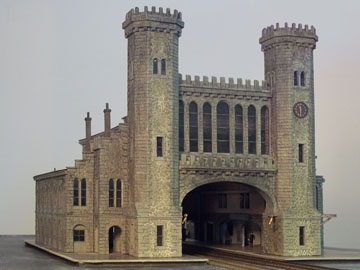
Arkham StationThe branch to Innsmouth had closed by the time of the events in “The Shadow Over Innsmouth”, but the Innsmouth Local still runs on the HO Scale Miskatonic Railroad, set in the 19th Century, with locations inspired by H.P.Lovecraft’s stories set in New England.

The centrepiecepiece is the splendid Victorian Gothic station of Arkham, modelled on the real-live station of Salem, MA (of witch-trial fame). Much like too much of the best Victorian architecture of Britain, it was demolished in the 1950s to make way for a car park.

Hat-tip to Kenneth Hite (who else?) for the link.

Posted in Modelling News, SF and Gaming | Tagged | Comments Off

Baby Pendolino Kickstarter

Tilt-shift PenodolinosMike Hale and Ben Ando are running a Kickstarter for an N-gauge Virgin Trains Pendolino.

Love them or hate them, they’re the signature train for the electrified west coast main line, which cannot be realistically modelled without them.  The model will be produced by the Canadian manufacturer Rapido Trains.

The model will be available in 9 or 11 car versions as per the prototype, in DC or DCC with sound. For those without the space for a full-length set (A 9-car train is just short of 5 feet), there is also the option of a shortened 5-car set. The price for the basic 9-car set without DCC is £255, which compares very reasonably to Bachmann’s 6-car Midland Pullman.

The above photo is a tilt-shift image the prototypes at London Euston, by Stuart Axe.

Posted in Modelling News | Tagged , , , , | Comments Off

Rats!

Graham Farish class 25/2

The long-awaited Graham Farish class 25/2 is finally here. Graham Farish have had a class 25/3 in the catalogue for many years, but the model dating from the Poole years is getting very long in the tooth. Following on from the new model of the similar class 24 from a couple of years back, a new class 25 was the obvious follow-up. In contast to the older Farish 25. the new model represents the earlier body style with front-end communication doors and bodyside grilles.

Known by the spotters’ nickname of “Rats”, the prototypes were built in the early to mid 1960, and the class eventually numbered no fewer than 327, making them the second most numerous class of main-line diesel after the class 47. The majority were allocated to the Midland Region though the Western and Scottish regions also had a few. Despite their large numbers they were relatively short-lived; the reduced demand for lower-power locomotives saw them last ones withdrawn in 1987, with many of them seeing less than 20 years service.

Graham Farish class 25/2

The Farish model comes in three different bodyshell variants representing the locomotives at different stages in their lives. The one I’ve got has both the boiler vent and the nose end doors plated over, and represents the condition of the locomotives in their final years in service.

I intend to renumber it to one of those allocated t o Plymouth Laira in the mid 1970s. These locomotives were brought into the West Country at the beginning of the 1970s to replace the class 22 diesel-hydraulics on local freight and passenger work in Devon and Cornwall. They were a common sight on china clay workings and Cornish local freight up to 1980 when the more powerful class 37s replaced them.

So far I have identified 25048, 25052, 25223 and 25225 as candidates for the new number. The above photo shows 25223 at Plymouth in 1976, and comes from John Woolley’s excellent photostream.

Posted in Modelling News | Tagged , | 8 Comments

Murdoch Bulk Muck Shifting

Oxford Diecast Murdoch tipper with Scania T-Cab

It’s almost disappointing to learn that “Murdoch Bulk Muck Shifting” is a real company based in Scotland rather than a joke at the expense of a well-known Australian newspaper proprietor.

The model is from Oxford Diecasts, filling what has until very recently been a big gap in the market, for modern commercial vehicles in British N (1:148) scale.

Posted in Modelling News | Tagged | Comments Off

The 2014 Derby Show

Photo & Video Sharing by SmugMug

A few photos from the Derby model railway exhibition from a couple of weeks ago. The first two are of Netherwood, an O gauge layout based on the final years of the Woodhead elecrification, set in south Yorkshire, with coal traffic predominating.

Photo & Video Sharing by SmugMug

The distinctive class 76 electric locomotives unique to that line are the obvious signature item, but I also liked the class 123 DMU, former Western Region trains that spent their final years on the South Trans-Pennine route, and occasionally ran over Woodhead on Sunday diversions. The model is made from cut-and-shut Lima Mk1 coaches.

Photo & Video Sharing by SmugMug

Like Netherwood, Barton Road oozes atmosphere, and although not based on any specific location, it has a very definite sense of time and place. It was predicted that the excellent recent N gauge diesel-hydraulic locomotives from Dapol and Farish would inspire a lot of 60s/70s Western Region layouts, and this is one of the first such new layouts I’ve seen.

Photo & Video Sharing by SmugMug

Although neither has a steam locomotive in sight, both of these layouts are historical models, capturing a railway scene long since gone. Which is why using the dated term “Modern Image” to describe them is just silly.

Posted in Modelling News | Tagged , , | 2 Comments

Toilet of the Month

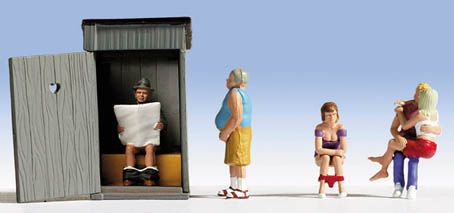
Noch ToiletThis is just… wrong.

But if you really want one on your N-gauge layout, Hattons of Liverpool have them on sale.

Posted in Modelling News | Tagged | 2 Comments

Modern Image?

Photo & Video Sharing by SmugMug

A column in the most recent DEMU Update suggested it’s well past time to retire the term “Modern Image” as a description.

It made perfect sense in the late 1960s when used by the likes of Cyril Freezer in the pages of The Railway Modeller. Back then, the default “serious” model railway was the archetypal GWR branch line terminus. Only a minority of modellers attempted to recreate the present-day scene, and a generation of enthusiasts had lost interest in the real railway with the end of steam in 1968.

In 2013, “Modern Image” makes a lot less sense. The railway of the early 1970s bears little or no resemblance to the colourful post-privatisation scene of today. Indeed, a layout set in the 1970s is set as far in the past as a chocolate-box 1930s layout would have been in the 70s.

Reframing “Modern Image” to define models set in the past decade isn’t so useful either, There’s no strong cut-off point equivalent to the end of steam in 1968, not even privatisation. In the years 1958 to 1968, British Railways replaced their entire motive power fleet aside from some early electrics. While recent years have seen a lot of new equipment replacing life-expired trains from the 60s and 70s, we haven’t seen a wholesale replacement on an equivalent scale. An awful lot of the 70s and 80s ex-BR fleet is still in traffic wearing new liveries, such as those mid-60s class 86s in the photo above.

Older modellers whose interests are firmly in the steam era will continue to use the term Modern Image through force of habit, and there’s little point trying to stop them. But that’s no reason not to discourage its continued use in magazines or exhibition programmes.

Continental-style epochs never really caught on, but I think it’s better to describe layouts and modelling interests in terms of approximate time period. “Pre-Grouping North British”, “30s Great Western”, “1970s Blue Diesel” or “Post-Privatisation” are seem perfectly adequate descriptors to me.

Posted in Modelling News | Tagged , | 4 Comments

Dapol Hydraulics

Dapol class 22

The layout has some new motive power in the shape of a couple of newly-released Dapol diesel-hydraulics. The little class 22 is the first of these.

The class 22s were one of those unsuccessful Modernisation Plan designs. Introduced in 1958 for secondary services, they were victims of the mass cull of non-standard designs at the end of the 1960s. The last was withdrawn in 1972, and despite an unsuccessful preservation attempt none of the locomotives have survived. British N has reached the stage where all the more popular and iconic classes of locomotives have been “done”, so manufacturers are looking at some of the more obscure prototypes.

Dapol Western Enterprise

The “Western” is altogether more iconic, making the national news when the last ones were withdrawn in 1977, and several survive in preservation. Graham Farish introduced the first N-gauge model back in the 1980s, and although it’s still in the catalogue their model is increasingly long in the tooth, so a modern state-of-the-art model is more than welcome.

“Western Enterprise” in its unique Desert Sand livery is a special commision for Osborns Models, a bit of a coup for them since these models were the first Westerns delivered from the factory, some weeks in advance of the more regular blue and maroon versions.

Dapol have come up with an interesting way of coping with the lower valance on the “Western” with regards to fitting a coupler while still allowing the locomotive to negotiate the sort of curves many modellers are forced to use. The model comes with a complete spare bogie, so you have the option of either having a coupler at both ends, or a coupler at one end only with a more realistic-looking front-end at the other. Both bogie and valance are push-fit meaning it takes just a few seconds to switch the locomotive between single and double-ended mode.

Both are very welcome models for anyone with an interest in 1960s Western Region in N, and it’s good to see the mundane in the shape of the 22 alongside the iconic.

Posted in Modelling News, Modelling Projects | Tagged , , , | 2 Comments

David Jones announces DJ Models Ltd

Dave Jones, formerly frontman of Dapol (Well, “Product Development Manager” was his offical title) has announced his new solo project, with a series of ready-to-run models in three scales.

As he says on the new website:

Starting from a blank canvas and using the best design, and modelling techniques currently in use for ready to run model locomotives, I intend to produce a raft of models over the next few years with my desire for innovation, and forward thinking put into each and every model I make.

The first three products announced are the Class 17 and 23 diesels, and the LNER J94 saddle tank, all three in N, with the J94 and Class 23 also appearing in 0, and the J94 in 00. Some interesting choices there; a couple of the short-lived unsuccessful Modernisation Plan locos that are probably unlikely to be duplicated by any other manufacturer.

Exciting news, and I’m hoping to see him pick up where he left off with Dapol, with models up to the standard of the recent “Western”.

Posted in Modelling News | Tagged , , | Comments Off