
A column in the most recent DEMU Update suggested it’s well past time to retire the term “Modern Image” as a description.
It made perfect sense in the late 1960s when used by the likes of Cyril Freezer in the pages of The Railway Modeller. Back then, the default “serious” model railway was the archetypal GWR branch line terminus. Only a minority of modellers attempted to recreate the present-day scene, and a generation of enthusiasts had lost interest in the real railway with the end of steam in 1968.
In 2013, “Modern Image” makes a lot less sense. The railway of the early 1970s bears little or no resemblance to the colourful post-privatisation scene of today. Indeed, a layout set in the 1970s is set as far in the past as a chocolate-box 1930s layout would have been in the 70s.
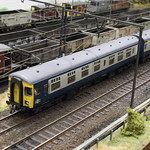
Reframing “Modern Image” to define models set in the past decade isn’t so useful either, There’s no strong cut-off point equivalent to the end of steam in 1968, not even privatisation. In the years 1958 to 1968, British Railways replaced their entire motive power fleet aside from some early electrics. While recent years have seen a lot of new equipment replacing life-expired trains from the 60s and 70s, we haven’t seen a wholesale replacement on an equivalent scale. An awful lot of the 70s and 80s ex-BR fleet is still in traffic wearing new liveries, such as those mid-60s class 86s in the photo above.
Older modellers whose interests are firmly in the steam era will continue to use the term Modern Image through force of habit, and there’s little point trying to stop them. But that’s no reason not to discourage its continued use in magazines or exhibition programmes.
Continental-style epochs never really caught on, but I think it’s better to describe layouts and modelling interests in terms of approximate time period. “Pre-Grouping North British”, “30s Great Western”, “1970s Blue Diesel” or “Post-Privatisation” are seem perfectly adequate descriptors to me.


A good point well made. We’re now at the point where nobody under 50 really remembers seeing steam in daily service on BR lines (I’m not counting the VoR as it wasn’t operationally part of the BR network even when BR ran it!).
While, as you say, a lot of BR stock from the 60s can still be found on the network, most stock built as a result of BR’s 1955 Modernisation Plan has followed steam to the heritage railways or the scrapyard and much of that happened 15-30 years ago.
Not convinced it should retire. It really does serve well the time it was coined when the shiny new electrics were hauling out of the box Mk2s on the WCML while the railway in General remained a steam-age one. Probable cut off would be the mid-70s when you move to the Crumbling Edge era. I know I’m old-fashioned but I like modern image but few use it so targeted to a period. If you must change then pre-TOPS, Crumbling Edge, Sprinter Revolution, and then Privitisation seem useful periods to me. I agree that Blue Diesel is a common replacement for Modern Image but that too misses a whole chunk of what it needs to convey – what space for the WCML and third-rail systems in Blue Diesel?
The problem with “Modern Image” is there’s no longer any consensus on what it means.
You use it to represent the 1965-1975 era covering the sort of things Cyril Freezer was describing. Other use the term to mean the present-day scene. And those whose interests are firmly steam-age use it mean anything post-steam.
I think I’m finally convinced that ‘modern image’ does need to go. The term is contemporaneous with my lifetime so a blue AL6 on Mark 2a stock could not by any stretch of the imagination be modern. The term was coined by CJF and it really did mean something at that point in history (45 odd years ago, which interestingly positions it around 45 years after the Grouping).
I still hold out though for ‘The Modern Image’, capitalised and with a definite article as perfect for that decade. Image suits it well because it was the image but hardly the reality for most of the rail system. Rattling down to Portsmoth in a Nelson or riding the mixed to the Higjlands, loose coupled coal or pick-up goods on the Cambrian belong to The Modern Image.
I know people will use it indiscriminately and that’s a shame. Time for the Railway equivalent of Modernism and post-modernist?