Music Blog

All the music-related posts gathered together in one place.

Rock Club Tragedy

BBC News are now reporting more than sixty dead in the terrible rock club fire at a Great White show at Warwick, Rhode Island. A lot of safety issues here, from the wisdom of using pyrotechnics in small venues, to the construction of the building itself; which burned to the ground in three minutes

One factor in the deaths is supposed to be the fact that almost everyone tried to get out through the main entrance where they came in, rather than the three other fire exits. Next time I go to a gig (and most of the bands I see nowadays are in that size of venue), I’ll make a mental note of the location of all the fire exits before the show. I suggest those of you that go to gigs do the same; it might just make the difference between life and death.

Update: Damien Penny, a fan of Great White, has some words on his blog, as does Andrew Ian Dodge.

Update 2: JimSpot has a lot more to say on the subject. Had he known about the gig, he would have been there.

Posted in Music | Comments Off

Music Man Was Not Meant To Hear

No, not Ümläüt this time, but A Shoggoth on the Roof: the Cast Album. One for Andrew Ian Dodge, methinks. (Thanks to Silkenray on Dreamlyrics for the link)

Talking of Ümläüt, I’m having great fun in a current game thread making up the early background of the band in-character (during an interview with a journalist) along with another player. Check out this thread for where’s it’s going, including the story of Nigel the Medallion Man.

Posted in Games, Music | Comments Off

When “Alternative” died.

Justin Anderson complains about Nirvana making “Alternative” into mainstream in Blogcritics: Death of a Genre

A&R reps scoured Seattle and other alternative hotspots for the next big thing. Bands that would otherwise have become boy bands saw the riches at the end of the alternative tunnel. And what that meant was a diminishment in the quality of music. It also resulted in a sort of cultural imperialism in which hordes of frat boys and teenybopper girls became “alternative” overnight.

Nothing for it, Justin; you’ll have to become a prog rock fan. Prog rock will never get taken over by ‘lemmings’, because it will never be ‘cool’.

Of course, one of the tragedies of “Alternative” becoming mainstream was to kill off a lot of good music and replace it with stuff that was quite frankly inferior, just like what happened in Britain after punk in the late 70s.

I don’t get the ‘elitist’ attitude either; I don’t care how ‘cool’ my CD collection is, I listen to stuff I actually like. I’d rather admit to liking Marillion and Uriah Heep than have to pretend that I like REM for peer approval.

Posted in Music | Comments Off

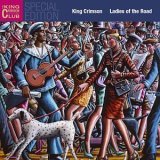
King Crimson – Ladies of the Road

I wasn’t really a fan of the 1971/2 version of King Crimson. The previous incarnation of the band, featuring Greg Lake and Ian McDonald, had produced the Mellotron-drenched classic “In the Court of the Crimson King”, while the later 1973/4 band with Bill Bruford and John Wetton came up a trio of classic albums full of frantic improvisation. In between these two lineups came the two rather directionless studio albums recorded with a revolving cast of musicians, “Lizard” and “Islands”, both of which I find pretty much unlistenable.

With this live release, “Ladies of the Road”, perhaps it’s time to reassess this version of the band. Recorded on the 1971/2 world tour, it sees Robert Fripp joined by saxophonist Mel Collins, Boz Burrell on bass and vocals, and Ian Wallace on drums. With the Mellotron that had earlier defined their sound pushed into the background, the focus here is on Fripp’s guitar and Collin’s sax.

Unlike every other King Crimson live release (of which there have been a great many), this isn’t a record of any single show; instead it’s a compilation of the best takes from a whole tour. Indeed, the lack of any mention as to which songs where recorded where suggests that Fripp has spliced together some numbers from bits recorded on different nights; a technique used a lot by the late Frank Zappa.

Disk One features a set that draws heavily from “Islands” and “Lizard”, but the powerful live version of songs like “The Letters”, “Formentera Lady” and “Cirkus” are vastly superior to their studio counterparts. We still get a couple of songs from the Greg Lake incarnation, “Pictures of a City”, and of course, “21st Century Schizoid Man”. I’m not sure of the blues jam version of “In the Court of the Crimson King”, perhaps it’s just as well it’s but 46 seconds long.

Disk Two is an extended “Up yours!” to all those the music journalists that hate solos. It’s a 45 minute epic version of “21st Century Schizoid man” created by knitting together the middle solo sections from eleven different live takes to form a seamless and relentless sax and guitar solo.

Fripp was to disband this version of King Crimson at the conclusion of the tour; while this album highlights some very energetic playing, the American blues/jazz direction the other three were heading in was at odds with Fripp’s own chosen course. A year later, a new, radically different King Crimson was to appear, but that’s another story entirely.

Oh, and the song “Ladies of the Road” isn’t actually on the album.

Posted in Music, Record Reviews | Tagged | Comments Off

For Spinal Tap Fans

It’s so… black.. It couldn’t be any more black. In fact it’s 25 times blacker than any known black.

Posted in Music | Comments Off

Jumping the Shark

Too long since I’ve blogged about music.

We hear a lot about the moment when TV series, movie franchises, series novels and even RPG lines “Jumped the Shark”; the episode when what had once been good becames a stale parody of itself. (see http://www.jumptheshark.com for a fuller description).

But what about bands? There are plenty of bands that were once good, and descended to become pale shadows of what they’d once been. But when did they Jump the Shark? Here are some suggestions:

Genesis: Once one of the most creative and innovative bands of the 70s progressive rock scene, Genesis turned into a boring, bland stadium rock act selling millions of records to people called ‘Kevin’ with no taste in music whatsoever. While some wrote off the band when Peter Gabriel left and Phil Collins took over as vocalist, for me the point the band blanded out was with the departure of guitarist Steve Hackett. It was clear on the first Hackett-less album “And Then There Were Three” that there was a dimension missing from the band’s sound. When the banal piece of fluff “Follow You, Follow Me” from that album was a hit, the siren songs of commercial sellout beckoned. When the dire Collins-penned drivel “Misunderstanding” from “Duke” was a hit with the Kevin brigade, it was time to put a fork in them. They were over.

Yes: Many people consider Yes to have died horribly with the over-ambitious and overlong double album “Tales from Topographic Oceans”. I, however thought this was a temporary blip, and the albums “Relayer”, “Going for the One” and even “Drama” all had their moments. The early 80s saw them play musical chairs with the lineup, culminating in the overproduced but hugely successful “90125″. Yes went pear-shaped with the weak followup, “Big Generator”, and never really recovered.

Deep Purple: Deep Purple are as much a soap opera as Yes, and have had more ups and downs than David Mellor’s trousers. After the band crashed and burned in 1976, they reformed eight years later, and despite some people doubts came up with a strong reunion disk, “Perfect Strangers”. Perhaps they should have just done one album and a world tour, then split. Instead, they tried to carry on, and “House of Blue Light” was the result. A weak, forgettable album with none of the spark or energy of it’s predecessor, it was the sound of a band going through the motions who’s heart wasn’t really in it any more. And the next two, including one featuring Joe Lynn Turner on vocals, were little better.

Queensrÿche: Queensrÿche are a band that peaked too early; after their classic third album the cyberpunk concept epic “Operation Mindcrime”, they charted a slow, graceful decline culminating in the empty “Q2K”. While some say the rot set in with “Promised Land”, I think that’s an album with good songs buried in muddy production. To me, the shark-jumping moment was the followup, “Hear in the New Frontier”, which lacked the scope and energy of their previous work.

Kansas: Kansas’ early work is a rare example of American first generation prog-rock, with heavy use of violin as a lead instrument. Unfortunately the musical climate of the early 1980s wasn’t friendly to this sort of complex music, and, presumably responding to record company pressure, they blanded out completely. “Audio Visions” was the album that showed this new, blander style. It didn’t help that this coincided with Kerry Livgren’s conversion to Evangelical Christianity giving the album a lot of embarrassingly cheesy ‘born again’ lyrics. Not a good advertisement for evangelical Christianity, I’m afraid.

Any other suggestions? Use the comments facility!
Posted in Music | 1 Comment

Run for cover!

Michele wants to know your favourite cover versions!.

I nominated the late great Frank Zappa’s take on “Stairway to Heaven”, with a reggae beat and a brass section playing the guitar solo note-for-note. Alternatively, for pure silliness, there’s Alberto Y Lost Trios Paranoias barbershop quartet version of “Anarchy in the UK”.

Meanwhile, I have music again, having finally got round to unpacking the stereo! First album is Threshold’s “Critical Mass”, which I really must get round to reviewing for BlogCritics

Posted in Music | Comments Off

Old Rockers and Tribute Bands

More musical musings: how many original members does a band need to still be considered the original band?

There are an awful lot of acts from the 60s and 70s that are still recording and touring, despite the fact that only two or three members of their most successful lineups remain. I’ve heard some people describe the current lineup of Uriah Heep (with only guitarist Mick Box and drummer Lee Kerslake from their 70s peak lineup) as ‘a tribute band with a couple of original members’, which I consider a little unfair, although the current lineup does lack the original frontman (the late David Byron) and the original main songwriter (Ken Hensley). However, the current lineup has now been together for more than sixteen years, half their thirty-two year existance!

Similarly, Blue Öyster Cult were known as “Two Oyster Cult” when reduced to just Eric Bloom and Don “Buck Dharma” Roeser plus three new guys, although Allen Lanier has since rejoined.

How much does it really matter? When you go so see Uriah Heep, Blue Öyster Cult or Deep Purple, what are you going for? Is it to see a particular bunch of guys perform, or is it to hear their music performed? I say this because I’ve seen all three bands perform in the past couple of years, and have enjoyed all three. However, one of the best shows I’ve seen all year has been by The Musical Box, a Canadian tribute band reproducing Genesis’ 1973 tour!

Posted in Music | Comments Off

Tommy Bolin and Purple

I haven’t blogged about music for a while – time to rectify that!

I’ve been listening to Tommy Bolin’s two solo albums, “Teaser” and “Private Eyes” recently, and it’s becoming clear what bugs me about Tommy Bolin’s sole studio contribution to the Deep Purple canon, the 1976 album “Come Taste the Band”.

The two Bolin albums, especially “Teaser”, released while he was still in Purple are choppy funk-rock. Meanwhile David Coverdale, as demonstrated by his later solo albums and with the earlier incarnation of Whitesnake (forget the late 80s MTV hair-metal version of that band!) was more into Hammond-heavy blues-rock. “Come Taste the Band” is an unhappy mix of these two styles, which for me is why the album as a whole doesn’t quite work for me. Some songs, such as “Dealer”, “Love Child” and “I Need Love” sound to me like bits of songs from “Teaser” and “Lovehunter” crudely chopped up and spliced together! The songs which do work, such as “Lady Luck”, “Drifter” and “You Keep On Moving” are where one style (Coverdale’s) predominates.

Saying that, “Teaser” and the heavier follow-up “Private Eyes” are fine albums, and it’s a pity Bolin’s career was tragically cut short by drug abuse; it’s just he was the wrong choice for Purple.

Sometimes I wonder what might have happened had Purple either chosen someone else, or sacked Bolin (and Glenn Hughes) in 1976. I’m guessing we’d have ended up with something much like early 80s Whitesnake, only with a flashier guitarist. Who was available in 1976? What about Gary Moore? Just what would a David Coverdale – Jon Lord – Ian Paice – Gary Moore – Neil Murray lineup have sounded like?

Posted in Music | 8 Comments

But you can’t dance to it!

It seems to be ‘conventional wisdom’ that prog-rock is crap ‘because you can’t dance to it’. Clearly nobody has told my seven-year old niece, who spontaniously danced very elegantly to King Crimson’s “Epitaph” and the title track on the classic “In the Court of the Crimson King”. I only put it on the stereo to show my nephew what a Mellotron sounded like.

Posted in Music | Comments Off