Quite a few veteran acts touring with just one or two original members get accused, rightly or wrongly, of being glorified tribute acts. Yes are a case in point; since the untimely death of Chris Squire the band have been touring without a single founder member, and just guitarist Steve Howe remaining from the early 70s band that made their reputation. There is a noisy faction of their ‘fans’ who refuse to accept the existence of the band without Jon Anderson, going to the extent of creating a Facebook group called “2/5ths of Yes is not Yes”. Given that Yes have gone though many personnel changes in their long history, that attitude is rather silly.
But what about AC/DC? With Phil Rudd in trouble with the law, and first Malcolm Young and then Brian Johnson forced to step down due to ill health they’re down to Angus Young and a bunch of hired hands. The Guardian’s Michael Hann has made a good argument for the band to call it a day after finishing their tour, and I find it hard to disagree with that.
There are plenty of bands on the nostalgia circuit for whom the label “glorified tribute band” is entirely appropriate. Bands who have been playing the same greatest hits sets for the past twenty years with diminishing levels of passion, and have either stopped recording new material altogether or release forgettable albums that add little to their legacy. But that has little to do with how many original members remain. One might even put The Rolling Stones in that category.
But there are others for whom the opposite is true. Look at Hawkwind, for example. Dave Brock spends much of the set sitting down, plays a bit of rhythm guitar, and lets the guys who weren’t even born when he started the band do all the work. But it’s his presence on stage that makes it Hawkwind in a way the rival bands featuring assorted ex-members are not. And what about The Enid, set to continue without mainman Robert John Godfrey with Robert’s blessing?
And how do you classify Zappa Plays Zappa, led by Dweezil Zappa and playing the music of his late father? Early incarnations of the band included Zappa alumni Napoleon Murphy Brock and Stevie Vai, though more recent lineups are made up entirely of younger musicians who weren’t part of any of Frank Zappa’s bands. But the spiritual connection is obvious.
As death or ill-health claims more and more of the classic rock generation it would be sad if their music stopped being performed live. The dividing line between tribute acts and original bands with no original members is likely to become increasingly blurred; a lot of it depends on whether they revolved around larger-then-life personalities, or whether, as in the case of Yes, the music itself is bigger than the performers.
In the end does it really matter? Is “authenticity” more important than the quality of the actual performances?
 Mirrors is one of those albums that still divides fans’ and critics’ opinions decades after it’s release. It was widely hated on its release; there had always been a lighter, poppier side to the bands’ music balancing out the heavy guitars and dark mysticism, but this was the one time they did an entire album in that vein. But taken as its own thing and approached on its own terms, it’s actually very good, and even the most commercial-sounding songs have a hint of darkness about them. The atmospheric epic “The Vigil” remains one of the band’s best songs. The only one that fails is “You’re Not The One I Was Looking For”, a strong candidate for the worst song they ever recorded, not just cheesy, but sounds like old cheese that’s been left out too long in the sun.
 Those who were underwhelmed by Mirrors hailed Cultosaurus Erectus, produced by Martin Birch of Deep Purple fame, as a return to form. It managed to keep a foot in both camps, with material in a similar vein as its predecessor balanced out with plenty of far heavier songs. One thing I’d never noticed before is the way a section of “Monsters” is a direct lift from “21st Century Schizoid Man”, many years before Kanye West sampled it. It’s probably the strongest of the band’s late-period albums, unless you include “Imaginos” which is best treated as a standalone thing in its own right.
 Fire of Unknown Origin is something of a poor relation. Again produced by Martin Birch, but this time with a lighter, less guitar-heavy sound. With cheesy 80s synth often prominent in the mix, it’s one BÖC album whose production has dated badly. Not that there’s anything much wrong with the songs. The production works on the more pop-orientated material such the title track, and “Burnin’ for You” was a big hit. But you’re left with the feeling that the likes of “Veteran of the Psychic Wars” and “Vengeance (The Pact)” need a bit more oomph.
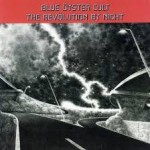 The Revolution By Night is one of their more underrated disks. By this time original drummer Albert Bouchard had left the band As well as filling the drumstool he’s been one of their more prolific songwriters; and the band had to make greater use of outside writers to come up with enough material to fill an album. The album had a rawer, heavier production with a big guitar sound that brings the songs to life in a way its predecessor didn’t. It’s a little patchy, it has to be said; “Let Go” is down there with YNTOIWLF, but though it’s a “lesser” track I’ve always loved “Dragon Lady”. Buck Dharma’s funk-tinged “Shooting Shark” is an absolute classic, often performed live.