Music Opinion Blog

Opinions and occasional rants about the state of the music scene. The views expressed are entirely my own, and do not represent those of any artists or publications with whom I may be connected.

When Only 30 People Turn Up

Got to love this story.

I’m not in the habit of seeing has-beens whose fifteen minutes of fame are long past, but I’ve been to a fair few gigs that have been as poorly attended. I’ll spare the names of the bands to save them embarrassment.

What I do know from speaking to bands is, apart from them not wanting it widely known that a particular gig only attracted a handful of people, is that they hate it when everyone hangs at the back rather than coming forward.

If there’s any kind of stage lighting, the band can’t see much beyond the first couple of rows, so if there’s nobody within ten feet of the stage it looks to them as if they’re playing to an empty room. In contrast, if all thirty people present come down the front, it looks as if it’s a full house for the same reason.

It also helps if those thirty make enough noise that it seems like two hundred. I have been to gigs like that too….

Posted in Music Opinion | Comments Off

The Economics of Streaming

Matt Stevens with The Fierce and the Dead

This very perceptive piece on the economics of music streaming by Anil Prasad, The Finger’s on the Self-Destruct Button includes this very illuminating quote from Matt Stevens.

“Streaming makes it very difficult for cult bands who sell 1,000 copies of each release,” the noted British guitarist and composer Matt Stevens told me. “If 1,000 people stream an album 10 times, we probably make a few pennies versus 1,000 download sales which create a model that will pay for modest recording expenses. At present, with downloads, it’s roughly sustainable, but not profitable. If we move to streaming and that income disappears completely, we’re in serious trouble.”

That’s a potentially very bleak prospect for much of the music that features heavily on this blog. Anil Prasad also believes the current streaming model of Spotify et al is unsustainable and will eventually collapse. What will that collapse leave in it’s wake?

It’s easy to be pessimistic, though it’s also important to remember the the old pre-internet music industry wasn’t perfect either; the vast majority of bands never got signed and never got to make a record, and most of those that did had to sign away the rights to their own music in order to be able to record and release it.

In many ways it’s a shame that hybrid streaming and download sites like mFlow failed, and that last.fm was forced to shut down their streaming radio stations. Both sites had great value for music discovery, and both drove actual music purchases. But both ended as internet roadkill under the wheels of Spotify.

Streaming in its present for isn’t going to provide a worthwhile income stream for anything other than the most mass-market and commercial end of the market that can benefit from scale. It’s easy to imagine a world divided into a small nunber of heavily hyped stars and everyone else relying on crowdfunding for much of their revenue.

Quite what the music landscape of a decade’s time might look like is anyone’s guess. All that can be said is that we live in interesting times.

Posted in Music Opinion | Tagged , | 1 Comment

Farewell, NME

plugholeWith news that the NME’s circulation has sunk to a pitiful 15,000, and it’s going to turn into a freesheet, a lot of people are giving eulogies for how it was a vital part of their teenage years, featuring such great writing from the likes of Tony Parsons, Julie Birchill and Paul Morley.

I am not one of those people; back in the NME’s 1980s heyday I was a loyal reader of Sounds, which was always far more catholic in its music coverage, and didn’t sneer at rock and metal. If your music world revolved around punk and indie, the NME at the time was your bible. But if you didn’t, the NME really wasn’t for you; it was the paper than hated what you loved.

As Classic Rock’s editor Scott Rowley famously said, had one of the other “inkies” survived instead of the NME, we might have a better mainstream music scene today. But in the end it wasn’t really the the NME’s fault; much like the excessive sanctification of John Peel, it was the laziness of the rest of the media that allowed the NME to punch well above its weight as a gatekeeper, and whatever the NME didn’t like (which was a lot of things) tended to get marginalised. It was pointed out on Twitter than in the years 2005 to 2015 the NME faves the Gallagher brothers appeared on more front pages than all female artists put together. And Pete Doherty wasn’t far behind.

With a combination of the internet and a whole load of more specialist publications on the market meaning there’s no longer one powerful gatekeeper, the British music scene will probably benefit from the NME’s continued slide into irrelevance.

Posted in Music Opinion | Tagged | Comments Off

Muse: Why The Hate

The comments in The Guardian’s Muse: 10 of the best have predictably filled up with drive-by trolls dismissing them as “shite”.

What is it about Muse that attracts the haters? Is it just that the self-appointed elitists hate anything that’s successful and popular? Or is there more to it than that?

There are of course many, many bands who are far better than Muse when it comes to pressing all the right buttons for specific niche audiences. But when it comes to bands who have reached the level when they can play stadiums and headline major festivals, there is a strong argument that Muse are the best band of their generation.

My theory is that the division of Britain’s music scene into separate indie/alternative and rock/metal tribes that seldom mix is a major factor. Muse are one major-league act who stand defiantly with one foot in both camps. They’re a band at ease with headining both Glastonbury and Download. They combine Jeff Buckley-style vocals with flamboyant guitar solos. And that offends the tribal purists in both camps.

Posted in Music Opinion | Tagged | 6 Comments

RIP Chris Squire

The progressive rock genre is in shock with the news of the death of bassist Chris Squire, founder and only constant member of Yes. Tributes have been pouring in from across the progressive rock world and beyond. At The Robin 2 last night Magenta opened their set with a cover of “Cinema”, the instrumental from “90125″ as a tribute, which was a lovely touch.

Chris Squire was one of a handful of true giants in rock. The Rickenbacker that was his instrument of choice always has a distinctive and instantly recognisable sound, but Chris Squire’s playing was unique. He expanded the boundaries of what a rock bassist could be, making the bass guitar into a lead instrument while still driving the rhythm. Many of Yes’ best songs had his propulsive riffs at their heart. Listen to “Roundabout”, “Parallels” or that incredible opening of “Heart of the Sunrise”. He’s known as a virtuoso bassist, but he was also a good singer, evidenced by some of his harmonies with Jon Anderson.

My introduction to Yes was a secondhand copy of “Fragile” acquired during my first year as a student, probably discarded by someone who’d rejected progressive rock in favour of punk and new wave. It was their loss. For a while it took me a while to get my head round what they were doing; the complex music that was forever taking off in different directions was a world away from anything I’d heard before in the rock world. But I persevered and eventually it all made sense, and it still sounds vital 35 years later.

I only ever got to see them live the once, back in 2004 on what turned out to be the last tour of the classic Yes lineup with both Jon Anderson and Rick Wakeman; even decades after their musical peak it was still an incredible and spectacular show. More recently, the music editor of The Guardian asked me to write a piece about Yes; my first ever paid piece of music writing.

Yes are still dismissed in some quarters as “that band who made Tales from Topographic Oceans, which was awful and punk had to come and save us”. Which is a shame. When a band like Muse are currently one of the biggest bands in Britain, anyone who loves Muse really ought to be able to find something to love about Yes. That Guardian article of mine highlighting ten of their best songs is a good place to start.

So farewell, Chris Squire, and thank you for all the life-changing music you made.

Posted in Music Opinion | Tagged , , | 2 Comments

One Can Only Hope

I find it impossible to read this poster for the Bospop festival in The Netherlands and not think “If only Jools Holland was to invite a few of the bands he’s sharing a bill with on Sunday to appear on Later“.

One can only hope.

Posted in Music Opinion | Tagged , | 2 Comments

Gatekeepers

Chantel McGregor at the 2014 Cambridge Rock FestivalChantel McGregor at the 2014 Cambridge Rock Festival, which prominently features female artists

The Guardian have run their fourth piece in as many weeks bemoaning the fact that the lineups of major festivals are too male-dominated.

Unfortunately while it does raise some valid points it ends with this awful paragraph that seems deliberately calculated to provoke a defensive reaction from male rock fans, especially when the proposed “solution” had been to add commercial pop acts like Taylor Swift or Katy Perry to the bill.

In a world where women are deconstructing pop music, club culture is booming with some of the most innovative sounds in years, and a new generation of hip-hop and rap stars are heralding a socio-political cultural revolution in America, the white, male rockist notion of what a music festival headliner should be begins to feel hopelessly archaic.

The use of the dated 1980s term “rockist” does rather imply the author didn’t actually like rock at all, and the whole thing smacked of Social Justice Warrior-style invasion of other people’s spaces. One of the authors did later clarify that that wasn’t what she meant and she did love rock after all, but by then the comments were swarmed with bellicose sexists. I even had to ask the moderators to remove one of my own comments that recommended and namechecked a female artist because I didn’t want her to become the subject of online harassment.

While there is undoubtably sexism across all levels in the music business, I still think one big problem is the way a very small number of gatekeepers get to filter all the music mainstream audiences get to hear. The problem is not just that those gatekeepers are disproportionately white and male but that so few people have a disproportionate amount of power.

Previous articles have spoken of “elite tastemakers” numbering as few as fifteen record label executives, radio programmers and magazine editors who get to decide almost everything Joe and Johanna public get to hear.

Commenter “Cathartic” writes of the influence of gatekeepers in metal, using the Download festival referenced in the piece as an example.

There are numerous metal bands with females in that are less commercially successful, which disproves the idea that women just like to watch, but its almost certain that if festivals gave newer acts (both male and female) more of a chance many would develop the fanbase needed to justify headline slots.

Its a Chicken/Egg situation largely. Download is extremely conservative about its line ups, most of the headliners and main stage acts are basically older American and British bands that have been around for decades, and they are not known for given the European bands a slot. The latest roadrunner signing will take preference over an established European band regardless of commercial appeal. 10 years later that band will have enough mid-afternoon slots that they would have to be really bad not to have turned that exposure into sales.

However elsewhere in Europe, Nightwish and Within Temptation are two examples of female fronted bands that will land headline slots in hard rock/metal festivals. Both would pull off a senior slot at download as well these days. Both those bands can pull off UK arena tours now, but it was Bloodstock that has pioneered these types of bands in the UK first. There is the audience out there.

There are plenty of female musicians – ratio is irrelevant – playing in smaller bands in genres which download claims to cater for. The question is why so few have been able to make the leap from small touring for petrol money to headliners. The reasons may be complex, but the reality is his festival (and other music industry big wigs) have acted as gatekeepers in the genre and adopted an extremely conservative booking policy that has meant download have never taken risks on helping the smaller bands reach a larger audience. His comments just portrayed an under ignorance of the genre he caters for. Reality is headliners may be the ones that sell tickets (and Nightwish and Within Temptation certainly could add ticket sales for download), but the mid-afternoon slots are far less risky to try something new and there are a whole host of bands with female musicians that get ignored. Many people at festivals find discovering new bands part of the reason for going to a festival anyway.

That hits the nail right on the head.

I do suspecr that one reason the grassroots progressive rock scene is more friendly towards female-led bands than the corporate indie-rock festival circuit is previsely because it isn’t so controlled by bean-counting gatekeepers.


Posted in Music Opinion | Tagged , | Comments Off

Thirty Years Ago Today

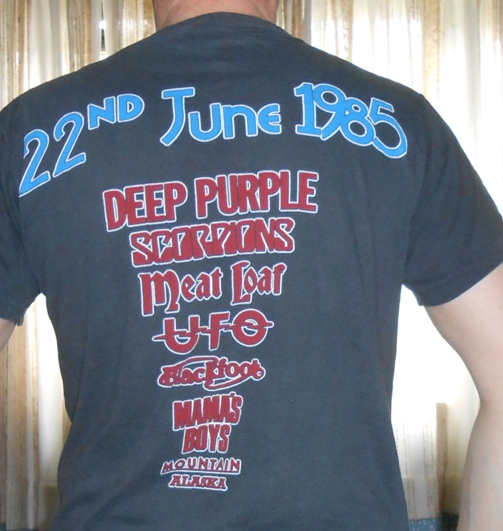
Today is the 30th anniversary of the 1985 Knebworth Fayre, headlined by Deep Purple. David Meadows shares his memories of the day.

It’s 1985. Thirty years ago today, as I write this. I’m a student in Sunderland and I’ve just passed my 20th birthday. And I have only recently been introduced to rock music by the people I’m living with. I grew up without much knowledge of contemporary music at all. I listened to my parents’ music. My sister bought all the pop records in the household, and I didn’t think much of most of them. I listened to classical music, some folk, some jazz, and mostly what these days they would call the “Great American Songbook”. So I’m only just starting to listen to rock music, and deciding that while a lot of it is rubbish, some of it might not be bad at all. The first rock LP I buy is something called Bat Out Of Hell, and I think it’s incredible. My friends go up to rock gigs in Newcastle every few weeks and come back telling me it was the best concert they’ve ever seen (which seems a silly thing to say; how can they always get better and better?) but I never want to go with them. It doesn’t seem like it would be my kind of thing.

So there’s suddenly this buzz about an old band called Deep Purple who have reformed and are going to be playing a big show in someplace I’ve never heard of called Knebworth. I’ve heard Deep Purple: a friend loaned me a compliation called Deepest Purple last summer, and some of it is not bad at all. More intriguingly, Meat Loaf, the Bat Out of Hell guy, will be on the bill.

The whole thing is well worth a read.

Almost every rock fan I know seems to have been at that gig. It was the hard rock equivalent of that much mythologised Sex Pistols gig in Manchester, except that everyone who claims to have been there actually was.

The thing we all remember the most is the rain. And Meatloaf being absolutely God-awful, And the rain. And Mountain missing out the good bit from “Nantucket Sleighridge”. And the sun coming out briefly during Blackfoot’s excellent set. And then the rain came back. And The Scorpions, at the peak of the powers, stealing the show from the headliners. But most of all, the rain.

The other thing that sticks in the memory is walking back from Kings Cross to Paddington, covered in mud, and having to cover two and three quarter miles in 45 minutes to catch the last train back to Slough at 1:40am. We made it with just seconds to spare.

I’ve seen Deep Purple a couple of times far more recently, but it’s still the only time I have ever seen Ritchie Blackmore live.

Posted in Music Opinion | Tagged , | Comments Off

Got to love the Sex Pistols credit cards. Thre is much schadenfreude at the congnitive dissonance it gives to those who still buy uncritically into the whole punk mythology. So much of “punk” was manufactured consumerist bullshit from the very beginning.

Posted on by Tim Hall | 2 Comments

Where are the women of rock?

Cloud Atlas album launch at Tokyos in YorkHaidi Widdop and Martin Ledger of Cloud Atlas

Regular readers of this blog ought to know the answer, but that is still the question John Harris asks in The Guardian, in a piece on the male-dominated nature of mainstream rock, which turns into a paeon of praise for Fleetwood Mac as the only band headlining a major festival this year that isn’t all-male.

After 17 years as an on-off quartet, Fleetwood Mac have assembled all five members of their most successful line-up and come back to remind us that they are by far the most successful mixed-gender rock band in history, though surprisingly few people have ever thought to follow their example.

The fact that their internal romantic entanglements made their most successful period such an emotional hell might serve as a cautionary tale. Then again, the incredible, fantastically honest music that came out of it all speaks for itself. Rock and pop tend to scrape perfection when they deal with love and relationships; in Fleetwood Mac’s greatest work, you hear those subjects explored with such power precisely because both male and female views are on show.

Which is just as true for some of the best work of bands like Mostly Autumn and Karnataka in their various incarnations. Albums such as “Delicate Flame of Desire” and “The Last Bright Light” are not filled with songs about Hobbits.

Harris’ comments about the male-dominated mainstream festival scene makes a stark contast to the grassroots progressive rock scene that this blog gives extensive coverage to. Looking at the bill of this March’s HRH Prog, which featured Knifeworld, The Skys, Touchstone, Anne Phoebe, Mostly Autumn, Collibus, Jump, Magenta and Steeleye Span, half the bands contained at least one female member. Not only that , they were overwhelmingly the better half of the bill too.

What’s notable about the way progressive rock has become more female-friendly in recent years is that it’s all happened organically. Bands have formed with women in them, and they’ve built up audiences. They’ve become such an accepted part of the scene that anything that looks overwhelmingly male is regarded with suspicion.

We have seen no aggressive campaigns to stop people listening to all-male bands as if it’s all a zero-sum game. Likewise there have been no Gamergate-style backlash complaining that wimmin are ruining prog. You might get the occasional grumpy old git moaning about too many female-fronted bands on a given festival bill, but nobody pays such misanthropes much attention.

Perhaps this is what happens when you have a scene driven by shared love of music rather than by corporate bean-counters and demographics-driven focus groups.

Posted in Music Opinion | Tagged , | Comments Off