Computing Blog

A blog about all aspects of computing and technology from software development to social network to commentary on the IT industry as a whole.

Angry Weasel on ISO29119

Angry Weasel provides the most succinct summary of what’s wrong with ISO29119 I have seen to date:

A lot of testers I know are riled up (and rightfully so) about ISO 29119 – which, in a nutshell, is a “standard” for testing that says software should be tested exactly as described in a set of textbooks from the 1980’s. On one hand, I have the flexibility to ignore 29119 – I would never work for a company that thought it was a good idea. But I know there are testers who find themselves in a situation where they have to follow a bunch of busywork from the “standard” rather than provide actual value to the software project.

Quite.

Posted in Testing & Software | Tagged | Comments Off

Testing and The Facebook Effect

Like many testing professionals, I don’t post as much about my work as I sometimes feel I ought to. An insightful post from Adam Knight entitled “The Facebook Effect” provides a good explanation as to why.

It’s always considered a no-no for any professional to criticise their employers on public forums, and rightly so. This is a problem for those of us in testing; our very job revolves around breaking things in interesting and innovative ways. It’s difficult to talk about your work in public when so much of it is about the bugs you’ve been finding. Your employer may well not want the world to know about that huge security vulnerability you just discovered.

This places us in something of a double-bind at times. While spilling too much information about current projects could be a seriously career-limiting move, not having a positive online presence can have exactly the same effect. I’ve actually been told I’m less likely to be hired if I’m testing in secret!

Fortunately Adam Knight does come up with some practical suggestions for sharing professional knowledge without compromising your employment.

Posted in Testing & Software | Comments Off

Alice and the Cheshire Cat talk ISO 29119

Mike Talks goes down the ISO29119 rabbit-hole and explains the likely outcome of IS29119 with Alice and the Cheshire Cat.

Alice took a quizzical look at the Cheshire Cat, “so you’re a tester? But you’re a cat!”.

“Oh,” the Cheshire Cat beamed, his almost rictus grin fixed permanently and inflexibly across his face, “in your world that might be a problem, but not in this one. Did you have a better candidate in mind? Would YOU want to sit in a meeting with the Mad Hatter, changing his seat every few minutes, or tell the Queen of Hearts that the project might have to be delayed?” He purred a very self-satisfied purr to himself. “No … I think you’ll find in reality, or as close as it gets in this place, I’m the perfect person for the job.”

I’m not going to spoil it by giving away the punchline; go and read the whole thing!

Posted in Testing & Software | Tagged | 2 Comments

If you’re seeing a banner ad just under the menu, it means you haven’t left any comments on this blog. I’m testing some code to inflict ads on people who wander in from Google without annoying my regular readers.

Posted on by Tim Hall | 1 Comment

If I find myself leaving snarky comments against risibly pompous and patronising articles served up by LinkedIn (Really, there was one that suggested your career depends on driving the right car!), then perhaps I really need to get back on Twitter…

Posted on by Tim Hall | Comments Off

Moderating Twitter

Twitter has a troll problem.

If you’re white, male, not a celebrity and don’t tend to say anything much that’s controversial, then blocking the occasional drive-by troll works perfectly well. If at least one of those things doesn’t apply to you there’s plenty of evidence that Twitter is a little bit broken and better blocking and moderation functionality is needed.

Twitter does have a function to report abuse, but I’m seeing complaints that it’s far too cumbersome, and that has a (possibly deliberate) effect of limiting its use. At least one person has noted that it takes more effort to report an account for abuse than it does for a troll to create yet another throwaway sock-puppet account, a recipe for a perpetual game of whack-a-mole.

In contrast, here’s the Report Abuse form from The Guardian’s online community. There is no real reason why reporting abuse on Twitter needs to be any more complicated than this.
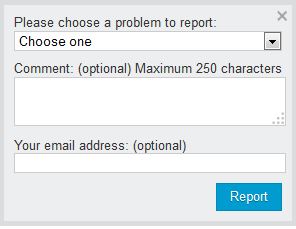
Grainiad Abuse Report
And here’s dropdown listing the reasons. Not all of those would be appropriate for Twitter; “Spam” and “Personal Abuse” certainly are, the others less so.
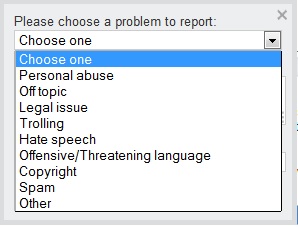
Grainiad Abuse Report 2
While I approve of Twitter taking a far tougher line against one-to-one harassment, I am not at all convinced that more generalised speech codes are appropriate for a site on the scale of Twitter. Such things are perfectly acceptable and even expected for smaller community sites where it’s part of the deal when you sign up and reflects the ethos behind the site. Indeed, most such community sites are only as good as their moderation, and there are as many where it’s done badly as those where it’s done well. We can all name sites where either lack of moderation or overly partisan moderation creates a toxic environment.

But for a global site with millions of users the idea of speech codes opens a lot of cans of worms which ultimately boil down to power. Who decides what is and isn’t acceptable speech? Whose community values should they reflect? Who gets to shut down speech they don’t like and who doesn’t? I can’t imagine radical feminists taking kindly to conservative Christians telling them what they can or cannot say on Twitter. Or vice versa.

Better to make it easier for groups of people whose values clash so badly that they cannot coexist in the same space to be able to avoid one another more effectively. Yes, there is a danger of creating echo-chambers; as I’ve said before, if you spend too much time in an echo-chamber, then your bullshit detectors cease to function effectively. But Twitter’s current failure mode is in the other direction; pitchfork-wielding mobs who pile on to anyone who dares to say something they don’t like, overwhelming their conversations.

At the moment, the only moderation tool available to individual users is the block function, which is a bit of a blunt instrument, and is only available retrospectively, once the troll has already invaded your space.

There are other things Twitter could implement if they wanted to:

For a start, now that Twitter has threaded conversations, how about adding the ability to moderate responses to your own posts ? Facebook and Google+ both allow you delete other people’s comments below your own status updates. The equivalent in Twitter would be to allow you to delete other people’s tweets that were @replies to your own. If that’s too much against the spirit of Twitter, which it may well be, at least give the power to sever the link so the offending tweet doesn’t appear as part of the threaded conversation.

Then perhaps there ought to be some limits to who can @reply to you in the first place. I’ve seen one suggestion for a setting that prevents accounts whose age is below a user-specified number of days from appearing in your replies tab, which would filter out newly-created sock-puppet accounts. A filter on follower count would have similar effect; sock-puppets won’t have many friends.

Another idea would be to filter on the number of people you follow who have blocked the account. This won’t be as much use against sock-puppets, but will be effective against persistent trolls who have proved sufficiently annoying or abusive to other people in your network.

All of these are things which Twitter could implement quite easily if the will was there. But instead they seem more interested spending their development effort on Facebook-style algorithmic feeds.

Posted in Social Media | Tagged , | Comments Off

Rent-Seekers : Michael Bolton on ISO 29119

In Rising Against the Rent-Seekers, testing Blogger Michael Bolton is under no illusions as to the real agenda behind proponents of ISO 29119. This particular observation is very, very telling:

If you want to be on the international working group, it’s a commitment to six days of non-revenue work, somewhere in the world, twice a year. The ISO/IEC does not pay for travel expenses. Where have international working group meetings been held? According to the http://softwaretestingstandard.org/ Web site, meetings seem to have been held in Seoul, South Korea (2008); Hyderabad, India (2009); Niigata, Japan (2010); Mumbai, India (2011); Seoul, South Korea (2012); Wellington New Zealand (2013). Ask yourself these questions:

  • How many independent testers or testing consultants from Europe or North America have that kind of travel budget?
  • What kinds of consultants might be more likely to obtain funding for this kind of travel?
  • Who benefits from the creation of a standard whose opacity demands a consultant to interpret or to certify?

It’s not exactly difficult to answer those three questions, is it?

Posted in Testing & Software | Tagged | Comments Off

I wonder what the internet would have looked like had micropayments for content been the default model rather than advertising? Had that happened, then I bet spam would have been far less of a problem.

Posted on by Tim Hall | 2 Comments

Because of the amount of bandwidth comment spammers have been eating, I have turned off comments on older posts. Hopefully this shouldn’t have much effect on the quality of blog conversations, because most of you only comment on recent posts anyway.

Posted on by Tim Hall | Comments Off

Stop ISO 29119

So, there is a proposed ISO standard for software testing, ISO 29119, which is causing an awful lot of controversy in the testing world.

Stop 29119Just about every software testing professional with an online presence is concerned about ISO 29119′s likely impact on the profession. The consensus is that forcing a highly bureaucratic one-size-fits-all cookie-cutter approach to testing across the whole software industry is unlikely to result in higher quality software, but will almost certainly stifle innovation and inhibit exploration of new creative approaches.

Rob Lambert is just one of many with serious reservations, and James Christie has this to say:

I’m afraid my hackles rise when I see phrases like “one definitive standard” and “used within any software development life cycle”. It immediately triggers an adverse emotional reaction as I remember this rhyme from Lord of the Rings, about the One Ring that would give the holder power over all.

“One Ring to rule them all, One Ring to find them,
One Ring to bring them all and in the darkness bind them
In the Land of Mordor where the Shadows lie”

Unfortunately it’s not something that anyone can guarantee will just go away if people ignore it.

Naturally those whose businesses revolve around selling consultancy to middle-management are going to support the introduction of a standard. As will the certification mills. And don’t even mention lawyers. I’m sure we can all easily imagine technically-illiterate politicians demanding that ISO 29119 be mandatory for all government contracts. After all, everyone knows that those gargantuan government IT failures we keep hearing about in the media are entirely down to sloppy software testing and have nothing to do with reality-denying project management.

There is now a petition against it. If you think ISO 29119 is a bad thing, go and sign it.

But not everyone agrees with the petition. Although this ridiculous Godwinesque screed hardly helps the cause:

Their objection is that not everyone will agree with what the standard says: on that criterion nothing would ever be published. The real reason the book burners want to suppress it is that they don’t want there to be any standards at all. Effective, generic, documented systematic testing processes and methods impact their ability to depict testing as a mystic art and themselves as its gurus.

I would say that resorting to personal attacks of that nature is strong indicator for the bankruptcy of their argument.

Posted in Testing & Software | Tagged , | 10 Comments