Computing Blog

A blog about all aspects of computing and technology from software development to social network to commentary on the IT industry as a whole.

Geek Social Fallacies

Whenever there is drama online, it’s always worth paying attention to the Geek Social Fallacies.  In this case, #4: Friendship Is Transitive

Every carrier of GSF4 has, at some point, said:

“Wouldn’t it be great to get all my groups of friends into one place for one big happy party?!”

If you groaned at that last paragraph, you may be a recovering GSF4 carrier.

GSF4 is the belief that any two of your friends ought to be friends with each other, and if they’re not, something is Very Wrong.

Hands up who else groaned at that, and immediately thought “That’s exactly what’s wrong with Facebook”?

Posted in Social Media | Tagged | 3 Comments

Recruiters are still talking about “Rock star developers”.  One consequence of being a software tester by day and music critic by night is that I don’t even want my rock stars to be rock stars. Do we really want the sort of egos who send emails in 14 point red bold arguing that the bug you raised was a missed requirement rather than a coding error?

Give me Rock Star Developers and I’ll test their work as if I’m Paul Morley writing for the NME in 1981…

Posted on by Tim Hall | 2 Comments

I am beginning to think it’s time for all of us to dump Facebook and go back to forums, blogs and email. Facebook tries to be all of those things mashed into one, and succeeds only in doing them all badly. Its only success has been in killing off everything that did those things better than Facebook does.

Posted on by Tim Hall | 4 Comments

The Twitter Block Fail Whale

FailWhaleIf you’ve been on Twitter the last couple of days you’ll have noticed a major shitstorm over Twitter’s ill-considered change to the way blocking worked.

Previously the block function not only prevented you from seeing the posts from people you’d blocked, but it also prevented them from following you or seeing your own tweets. The change reduced this to a mere “mute” functions; all it did was to mute them from your own timeline and interactions tabs, without preventing them from following or even from retweeting you.

All credit to Twitter for rolling back the change within the space of a few hours in response to the storm of anger from users, but you have to wonder what they were thinking when they implemented it in the first place. Something tells me that nobody involved in the decision ever consulted anyone with first-hand experience of online harassment or stalking.

Yes, I am aware that blocking was never 100% effective, since your public posts are still visible to a logged-out user if they go to your profile. But there’s a big difference between @Dickhead being able to see your profile by logging out, and @Dickhead being able to follow you and retweet your posts to his dickhead friends. It’s akin to saying there’s no point locking your door because a burglar can always break the window.

And I’m also aware that Twitter has a serious problem with abusers and trolls, and there isn’t any optimal solution that doesn’t have potential downsides; successful moderation strategies that work on community-based sites just don’t scale to something the size of Twitter, especially it’s part of a wider ecosystem that includes other sites over which Twitter has no control. But that’s no excuse to roll out a change that actually enables the bad actors.

Posted in Social Media, Testing & Software | Tagged , | Comments Off

When did the word “meme” come to mean “Self-righteous or passive-aggressive platitude superimposed upon a stock image to be shared on social media by attention-seeking individuals who are too lazy to post anything original of their own”?

Posted on by Tim Hall | 1 Comment

The long-running debate in the testing community of the value of certification is getting ugly. A blogger expresses robust but strongly held professional opinions on the subject, then someone with an axe to grind complains to his employer in an attempt to shut him down.

Posted on by Tim Hall | Comments Off

Do the people who always use “lol” in place of full stops on the Internet also end every sentence in real-life conversations with an intensely annoying high-pitched laugh? Because that’s what I hear in my head when I read their posts…

Posted on by Tim Hall | 1 Comment

You know you’re too deep in the YouTube rabbit-hole when you come to an episode of The Teletubbies dubbed into German. I’m blaming Mertesacker for this…

Posted on by Tim Hall | Comments Off

So I’m a tester, and I happen to be the very first person to order something from a new website. Of course I found a bug.

Posted on by Tim Hall | Comments Off

The day Twitter.com died

Twitter have done what they’ve been threatening to do for a while, and started displaying “rich content” (i.e. pictures and videos) in timelines. It means Twitter now looks like this:
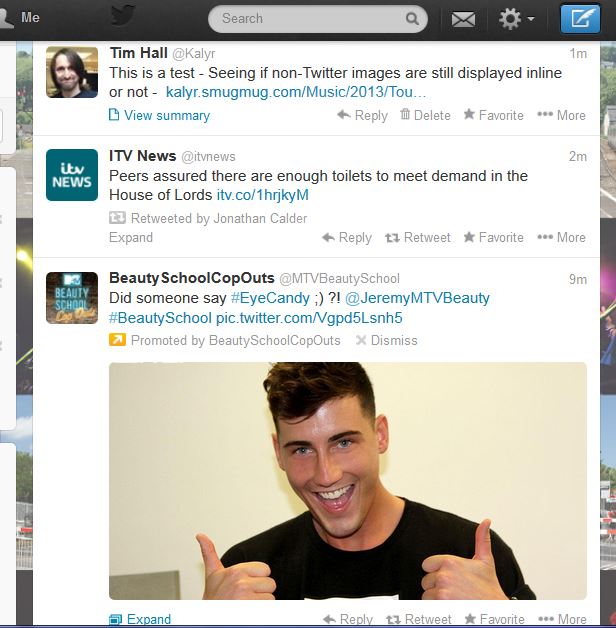
The Day That Twitter Died

It is just as bad if not worse than I feared it would be, with what had been a clean text-focussed User Experience utterly clogged-up with low-value images that dramatically lowered the signal-to-noise ratio.

The grinning backpfeifengesicht above is from one of the dreaded “Promoted Tweets”, and probably gives away the real reason for the change; it’s a backdoor implementation of huge intrusive banner ads.

The Twitter blog makes this claim:

So many of the great moments you share on Twitter are made even better with photos or with videos from Vine. These rich Tweets can bring your followers closer to what’s happening, and make them feel like they are right there with you.

We want to make it easier for everyone to experience those moments on Twitter. That’s why starting today, timelines on Twitter will be more visual and more engaging: previews of Twitter photos and videos from Vine will be front and center in Tweets. To see more of the photo or play the video, just tap.

I’ve left with the impression that Twitter’s intended audience for this is semi-literate teens and annoying marketing types who want the ability to shout louder than everyone else. As others have said, Twitter now resembles what many of us don’t like about Facebook.

Fortunately the iOS and Android Twitter clients give the ability to switch this new feature off, but no such setting exists in Twitter.com. For us grownups who want to use Twitter to express ourselves in words, it’s time to stick a fork in Twitter.com and use alternative web-based or desktop clients.

Posted in Social Media | Tagged | 1 Comment